
The cost of a “no wagering” casino bonus in Australia in 2026
Data updated on 16 October 2026 and verified against the ACMA’s register of licences and the authority’s formal warning publications. A no-wagering bonus is the cleanest promise that offshore gambling marketing knows how to write: no playthrough, immediate withdrawal, your own money. In Australia, that promise travels on an infrastructure that does not exist. No state or territory jurisdiction licenses online casinos or the pokies that offer these bonuses, and the pages advertising them operate from abroad, beyond the reach of BetStop, the ACMA, and any Australian complaints body. What follows is what the offer actually costs: to the player, first, and then to the regulatory framework that an Australian inherits when landing on one of these pages.
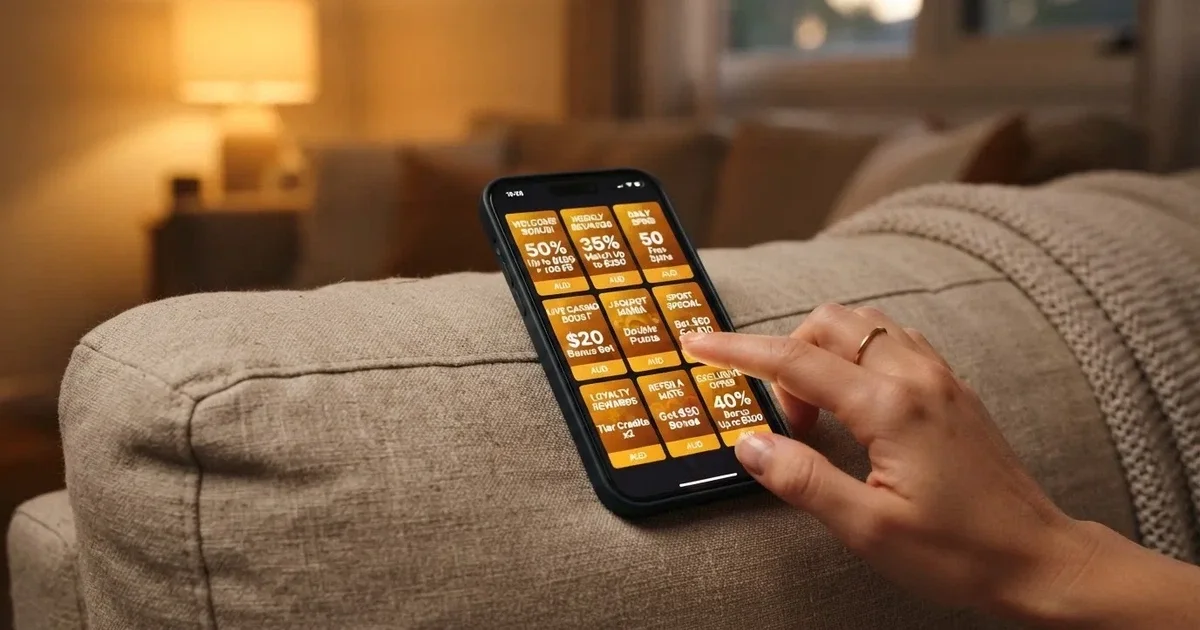
Table of Contents
- What “no wagering” really means
- The actual price: what a no-playthrough offer really costs
- Crypto and no-wagering: the shortcut that doesn’t exist
- Payment speed: the metric that marketing sells
- Player protection: what BetStop and the Australian regime actually cover
- The legal framework: what an Australian inherits when landing on these pages
- The table of operators cited by the ACMA
- The ACMA blocking pace: the closing page
- Australian payment habits that an offshore operator encounters
- The phrase worth reading before any other
- Frequently Asked Questions
What “no wagering” really means
A no-wagering bonus is a credit that a player can withdraw without first wagering it a certain number of times. It is the end of the multiplier — that figure (40x, 50x, sometimes 70x) that transforms a A$100 bonus into A$4,000, A$5,000, or A$7,000 of required volume before the withdrawal unlocks. Without playthrough, the promised amount is — on paper — the amount you cash out.
The definition seems clear. It is not, and it is worth establishing three distinctions that offshore marketing continually blurs.
No wagering vs. low wagering. A “low wagering” bonus typically still carries a playthrough: 10x, 20x, sometimes 35x. It is lighter than the market average, but it is not free of conditions. The difference is operational, not cosmetic. A 20x bonus on A$200 requires A$4,000 in qualified wagers before withdrawal; a zero-x requires A$0. The distance between the two claims is not a step, it is a different level.
No wagering vs. cashback. Cashback pays a percentage of net losses over a period. It is not a bonus deposited into the account; it is a refund calculated in arrears, often with a cap and weekly credit windows. Some pages present it as a “no wagering bonus” because the refunded amount arrives without playthrough — but its structure is different: the player must lose first, and then receives a portion back. The cost to the player is measured against the losses that generated it, not on wagering the amount.
No wagering vs. “winnings only”. Some free spin packages advertised as no-wagering pay winnings directly as withdrawable balance, but with a maximum withdrawal cap — a fixed limit (A$100, A$200) beyond which the excess is cancelled. The cap is the real cost of the offer, because it is the ceiling on what the player can actually cash out from that specific bonus. The “no wagering” promise remains technically true; the “win what you want” promise does not.
An Australian page searching for this market encounters the three formulations treated as if they were the same thing. They are not, and the player who confuses them ends up evaluating offers that measure on different scales.
The actual price: what a no-playthrough offer really costs
The multiplier is the most visible figure on bonus terms. When it is missing, the cost structure shifts to three levers that offshore marketing prefers not to highlight.
Withdrawal cap on free spins
A no-wagering free spin package, in the absence of a cap, would mean that every win — even a screen of premium symbols on a high-volatility slot — comes to the player as withdrawable balance. The industry does not write offers like that. The cap is omnipresent: it is found on the individual package, on the convertible amount from free spins, or on the account’s maximum weekly/monthly withdrawal. The player who reads only the word “no wagering” without reading the cap is looking at the offer from only one side.
Deposit requirements to unlock withdrawal
Some no-wagering promos are “deposit-gated”: the player must make a real deposit (even a minimal one) before bonus winnings are withdrawable. Without a deposit, winnings remain on the account as non-withdrawable balance or are cancelled. It is a less visible structure than a 40x multiplier, but equivalent in substance: the player must first spend real money to convert the bonus into their own money. The condition does not cancel the no-wagering; it makes it irrelevant until the deposit has been made.
RTP and volatility of the title on which the bonus is spent
A no-playthrough bonus moved to a slot with lower than market average RTP returns less to the player for each spin — regardless of the fact that the playthrough is zero. No-wagering does not neutralize the house margin; it simply lets it operate undisturbed, without the multiplier diluting its effect over time. On a title with 94% RTP and A$100 bonus, the expected gross loss is about A$6 for every A$100 wagered — a figure that seems modest but that multiplies rapidly because there is no longer a multiplier to slow down the action.
What the calculation tells us
The expected loss on a no-wagering bonus follows the same logic as any game session, because the bonus is now played as real balance: expected loss = volume × (1 − RTP). On A$100 bonus played fully on a 96% slot, the expected gross loss is about A$4. On a 94% slot it rises to about A$6. On a high-volatility slot with 92% RTP — the type of title that offshore promotions tend to use for free spins — the expected gross loss approaches A$8. The no-wagering bonus is not free; it costs exactly as much as the game absorbing it, with the difference that the player no longer has a multiplier to slow down the volume.
Crypto and no-wagering: the shortcut that doesn’t exist
Some affiliate pages present no-wagering bonuses from crypto casinos as a way to bypass Australian gambling rules. The argument is that a blockchain-based payment rail — a transfer in BTC, ETH, or USDT to a casino-controlled wallet — does not go through local banking circuits and therefore does not touch the anti-gambling blocks that Australian banks have introduced.

The argument is precise and wrong on points that matter.
The licence does not reside in the payment method. The Australian prohibition on online casinos resides in the Interactive Gambling Act 2001 and its amendments. Paying in bitcoin, stablecoin, or via SEPA bank transfer does not change the nature of the service received: it is still an offshore casino offering gambling to a person in Australia. The ACMA has acted on crypto operators exactly as it has on fiat ones — Jackbit and CasinOK, operated by Ryker B.V., received a formal warning in April 2026.
Bank blocks operate on the card, not on the bonus. Westpac, ANZ, and Commonwealth Bank manage gambling blocks via the “Betting/Casino Gambling” merchant category code associated with the transaction. A crypto top-up arriving via on-chain exchange might not be intercepted by the MCC filter — but the problem is not the filter. The problem is that the underlying service is prohibited anyway.
Transfer speed does not change consumer protection. A BTC withdrawal arriving in twenty minutes is faster than an Osko transfer arriving in one minute — but the consumer who does not receive the withdrawal has the same complaints tools in both cases: none. Affiliate pages presenting crypto as an access solution gloss over this point, and that point is the only one that matters when the withdrawal does not arrive.
Wallet anonymity is not player anonymity. A blockchain is transparent by design. Every transaction to an offshore casino address leaves a permanent trail on a public ledger. The illusion of anonymity vanishes at the first instance of a disputed chargeback, an AUSTRAC investigation, or cooperative tracing with a regulated Australian exchange.
For an Australian, crypto is not a gateway to a no-wagering bonus. It is a gateway to the same no-wagering bonus, from a slightly different angle, with the same risks and without the rights they would have had on a traditional circuit.
Payment speed: the metric that marketing sells
Affiliate pages measure payment speed in hours: withdrawals in 24 hours, in 12 hours, “instant” for crypto casinos. The figure is true for most successful transfers. It is irrelevant for transfers that do not go through — and in an unregulated offshore market, the queue of rejected, delayed, or reversed withdrawals is the metric that counts.
What happens when the withdrawal does not arrive
On an offshore operator, the absence of an Australian complaints body means the player has three options: contact support (where the ticket is handled by the operator itself), file a complaint with the foreign licensor (Curaçao, Anjouan, Kahnawake — jurisdictions with very different obligations from the ACMA), or act on their own. None of the three options is fast. None of the three has coercive force comparable to that of a local regulator. The player receiving the withdrawal in an hour does not need these tools; the player who does not receive it needs all three, and the months they require.
Local payment circuits and their role
Australian circuits are where offshore marketing attempts to project credibility. PayID, Osko, and BPAY are mentioned because they are familiar to Australian players and because — on paper — they are not associated with offshore gambling.
PayID is a payment identifier linked to an Australian bank account: phone number, email address, or ABN, resolved in real-time by the New Payments Platform. Over 100 Australian financial institutions participate; over 25 million identifiers were registered as of April 2025. When a player pays to a PayID, they see the name of the account holder before confirming the transfer — a detail AP+ defines as anti-scam protection. Transferring to a PayID associated with an offshore gambling site is, according to AP+ itself, an almost certain signal that the site is a scam.
Osko is the NPP’s instant bank transfer service: credit in under a minute, 24/7, even on weekends. The speed does not discriminate between lawful and unlawful circuits — the money arrives anyway.
BPAY is a bill payment service active since 18 November 1997, now operated by Australian Payments Plus (AP+), available in the online banking of over 140 institutions. It is the most familiar circuit for domestic bills; it is not a typical deposit channel to offshore casinos, but its mention on affiliate pages is intended to evoke familiarity.
American Express deserves a separate mention. Unlike Visa and Mastercard circuits — four-party networks — Amex operates traditionally as a three-party scheme, issuing cards and processing transactions directly. The Reserve Bank of Australia, in its July 2025 review on the cost of card payments, proposed banning merchant surcharges only on eftpos, Mastercard, and Visa, explicitly leaving Amex out of the scope. For an Australian paying with Amex on an offshore casino, this means potentially higher merchant fees and different chargeback protection regulations.
Familiarity with the circuit is not a guarantee. It is a channel.
Player protection: what BetStop and the Australian regime actually cover
Australia has built a more robust player protection architecture than most European markets, but its architecture has a precise perimeter. What it covers, it covers with effective tools; what it does not cover, it simply does not cover.
BetStop — the National Self-Exclusion Register
BetStop is the national self-exclusion register, active since August 2023. When a player registers, every Australian-licensed online or phone betting operator is obligated to close their accounts, block new ones from opening, and refuse direct marketing for the chosen period — from three months to life. Coverage is effective: the operator that does not respect the exclusion commits an infringement.
Coverage stops at the perimeter of Australian-licensed operators. An offshore casino is not connected to BetStop. Self-exclusion does not prevent that player from opening an account on a foreign site, because that site does not receive the register’s notification and has no obligation to verify it.
Gambling Help Online — 1800 858 858
The National Gambling Helpline is free, active 24 ore, 7 giorni a week, with chat available via Gambling Help Online. It is the operational contact point for a player who is losing control, regardless of whether the gambling takes place on an Australian-licensed operator or an offshore site. The counseling offered is the same; the effectiveness of the tools the counselor can recommend is not.
Bank gambling blocks
Australian banks have introduced, on a voluntary basis and then with increasing standardization, tools to block gambling transactions at the card level. These are secondary prevention tools — they do not prevent opening an offshore account, but they prevent that account from being funded via the local banking circuit.
Westpac manages a gambling block at the card level: it refuses authorization for transactions registered under the “Betting/Casino Gambling” merchant category code on eligible personal debit and credit cards.
ANZ offers an analogous block, activatable from the ANZ app, which also blocks Gambling Transactions made through a digital wallet (Apple Pay, Google Pay) on the eligible card. Once activated, the block requires a 48-hour waiting period to be removed. ANZ explicitly warns that not all gambling transactions will be blocked and that some non-gambling transactions might be blocked in error.
Commonwealth Bank allows a gambling lock to be applied to eligible cards via the CommBank app. In this case, too, the bank states it cannot guarantee that all gambling-related purchases will be stopped.
The three blocks share a structural limitation: they operate on the MCC, not on the site content. A top-up that a player makes to an exchange wallet, and from there to a crypto address of an offshore casino, may not be filtered. For the player trying to limit themselves, the bank block is a tool — not a solution.
Cash transactions over A$10,000
A clarification that recurs on some pages and is worth clarifying: the AUSTRAC rule on “threshold transaction reports” applies to transfers in physical cash of A$10,000 or more. Ordinary electronic bank transfers — to PayID, Osko, or a foreign IBAN — are not subject to that transaction reporting obligation, regardless of the amount. It is not a loophole; it is simply the distinction between the two circuits.
The legal framework: what an Australian inherits when landing on these pages
The rule is clear and precedes the bonus discussion by years.
The Interactive Gambling Act 2001
The Interactive Gambling Act 2001 (IGA), strengthened by the 2017 amendments, makes it a criminal offence for an operator to provide online casino games, online pokies, or in-play betting to a person physically in Australia. No state or territory licenses these activities. What is licensable is wagering on races and sport placed before the event, lotteries, and keno — in practice licensed by the Northern Territory.
The minimum age is 18. The rule admits no exceptions: an offshore operator accepting a 17-year-old player is violating both Australian law and its own terms.
ACMA enforcement
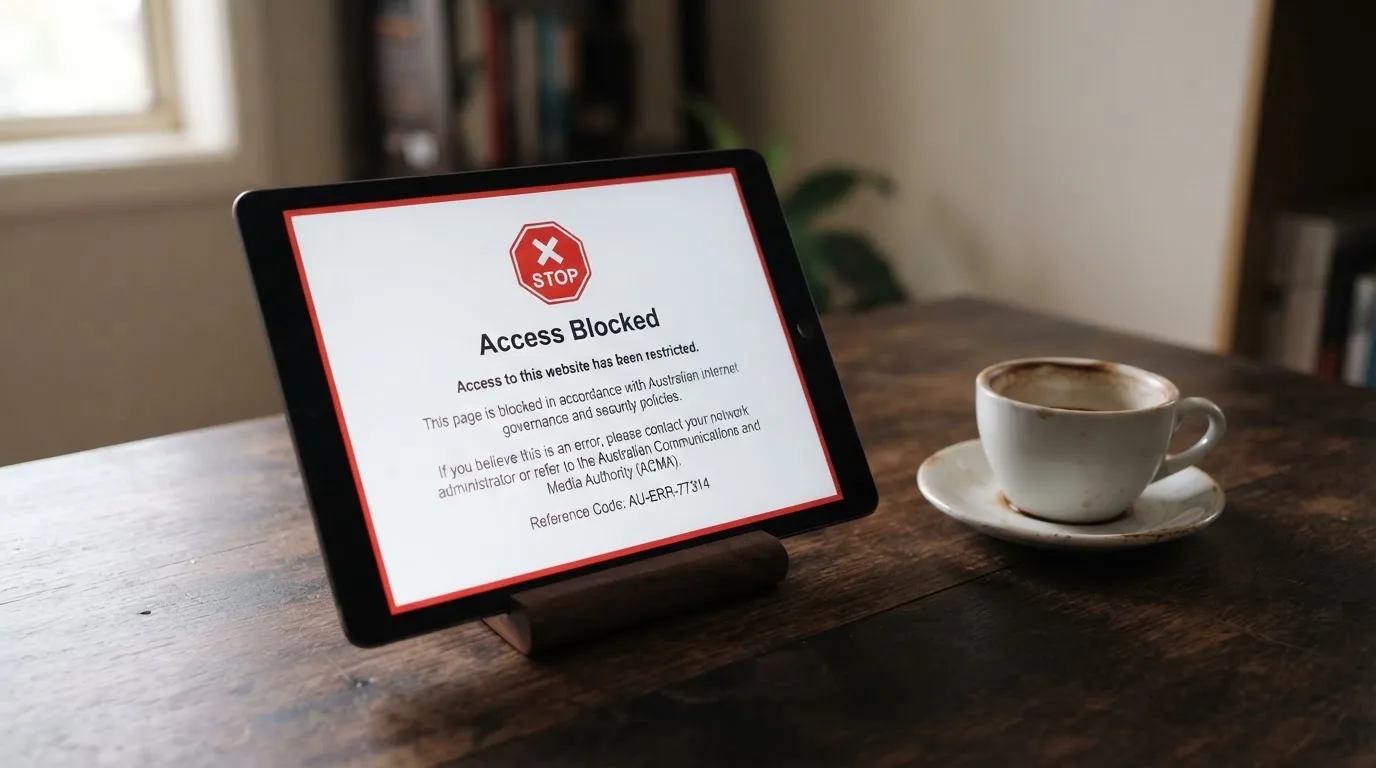
The ACMA (Australian Communications and Media Authority) investigates, issues formal warnings, and orders internet providers to block illegal sites. As of June 2026, a total of 1,751 illegal gambling and affiliate marketing websites had been blocked since the first blocking request in November 2019, and over 230 unlicensed gambling services had left the Australian market since enforcement was strengthened in 2017.
In a single round reported on 26 June 2026, the ACMA asked Australian ISPs to block 12 more illegal gambling websites: 7Signs, ChromaBet, Donbet, Duospin, Freshbet, Slots Gem, Jacks Club, Lucky Start, Pointsbetz.com, Spinrise, Vinyl Casino and Wildsino.
The individual player is not prosecuted — the IGA targets the provider — but an offshore site offers no protection to the Australian consumer, no complaints body, and no recourse in case of a refused withdrawal. The site can be blocked with a balance still on the account. This is the legacy an Australian inherits when landing on one of these pages.
The 2026 reform
The Interactive Gambling Amendment (Gambling Reform) Bill 2026 passed Parliament on 19 August 2026. Its advertising and inducement measures commence 1 January 2027. It is law with a start date, not yet in force on a 2026 page. Offshore affiliate pages citing the reform as already operational are describing a future rule, not a current one.
Payments under the IGA
Since 11 June 2024, Australian-licensed online wagering services cannot accept payment via credit card, credit-related products, or digital currency — with penalties of up to A$247,500 for operators. Legal deposit routes for licensed wagering are debit card, bank transfer, PayID/Osko, and BPAY.
A site asking an Australian for a credit card or crypto deposit is operating outside Australian rules. The circuit rule also applies in reverse: paying with a debit card on an offshore site does not make the site legal. It only makes it easier for the bank to detect the transaction.
Winnings tax
Recreational player gambling winnings do not constitute assessable income (section 6-5 ITAA 1997) and losses are not deductible, unless the person carries on gambling as a business — a rare model and different from that of an occasional player. The operational recommendation is to check with the ATO. The distinction is relevant only if the player has a volume of activity that justifies the inquiry, and at that point, advice is no longer optional.
The table of operators cited by the ACMA
The following list is an extract from the register of formal warnings published by the ACMA. It is not a ranking, not a shortlist of “best no-wagering bonuses,” and not a recommendation for use. It is a register of what the ACMA itself has made public: operators that received a formal warning for offering prohibited services to persons in Australia. The fact that an operator appears here does not mean its no-wagering bonus is better or worse than another’s; it means it has already been the subject of Australian regulatory action.
The player reading this table is not choosing a casino. They are seeing the perimeter of what is available from a location in Australia.
| Brand | ACMA action and date | Operator named by the ACMA | Subject support |
|---|---|---|---|
| RocketPlay | Formal warning March 2026 (and May 2022) | Pulsup Ltd (Rocketplay.com.au); previously Dama N.V. | Listing only |
| Level Up Casino | Formal warning May 2022 | Dama N.V. | Listing only |
| Woo Casino | Formal warning March 2025 | Dama N.V. | — |
| Spirit Casino | Formal warning May 2025 | Dama N.V. | — |
| National Casino | Formal warning July 2025 | Consolutetish S.R.L. | Listing only |
| Bizzo Casino | Formal warning July 2025 (and 2022) | Consolutetish S.R.L.; previously TechSolutions | Listing only |
| Ignition Casino | Formal warning July 2025 | Bamboo Media | — |
| Instant Casino | Formal warning February 2025 | EOD Code SRL | Listing only |
| Jackbit | Formal warning April 2026 | Ryker B.V. | — |
| Casino Intense | Formal warning April 2025 | Sterplay Holding Ltd | Listing only |
| Sky Crown | Formal warning (September 2022) | Hollycorn N.V. | — |
The subject support column reflects what third-party sources — industry pages, banks, public registers — report regarding the brand, not what the brand itself claims. Rows with no value indicate an absence of coverage by those sources, not an affirmation or denial by the operator.
RocketPlay
RocketPlay received a formal warning in May 2022 from the ACMA as part of an action on six Dama N.V. brands, and a second warning in March 2026 directed at Pulsup Ltd on the Rocketplay.com.au domain. The brand’s presence in both actions indicates a change of operator not declared by the ACMA but recorded in its acts. For an Australian considering this operator, the relevant issue is not the no-wagering bonus — it is the fact that the domain has been subject to action twice in four years, and that the balance on an account blocked by an ACMA action is a lost balance.
Level Up Casino
Level Up Casino was the subject of a formal warning in May 2022 under Dama N.V., the same entity that managed Rocketplay, Wild Tornado, Cobra Casinos, Dazard, and Bambet at the time. The action was part of a coordinated action against a group of brands, not Level Up specifically. The relevance for an Australian player is the same: the service is prohibited, the warning is public, and any withdrawal has no Australian recourse.
Woo Casino
Woo Casino received a formal warning in March 2025 under Dama N.V. — an action separate from the 2022 round that had covered other brands of the same operator. The warning signals that Dama N.V. was still active in the Australian market three years after the first action, and that the offshore corporate structure continued to offer prohibited services.
Spirit Casino
Spirit Casino received a formal warning in May 2025, also under Dama N.V. — a third public action against the same operator in three years. The repetition is itself the information: the formal warning is not a definitive sanction, and the ACMA continues to issue them to brands in the same group.
National Casino
National Casino was the subject of a formal warning in July 2025 under Consolutetish S.R.L. The brand is registered in industry sources and in AUSTRAC and BetStop — not because it is covered by Australian protection, but because its name appears in industry monitoring registers. Presence in those registers is not an endorsement.
Bizzo Casino
Bizzo Casino was the subject of a double formal warning: July 2025 under Consolutetish S.R.L., and previously a 2022 warning under TechSolutions (CY) Group Limited and TechSolutions Group N.V. The double action against two distinct operators for the same brand is one of the clearest signals of the ACMA’s warning letter: the change of legal entity does not erase the responsibility.
Ignition Casino
Ignition Casino received a formal warning in July 2025 under Bamboo Media. The name “Ignition” recurs across multiple jurisdictions with different operators — a fragmentation that makes it difficult for the player to know which entity they are actually dealing with.
Instant Casino
Instant Casino received a formal warning in February 2025 under EOD Code SRL. The brand appears on payment method listings (ecopayz) and payment system listings (Payid.com.au) — not as an approved partner, but as a name present in industry datasets.
Jackbit
Jackbit received a formal warning in April 2026 under Ryker B.V., along with CasinOK. Both are crypto-forward operators, and the ACMA action confirms that the crypto model does not place the operator outside Australian jurisdiction.
Casino Intense
Casino Intense received a formal warning in April 2025 under Sterplay Holding Ltd. The brand appears in AUSTRAC, BetStop, and gamblinginsider listings — again as a name present in monitoring registers, not as a covered operator.
Sky Crown
Sky Crown was the subject of a formal warning under Hollycorn N.V., published as a PDF in September 2022, along with Blue Leo. Hollycorn N.V. manages a constellation of brands; the ACMA chose to cite two specifically.
The ACMA blocking pace: the closing page
The ACMA does not chase one operator at a time. It operates in rounds, and the rounds have accelerated. As of June 2026, 1,751 illegal gambling and affiliate marketing websites had been blocked since the first blocking request in November 2019 — about 263 sites per year on average, or just over five sites per week. The last round alone (26 June 2026) removed 12 more domains in one day.
The figure that counts is not the absolute total. It is the removal speed relative to the arrival speed of new offshore operators. An operator blocked today reopens tomorrow under a new domain, and the ACMA requires time to process the case. The useful life window of an offshore casino domain destined for the Australian market has shrunk — but it has not closed.
H2 Gambling Capital, in its 2025 report, estimated that Australians lose about A$3.9 billion per year to illegal gambling sites, and that the share of gambling going through legal channels fell from 74% in 2021 to 64%. The trend is opposite to what enforcement should produce. The explanation is not ACMA inefficiency: it is that the block removes the most visible and easily reachable sites, leaving the affiliate ecosystem that leads Australian players toward the next sites intact.
Australian payment habits that an offshore operator encounters
An offshore operator seeking Australian players clashes with an unusually structured local payment ecosystem. Data from the Reserve Bank of Australia and Australian Payments Plus paint a specific picture.
The card market
By the end of 2025, Apple Pay, Google Pay, and Samsung Pay transactions collectively accounted for around 45% of all card payments in Australia by number. Mobile wallet is the norm for the Australian consumer, not the exception. For an offshore operator that accepts only cards, this is partially good news: the transaction goes through, because Apple Pay uses the underlying card, and the card is filtered by the MCC. For an operator trying to bypass the filter using crypto, it is indirect confirmation that the consumer is not using crypto — they are using the card.
Circuit structure
The Reserve Bank of Australia, in its July 2025 review, proposed removing surcharges only on eftpos, Mastercard, and Visa — explicitly excluding American Express. Amex, traditionally a three-party scheme (issuing cards and processing transactions directly), has different cost dynamics from four-party circuits. For an Australian paying with Amex, potentially higher merchant fees are an indirect deterrent toward operators that absorb them poorly.
Apple Pay as a special case
Apple does not charge the consumer for using Apple Pay — fees come from the merchant. Transaction limits and PIN requirements are set by the card issuer or the merchant, not by Apple. This means that the bank’s anti-gambling block (Westpac, ANZ, CBA) operates on the card relationship — Apple Pay does not add an independent level. If the underlying card is blocked for the “Betting/Casino Gambling” MCC, Apple Pay does not bypass the block.
The phrase worth reading before any other
A no-wagering bonus is a label. The offer it carries is a structure: an accrual percentage, a maximum cap, an RTP of the title it is spent on, a withdrawal cap, an expiry term. Each of these elements is measurable in Australian dollars and in hours. The phrase “no wagering” describes only one of these dimensions — the absence of playthrough. The player who reads it as a complete description of the offer is looking at the label, not the structure.
And the label is affixed to a service that an Australian cannot legally receive from a locally licensed operator, which the ACMA has acted to remove repeatedly, and for which no Australian complaints body has jurisdiction. The no-wagering bonus is not a gateway to a legitimate market. It is a gateway to a prohibited market, with a design feature that marketing has learned to highlight because it masks the others.
Frequently Asked Questions
What is the difference between a bonus advertised as “no wagering” and a “low wagering” one?
No-wagering is a bonus that the player can withdraw without wagering it — zero playthrough. Low-wagering still applies a reduced multiplier (10x, 20x, sometimes 35x) that requires a volume of wagers before withdrawal. On a A$200 bonus, a 20x playthrough means A$4,000 in qualified wagers before being able to withdraw. Zero-x means zero. They are different plans, not variants of the same plan.
Do no-wagering free spins really have a withdrawal cap in practice?
Almost always. The most common structure on free spins advertised as no-wagering is a fixed cap — A$100, A$200 — on the amount convertible into withdrawable balance. The cap does not cancel the “no wagering” promise; it simply makes it honest. Reading the cap before claiming the offer is the difference between a free bonus and a limited bonus.
Does a no-wagering bonus on a bitcoin casino bypass any Australian wagering rules?
No. The ACMA has acted on crypto-forward operators like Jackbit and CasinOK with a formal warning in April 2026, just as it has on fiat ones. The prohibition resides in the service offered, not the payment method. Changing the circuit does not change the nature of the service received.
How do you distinguish a “no deposit and no wagering” offer from a deposit bonus without wagering?
The first credits the bonus or free spins without requiring a deposit — but often requires a minimum deposit before making winnings withdrawable (deposit-gated structure). The second credits the bonus in proportion to the deposit made, and winnings are generally withdrawable without further conditions. The first is a teaser; the second is an operation. The cost to the player is measured differently.
What should a player realistically expect to receive from a “no wagering requirements” promise?
The nominal amount of the bonus, minus the expected loss derived from the RTP of the game it is spent on. On A$100 bonus played on a 96% RTP slot, the expected gross loss is about A$4. On a 94% slot, it rises to about A$6. The withdrawal cap, where present, is the second cost — and reading it is the difference between a free bonus and a bonus with a ceiling.
Why do so many no-wagering bonus pages specifically mention crypto casinos?
Because the crypto model lends itself to three marketing levers: transfer speed (alleged or real), the absence of an intermediary banking circuit, and the illusion of anonymity. None of the three levers changes the legal status of the service in Australia. The mention is a marketing lever, not consumer protection information.
The cost of a “no wagering” casino bonus in Australia in 2026 — More on this topic at casino banking.