Best 3-Reel Slots Australia 2026: The Format, the Law, and What It Costs
 Available in US
The three-reel slot is the slot machine the rest of the format grew out of. Three reels, one payline, a handful of symbols, a coin-in and a coin-out. What a player pays for that simplicity in Australia in 2026 is the subject of this page, because the simplicity is not free and the market a reader is searching within is unusual. Every online casino and every online pokie, three reels or five, is prohibited for Australian-based play under the Interactive Gambling Act 2001. The 3-reel games that surface on search results are, without exception, offered by offshore sites the ACMA has been moving against for years. So the page that follows explains the format the reader asked about, then sets out the legal frame that surrounds it, the offshore sites the ACMA has acted against, and the arithmetic of what a typical bonus actually costs the player who claims it.
Data current as of 23 September 2026, checked against the ACMA’s formal warning register and the Australian Communications and Media Authority’s blocking notices.
Table of Contents
- Responsible Gaming and Where Help Starts
- What 3-Reel Bonuses and Free Spin Offers Generally Involve
- 3-Reel Slot Format: Paytables, Symbols, and Win Lines
- The Comparison That Cannot Be Made
- Eleven Brands the ACMA Has Formally Warned
- The ACMA Record in One View
- The Legal Frame Around 3-Reel Play in Australia
- The Blocking Rate and What the Numbers Mean
- Pokies Outside Casinos: Where the Legal 3-Reel Format Lives
- What a Player Actually Pays: The Cost Side of the Page
- What a Fair Comparison Would Weigh
- The Offshore Reality and What It Means for the Reader
- Frequently Asked Questions
Responsible Gaming and Where Help Starts
Any page about real-money play that does not open with help is a page written for someone other than the reader. If 3-reel play, online or otherwise, starts to feel compulsive — chasing losses, hiding time or spend, borrowing to keep playing — free confidential help is available around the clock.

The National Gambling Helpline is 1800 858 858, free and 24/7. Chat support runs through Gambling Help Online. For anyone who wants a hard stop rather than a conversation, BetStop — the National Self-Exclusion Register — has been live since August 2023. BetStop binds every Australian-licensed online and phone wagering service, so registering excludes the reader from legal sports and racing operators in one step. What it does not bind is offshore casino sites: a 3-reel game on a Curacao-licensed operator sits outside the register, and self-exclusion there is a matter of each site’s own tools, if it offers them at all.
Two practical points sit alongside the help lines. The first is that the Interactive Gambling Act 2001 targets the provider, not the individual player. Australians are not prosecuted for placing bets on offshore sites. The second is that an offshore site gives no Australian consumer protection: there is no Australian complaints body, no Australian recourse if a withdrawal stalls, and no guarantee the site stays reachable — the ACMA can and does direct Australian ISPs to block these services, sometimes with player balances still on the account. The block is the player’s problem in practice, even though the law was aimed at the operator.
What 3-Reel Bonuses and Free Spin Offers Generally Involve
Three-reel slots are heavily marketed as “classic” or “fruit machine” formats, and the bonus offers attached to them tend to follow a familiar shape. This section describes the shape, not the offers themselves, because the page covers the structure a reader will run into wherever such an offer exists.
The headline number is rarely the number the reader ends up with. A welcome package might advertise a deposit match plus free spins on a named 3-reel title; the conditions attached decide what the package is actually worth. Three terms recur across the market:
- A wagering or playthrough multiple. The bonus amount, and sometimes the deposit as well, has to be turned over a stated number of times before any winnings become withdrawable. Multiples in the 35x–50x range are common; anything higher than that is steep against the market.
- Game weighting. Most sites do not count every spin toward wagering at the same rate. Slots typically contribute 100%, table games far less. A reader using a 3-reel slot to clear a bonus is on the favourable side of this weighting, which is part of why 3-reel titles appear in bonus terms at all.
- A maximum cashout cap, particularly on no-deposit free spins. A cap of A$50–A$100 on winnings from a free-spin bundle is typical. Anything above the cap is forfeited on withdrawal.
The arithmetic of “how long to clear a bonus” follows a fixed form: required turnover = bonus × wagering multiple; spins = turnover ÷ stake per spin; play time = spins × a 5-second spin interval ÷ 3600 hours. For a hypothetical A$100 bonus with a 40x playthrough at A$1 per spin, the turnover is A$4,000, the spin count is 4,000 spins, and the time to clear it is roughly 5.6 hours of continuous play. That is one operator’s worth of one bonus on one stake size. The expected cost to the player over those spins is turnover × (1 − RTP); at a 96% RTP, the expected loss on A$4,000 of action is A$160, which is more than the bonus itself. The arithmetic is statistical, not a promise — it is an average over many spins under the stated assumption, not what any single session will produce.
The move worth making on a bonus page is to read the wagering multiple before reading the headline. A A$500 package with a 50x playthrough and a A$100 cap on free-spin winnings is not the same product as a A$200 package with a 25x playthrough and no cap. The first looks larger and pays out less.
3-Reel Slot Format: Paytables, Symbols, and Win Lines
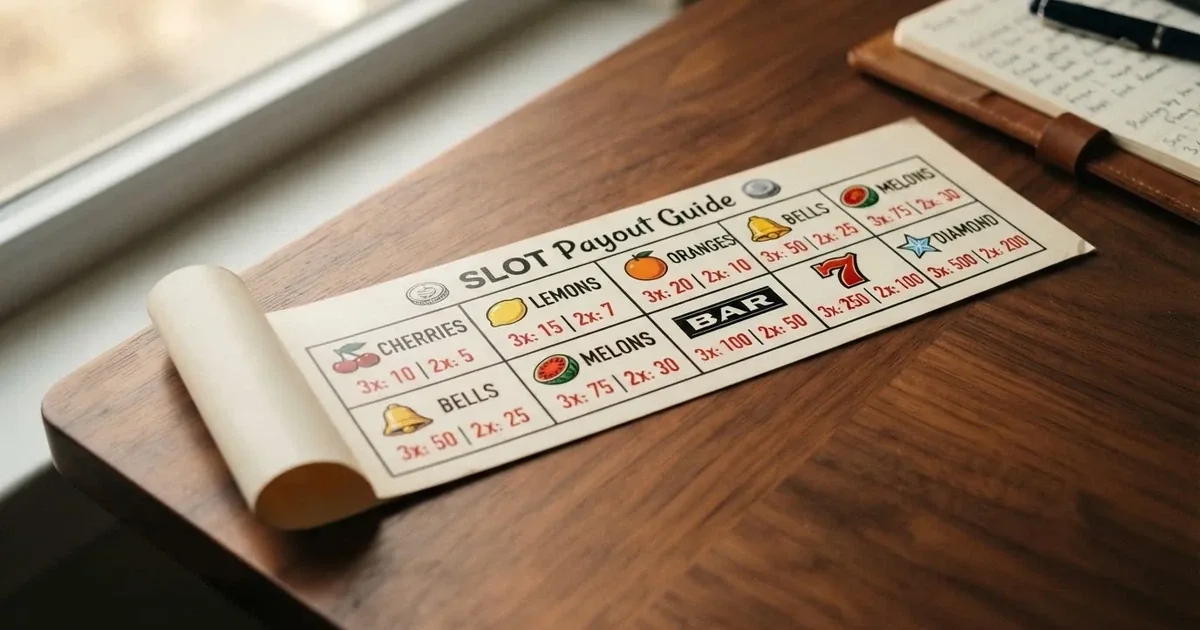
The classic 3-reel slot is the format Charles Fey of San Francisco developed in the late 19th century: three reels, five symbols (horseshoes, diamonds, spades, hearts and the Liberty Bell), with three bells in a row paying the top prize of ten nickels. That machine is the ancestor of every reel slot played since.
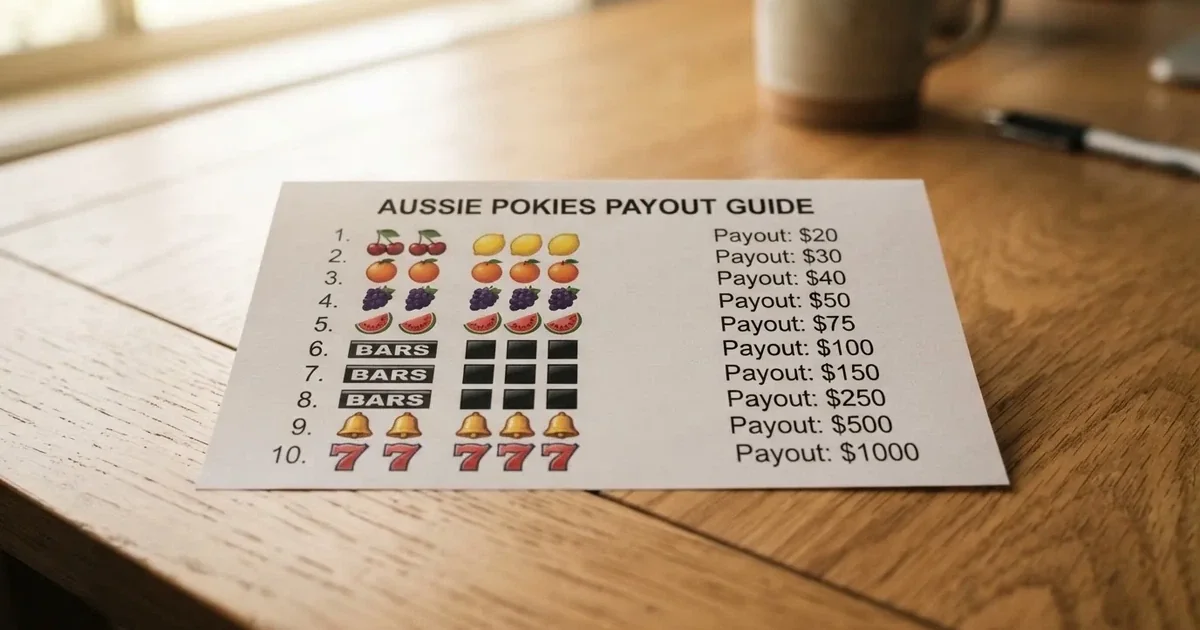
A modern 3-reel title online keeps the structure and updates the artwork. Three reels, usually three rows visible, a small number of symbols per reel (often fewer than 12), and a paytable that lists what each combination pays. The paytable is the document a reader should look at before playing: it states the symbol values, the win lines (typically one to five on a 3-reel format, compared with dozens on a five-reel video slot), and the rules for any feature the title carries. The paytable is also where the game’s RTP and volatility class are stated, when the operator chooses to disclose them, which is not always.
A few structural points carry through every 3-reel title:
- Reel count and symbol count determine the number of possible combinations. A mechanical 3-reel machine with 10 symbols per reel produces roughly 1,000 possible outcomes. A modern video slot with five reels and 50 symbols per reel can produce combinations running into the hundreds of millions. The 3-reel format is mechanically simpler, which is part of why it is described as “classic” — fewer outcomes means easier reading of what any spin did.
- Volatility describes how the wins are distributed, not how often they occur. A high-volatility 3-reel title pays rarely and in larger chunks; a low-volatility one pays often and in smaller amounts. The label is the operator’s or developer’s, and it varies by title, so the paytable is the document to read.
- The house edge is not the same figure as the RTP. A 96% RTP implies a 4% house edge, but the edge is paid out over many spins. In any single session, the realised edge can be far higher or lower than the headline figure.
- State-by-state regulation sets minimum payout percentages for physical machines in some jurisdictions; outside those jurisdictions, the operator sets the RTP. Online, the figure is what the software reports; there is no third-party verification a player can run on it.
What a 3-reel title does not have, generally, is the bonus-round structure of a five-reel video slot. Free spin rounds, cascading reels, pick-me bonus games and progressive jackpots are features that arrived with the five-reel format. A 3-reel title with a “bonus” is usually a title that gates a feature — a second-screen pick round, a hold-and-spin mechanic, a nudging wild — behind a specific combination on the base reels. The marketing word “bonus” in “3-reel bonus slots” refers to that, not to a separate bonus game played on a different screen.
The Comparison That Cannot Be Made
A typical comparison page ranks casinos against one another on game count, payout speed, bonus value and licence. This page cannot do that and is not going to pretend it can. Every online casino offering 3-reel slots to an Australian-based player is offering a prohibited service under the Interactive Gambling Act 2001. The licence any such site displays — Curacao, Malta, Anjouan — is a licence issued by a jurisdiction that is not Australia. It does not make the site legal in Australia; it makes the site legal in the place that issued the licence.
What a fair comparison can weigh, then, is the ACMA record. The ACMA publishes formal warnings and blocking notices, both of which are public, both of which name the operator behind a brand and the date of the action. A reader who wants to know what the regulator has done about a brand they have encountered can look at that record directly.
The brands reviewed below are not ranked and are not recommended. Each one appears because the ACMA issued a formal warning over it for offering prohibited interactive gambling services to Australians. The warning is the entry point; the comparison is the regulatory record.
Eleven Brands the ACMA Has Formally Warned
The brands below are listed in the order set by the ACMA record and the formal warning register. For each one, the table below the section carries the operator name behind the brand, the date of the warning, and the ACMA’s own statement on the action. Where research carries a payment-method or game-provider token for a subject the brand supports, it is noted; where it does not, the column is left blank rather than the brand’s position being assumed.
RocketPlay
Pulsup Ltd is the operator the ACMA named in March 2026 over RocketPlay. The same brand, under Dama N.V., was the subject of a wider warning in May 2022 covering six casino brands including Rocketplay. Two actions over the same brand by two different operators four years apart is itself a piece of information: the brand re-emerged under a new corporate wrapper after the first warning. Online casino games cannot be licensed anywhere in Australia, whatever licence the site displays.
Level Up Casino
Dama N.V. was the operator named in the ACMA’s May 2022 warning, which covered Level Up alongside five other brands. Level Up is a listings-only entry on third-party game-provider directories, which is what the support token reflects — the game library is documented elsewhere, not on the ACMA record.
Woo Casino
Dama N.V. was the operator named in the ACMA’s March 2025 warning over Woo Casino. The brand had not been named in the earlier 2022 round; the second appearance reflects ongoing offering of prohibited services under the same corporate wrapper.
Spirit Casino
Dama N.V. was named in the ACMA’s May 2025 warning over Spirit Casino. The pattern — same operator, multiple brands, formal warnings spread over several years — is the one the ACMA’s enforcement record describes. Online casino games cannot be licensed anywhere in Australia, whatever licence the site displays.
National Casino
Consolutetish S.R.L. was the operator named in the ACMA’s July 2025 warning over National Casino. National Casino appears on Wikipedia’s list of online gambling companies, which is what the listings-only token reflects — directory presence, not an Australian licence.
Bizzo Casino
Consolutetish S.R.L. was named in the ACMA’s July 2025 warning over Bizzo Casino. Bizzo had already been the subject of a 2022 warning issued to TechSolutions (CY) Group Limited and TechSolutions Group N.V. The brand has cycled through two operators and two formal warnings in three years.
Ignition Casino
Bamboo Media was the operator named in the ACMA’s July 2025 warning over Ignition Casino. Ignition has appeared in offshore-facing marketing for years; the formal warning brings it into the Australian record.
Instant Casino
EOD Code SRL was named in the ACMA’s February 2025 warning over Instant Casino. The brand is a comparatively recent addition to the offshore market and the warning is the first Australian action over it.
Jackbit
Ryker B.V. was named in the ACMA’s April 2026 warning covering Jackbit and CasinOK. Two brands under one warning is the same pattern Dama N.V. ran across half a dozen brands a few years earlier.
Casino Intense
Sterplay Holding Ltd was named in the ACMA’s April 2025 warning over Casino Intense. Casino Intense has appeared in Australian-facing affiliate marketing, which is what the listings-only token on directory entries reflects.
Sky Crown
Hollycorn N.V. was named in the ACMA’s formal warning covering Sky Crown and Blue Leo, the latter being the only brand on this page that shares an operator with a brand not on it. Hollycorn N.V. has run multiple brands through the same corporate wrapper, and the warning describes the offering of prohibited services to Australians.
The ACMA Record in One View
| Brand | ACMA action and date | Operator named by the ACMA | Subject support |
|---|---|---|---|
| RocketPlay | Formal warning, March 2026 (earlier May 2022) | Pulsup Ltd (2026); Dama N.V. (2022) | — |
| Level Up Casino | Formal warning, May 2022 | Dama N.V. | listings-only |
| Woo Casino | Formal warning, March 2025 | Dama N.V. | — |
| Spirit Casino | Formal warning, May 2025 | Dama N.V. | — |
| National Casino | Formal warning, July 2025 | Consolutetish S.R.L. | listings-only |
| Bizzo Casino | Formal warning, July 2025 (earlier 2022) | Consolutetish S.R.L. (2025); TechSolutions (2022) | — |
| Ignition Casino | Formal warning, July 2025 | Bamboo Media | — |
| Instant Casino | Formal warning, February 2025 | EOD Code SRL | — |
| Jackbit | Formal warning, April 2026 (alongside CasinOK) | Ryker B.V. | — |
| Casino Intense | Formal warning, April 2025 | Sterplay Holding Ltd | listings-only |
| Sky Crown | Formal warning (alongside Blue Leo) | Hollycorn N.V. | — |
The pattern in the table highlights what the ACMA record tells us about this market. One operator — Dama N.V. — accounts for four of the eleven brands and two of the warnings span (2022 and 2025). Another operator group — Consolutetish S.R.L. and its predecessor TechSolutions — accounts for two brands and two warning spans (2022 and 2025). The rest of the table is one operator per brand. The ACMA record describes a market where a small number of corporate wrappers rotate through brand names; the warnings are the moments the rotation is named.
The Legal Frame Around 3-Reel Play in Australia
The Interactive Gambling Act 2001 (IGA) makes it an offence to provide online casino games, online pokies or in-play betting to a person physically present in Australia. The Interactive Gambling Amendment Act 2017 strengthened the Act and gave the ACMA its current enforcement tools. What is licensable under Australian law is wagering on races and sport placed before the event, lotteries and keno. In practice, online and phone wagering is licensed by the Northern Territory through the Northern Territory Racing and Wagering Commission (NTRWC), which regulates 52 of Australia’s online bookmakers — Sportsbet, Bet365, Ladbrokes among them. The NTRWC has no full-time staff and meets once a month in Darwin. That is the regulator the reader has, and it does not cover casino games.
State and territory gambling regulators cover physical venues. Crown Melbourne’s blackjack and baccarat tables operate under Victorian Gambling and Casino Control Commission approval; NSW pub and club machines operate under the state’s Casino Control Act 1992 framework for casino-floor games, with separately licensed pub and club machines outside casinos. These are the legal channels; 3-reel slots exist on the legal side of the market as physical machines in pubs, clubs and the two casino floors (Crown Melbourne and The Star Sydney), not as online products.
The ACMA enforces the prohibition against online casinos in three ways. It issues formal warnings naming the operator behind a brand. It investigates complaints. It directs Australian internet service providers to block specific sites, which is the action most readers will have seen reported. The block works at the ISP level: an Australian reader attempting to reach a blocked site through a major Australian ISP will hit a stop page. The block does not extend to offshore VPNs, and the block is one-way — the site is not prevented from contacting Australian customers through other channels.
A specific rule worth flagging on payment: credit cards, credit-related products and digital currency have been banned as payment methods for licensed online wagering since 11 June 2024. Penalties reach A$247,500 for an operator accepting them. A site that asks an Australian player for a credit card or a crypto deposit is operating outside the Australian rules, and the payment method is itself a signal about where the site sits.
On advertising and inducements, the Interactive Gambling Amendment (Gambling Reform) Bill 2026 passed Parliament on 19 August 2026. Its advertising and inducement measures commence on 1 January 2027. As of 2026, that is law with a future start date — passed but not yet in force.
On tax, the position is clean for a recreational player. Gambling winnings are not assessable income (section 6-5 ITAA 1997), and losses are not deductible, unless the person is carrying on a business of gambling. The “business of gambling” line is a test the ATO applies, not a self-certification, and professional poker players and sports bettors have been taken to task on it. The default position for a casual 3-reel player is that winnings are tax-free and losses are personal.
The Blocking Rate and What the Numbers Mean
The arithmetic this page is built around is the blocking rate: the running total of illegal sites blocked since the ACMA’s first blocking request in November 2019, against the time that has passed. According to the ACMA as reported in June 2026, a total of 1,751 illegal gambling and affiliate marketing websites had been blocked since November 2019, and more than 230 unlicensed gambling services had left the Australian market since enforcement was strengthened in 2017.
The blocking rate is a band, not a single figure. At the broad end: 1,751 sites over roughly 6.5 years (November 2019 to June 2026) is a rate of about 270 sites per year, or roughly 22 sites per month. At the narrow end: the most recent round reported on 26 June 2026 directed ISPs to block 12 sites — 7Signs, ChromaBet, Donbet, Duospin, Freshbet, Slots Gem, Jacks Club, Lucky Start, Pointsbetz, Spinrise, Vinyl Casino and Wildsino — which is one round’s output, not the trend. The 230 services that have left the market since 2017 is a separate count covering withdrawals and exits, not blocks, and the two figures should not be added.
The relevant comparison for a reader is the trend, not any single round. The blocking rate has accelerated over the period covered by the record. Early rounds blocked single-digit numbers; later rounds reach double digits regularly. The June 2026 round’s 12 sites is consistent with the recent rate, not a spike. The 230 withdrawals-and-exits figure tells the same story from the operator side: services are leaving the market faster than they used to, in part because blocking makes Australian-facing operation uneconomic.
Two figures sit alongside the blocking record and should be carried with it. H2 Gambling Capital’s 2025 report estimates that Australians lose about A$3.9 billion a year to illegal gambling sites, and that the share of gambling going through legal channels fell from 74% in 2021 to 64%. The fall is the trend; the A$3.9 billion is the size of what the ACMA’s enforcement is trying to reduce.
Pokies Outside Casinos: Where the Legal 3-Reel Format Lives
The 3-reel format has a long Australian history on the legal side of the market. New South Wales legalised slot machines in 1956. By 2010 Australia operated an estimated 97,103 gaming machines outside casinos — a per-capita rate about five times that of the United States. State-by-state, the count of pokies-style slot machines outside casinos ran at 87,298 in New South Wales (June 2023), 26,380 in Victoria (2021–22), 21,122 in Queensland (October 2023), 11,672 in South Australia (September 2023) and 3,587 in the ACT (November 2023).
These are physical machines, not online products. A 3-reel pokie in a pub or club is a legal product regulated by the state or territory; the same title offered online by an offshore site is a prohibited service. The format is the same; the regulatory frame is not.
A useful historical anchor: Bally’s “Money Honey,” released in 1963, was the first slot machine with a bottomless hopper and automatic payout of up to 500 coins without an attendant. The first video slot was developed in 1976 by Fortune Coin Co. in Kearny Mesa, California. The 3-reel format is older than both, and the modern online 3-reel title is a software rendering of a machine that has existed in pubs and clubs for decades.
What a Player Actually Pays: The Cost Side of the Page
The reader typing this query is not asking about law, although they need to know it. They are asking what the format costs. Three figures sit at the centre of that question.
The first is the house edge. The house always has an edge, and on 3-reel slots that edge is set by the operator’s chosen RTP. A 96% RTP implies a 4% edge; a 94% RTP implies a 6% edge. The edge is paid out over many spins. In a session of 1,000 spins at A$1 per spin at 96% RTP, the expected loss is A$40; at 94% RTP, it is A$60. Neither figure is what any individual session will produce; both are what the average over many sessions would approach.
The second is the bonus cost, on top of the edge. A A$100 bonus with a 40x playthrough requires A$4,000 of turnover; the expected loss on that turnover at 96% RTP is A$160, which exceeds the bonus. The bonus pays the player less than the edge costs them, before any max-cashout cap is applied. A reader who takes a bonus is paying for the privilege of clearing it; the bonus is the operator’s marketing budget, not a gift to the player.
The third is the cap. A no-deposit free-spin bundle with a A$100 max cashout pays the player up to A$100, regardless of how much the underlying spins returned. The cap is the ceiling; everything above it is forfeited on withdrawal. The cap matters most when the bonus clears successfully and the player tries to cash out a balance that exceeds the cap.
What the three figures add up to is the cost shape of the format: a base edge per spin, a bonus cost layered on top when a bonus is claimed, and a cap that bounds what the bonus can pay out. None of the three is unique to 3-reel slots. The 3-reel format is the cheapest place to clear a bonus because slots typically count 100% toward wagering requirements, which is part of why 3-reel titles appear in bonus terms. The format is not cheaper in absolute terms; it is cheaper relative to other games that count less.
What a Fair Comparison Would Weigh
If the ACMA record were not what it is, a fair comparison of 3-reel slots sites would weigh licence, payout speed, game count, RTP disclosure, bonus terms and customer support. The record makes licence unavailable to any Australian-based player, which collapses the comparison onto what is left: payout speed is moot if the site is blocked; game count varies across the market but no site’s library is reachable through an Australian ISP without a VPN; RTP disclosure is voluntary; bonus terms vary; customer support is offshore.
What can be weighed, and what the table above weighs, is the ACMA record itself. The number of formal warnings over a brand, the number of operators behind the brand, the dates of the warnings, and the pattern across the market. The pattern is the comparison: most brands sit with one warning and one operator; a handful sit with multiple warnings across multiple operators; the rest of the table is one warning per operator per brand. The reader who wants to know what the regulator has done with a brand they have encountered can read the table directly.
The Offshore Reality and What It Means for the Reader
Three points sit underneath the legal frame and are worth stating plainly.
The first is that an Australian player on an offshore site has no Australian consumer protection. There is no Australian complaints body, no Australian recourse if a withdrawal is refused, and no guarantee the site stays reachable. The ACMA can direct ISPs to block a site, and a player with a balance on the blocked site has no path to recover it through Australian channels.
The second is that the IGA targets the provider, not the player. Australians are not prosecuted for placing bets on offshore sites. The legal risk sits with the operator offering prohibited services to Australians; the player is the customer the operator is being prosecuted for serving.
The third is that the ACMA’s enforcement is moving in one direction. The blocking rate has accelerated over the period covered by the record; the number of services that have left the market since 2017 has grown. A reader choosing to play on an offshore site is choosing a service whose Australian availability is shrinking.
Frequently Asked Questions
What makes a 3-reel slot different from a standard five-reel video slot?
A 3-reel slot has three reels and typically one to five paylines, with a small number of symbols per reel. A five-reel video slot has five reels, often dozens of paylines, and 50 or more symbols per reel, producing combinations running into the hundreds of millions. The 3-reel format is mechanically simpler and reads more like the original slot machine Charles Fey developed in the late 19th century.
Can 3-reel slot machines be found in licensed Australian pubs and clubs?
Yes. Pokies-style slot machines in Australian pubs and clubs include 3-reel titles, with state-by-state counts running to tens of thousands per state. NSW alone recorded 87,298 pokies outside casinos in June 2023. These are physical machines, not online products, and they are regulated by state authorities.
Do 3-reel slots typically pay out differently than newer five-reel formats?
The payout structure differs but not always in the direction a player might assume. A 3-reel title with fewer combinations can produce a higher hit frequency on small wins; a five-reel video slot with more combinations can support larger top prizes and more bonus features. Volatility is set per title and varies across both formats; the paytable is the document that states it.
Is a 3-reel slot online the same game as a 3-reel machine on a casino floor?
The format can be the same, but the regulatory frame is not. A 3-reel machine on a casino floor in Australia is licensed and regulated by the state authority; the same title online through an offshore operator is a prohibited service under the Interactive Gambling Act 2001. The screen and the symbols can be identical; the law around them is not.
Are 3-reel slots for real money available legally from an Australian-based site?
No. Online casino games and online pokies, three reels or five, cannot be licensed in Australia. What is licensable is wagering on races and sport, lotteries and keno. A site offering 3-reel slots for real money to an Australian player is operating outside Australian law, regardless of any other licence it displays.
Do reel count and paytable structure affect how a slot’s volatility is described?
Yes. Volatility describes the distribution of wins, not the frequency alone. A 3-reel title with a flat paytable tends toward lower volatility; a 3-reel title with a single high-paying combination tends toward higher volatility. The paytable states the volatility class when the operator chooses to disclose it, and the figure is set per title, not per format.
Created by the ”Instant bank transfer casino Australia” editorial team.