
PayID casinos in Australia — what the offshore route costs the punter
A punter typing “casino that accepts PayID Australia” into a search bar is usually chasing the same thing: a pokies-style site where a bank transfer settles in seconds and the minimum deposit is small enough to risk. What the search returns is an offshore site — sometimes licensed in Curaçao, sometimes not visibly licensed at all — that lists PayID among its deposit methods. The page below is built around what that arrangement costs the person on the other end of the transfer. Not the operator’s cost, not the bank’s cost, but the reader’s: in legal exposure, in the chance of being paid out at all, and in the time the balance sits there once the site has been told to disappear. Every figure, date and licence line below traces back to a named source. The conclusions are the editor’s.
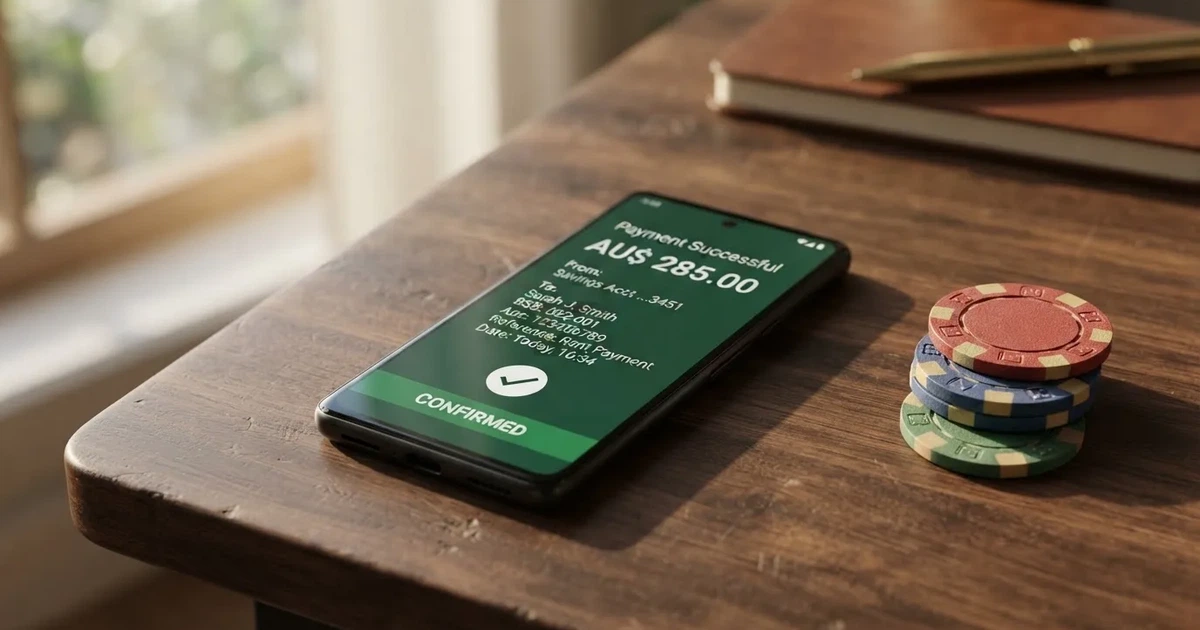
Data current as of 7 November 2026 and checked against the ACMA’s formal-warning register and the Reserve Bank of Australia’s New Payments Platform materials.
Table of Contents
- The cost in plain terms: an offshore PayID casino is prohibited here
- Responsible gaming: who actually answers when an offshore casino refuses a withdrawal
- Payments and payout speed: what PayID actually does and what it does not
- The eleven brands on the ACMA’s warning list: what the table is showing
- Overview of the offshore PayID casino market
- Legality and regulation: where the prohibition sits
- Each brand, in the order the ACMA named it
- Frequently asked questions
The cost in plain terms: an offshore PayID casino is prohibited here
PayID itself is harmless — it is the Australian instant-transfer rail, operated by Australian Payments Plus, offered by more than 100 Australian banks and built into their online banking, with more than 25 million PayIDs registered by April 2025. The cost the reader pays is for joining it to a casino that the Interactive Gambling Act 2001 does not allow to take the payment. That prohibition covers every online casino game, every online pokie and every in-play betting product offered to a person physically in Australia. It is enforced against the provider, not against the individual player, but it produces three costs the reader is exposed to regardless:

- no Australian consumer protection on a withdrawal dispute — there is no local complaints body the punter can take an offshore casino to when a payout is held or refused;
- the balance can be stranded — the ACMA can direct Australian internet service providers to block the site, and the blocking does not return the money sitting in the account;
- no entry on BetStop covers it — the National Self-Exclusion Register binds only Australian-licensed wagering services, so the self-exclusion tool an Australian might rely on does not reach an offshore casino.
What that adds up to is the framing for the rest of this page. The eleven brands that follow are not ranked by safety or by quality; they are listed because the ACMA itself has issued a formal warning over each of them for offering prohibited services to Australians. PayID enters that picture as the rail the punter uses to fund the account, and the rail is the one piece the punter’s own bank cannot be assumed to block.
Responsible gaming: who actually answers when an offshore casino refuses a withdrawal
The responsible-gaming shelf sits first because it is the cost the reader only discovers after the deposit has cleared. Once a balance sits with an offshore casino, the only person who decides whether the punter gets it back is the operator. That is the structural difference between this market and the licensed wagering market that BetStop and the National Gambling Helpline sit over, and the difference is sharper than the marketing pages make it sound.
What BetStop covers, and what it does not
BetStop, the National Self-Exclusion Register, went live in August 2023. A person who registers is blocked from opening new accounts and from receiving marketing across every Australian-licensed online and phone wagering service. Sportsbet, Bet365 and Ladbrokes sit in that net because they hold Northern Territory wagering licences; the offshore casinos on the warning list do not. The punter who self-excludes through BetStop and then opens an account at one of the eleven brands below gets no protection from that registration against the offshore site — BetStop does not reach it, the offshore site does not consult it, and the ACMA’s enforcement against the site has no refund mechanism attached to it.
The helpline works whether or not the casino does
The National Gambling Helpline — 1800 858 858 — is free, runs 24/7 and offers chat through Gambling Help Online. It is reachable regardless of which casino the punter used, because the helpline is funded to help anyone affected by gambling harm in Australia, and the offshore status of a casino is not a question it asks. The cost of the offshore route, in responsible-gaming terms, is that the formal self-exclusion and harm-minimisation infrastructure stops at the licensing border, and the informal support outside that border has to take up the slack.
The bank’s own gambling block is the layer that might catch the deposit
Two of the four major banks now run an opt-in gambling block on the card itself. Westpac’s block refuses authorisation on transactions carrying the merchant category code “Betting/Casino Gambling” across eligible personal credit and debit cards. ANZ’s block, once turned on in the app, also blocks gambling transactions made through a digital wallet such as Apple Pay on an eligible card — it is not just the physical card. ANZ adds a 48-hour cooling-off before the block can be turned off again, and warns that some non-gambling transactions may be blocked in error. The same block does not stop a PayID transfer by default: a PayID-to-PayID bank transfer is not a card transaction and does not carry an MCC, so it is routed through NPP/Osko without consulting the card-level gambling block. That gap is the cost a punter with the block on still pays for, in the form of a transfer that the bank would otherwise have refused.
Payments and payout speed: what PayID actually does and what it does not
The PayID part of the search query is the part the reader can verify before signing up. PayID is a simply-addressed payment identifier — a mobile number, an email, an ABN or an Organisation Identifier — linked to a chosen bank account. PayID sits on the New Payments Platform, which the Reserve Bank oversees and which launched in February 2018; Osko is the brand for the instant-transfer service that runs across it, and Osko settles a transfer between participating Australian banks in under a minute, 24 hours a day, weekends included. None of that requires the casino’s cooperation. The casino cannot make the transfer faster than the rail allows, and the rail is already at its ceiling.
What the rail guarantees, and what the casino adds on top
The instant settlement happens on the Australian side, between the punter’s bank and the receiving account. It does not cover the casino’s internal processing time between “funds received” and “balance available to play”. On the way out, the same gap appears: a PayID withdrawal request still has to clear the casino’s own manual checks — identity, anti-money-laundering, source-of-funds — before the operator pushes it onto the rail. That second leg is what determines whether a withdrawal is paid out the same day or whether it sits in “pending” for two business days while the casino’s payments team works through it. PayID makes the bank leg short; it makes the casino leg whatever the casino decides to make it.
Minimum deposits and the rail’s fee structure
The casino-level minimum deposit is set by the casino, not by the rail. PayID transfers themselves carry no consumer fee charged by AP+ or by the participating banks for standard instant transfers; any fee the punter sees is set by the merchant. Australian banks have been told in the Reserve Bank’s July 2025 review that surcharging on eftpos, Mastercard and Visa transactions is the next thing to be reformed; American Express sits outside that proposal, and any surcharge on a card payment to a casino is a merchant-set fee, not a PayID cost. The minimum deposit the punter meets at an offshore casino is a marketing decision by the operator, expressed in Australian dollars because that is the currency the punter’s account settles in.
The scam-side of the PayID rail
PayID’s own design includes one safety feature that affects the reader: before a payment is sent, the sender is shown the name registered against the PayID. That display is what catches typos and impersonation. It is also what AP+ has used to publish a direct warning — that being asked to transfer funds to a PayID on an illegal gambling site is “almost certainly a scambling website”, which AP+ defines as slang for illegal online gambling platforms advertised on social media and messaging apps that lead a person to a scam site rather than a real operator. The implication for the punter using PayID at an offshore casino is that the rail itself has been used to describe that transaction as a probable scam; the casino-level processing time and the absence of Australian recourse become part of a structure the rail’s own operator has named.
The eleven brands on the ACMA’s warning list: what the table is showing
The block below sets out the eleven brands a punter will encounter when searching for an Australian-facing PayID casino, with the ACMA action and the operator the ACMA named. The angle is not “best of” or “top pick” — none of these is licensed to take an Australian player — but rather what the formal-warning register says about each one and what the listings themselves report about whether they take PayID. The “PayID subject support” column carries only what named listings say; it does not certify that the brand actually settles a withdrawal through PayID, and a blank or dash there does not mean the brand does not list PayID on its cashier page. It means the named listings the research drew on did not make that claim in the form checked.
| Brand | ACMA action and date | Operator named by the ACMA | PayID subject support |
|---|---|---|---|
| RocketPlay | Formal warning, March 2026 (earlier warning to Dama N.V. covering this brand, May 2022) | Pulsup Ltd (RocketPlay); earlier Dama N.V. | — |
| Level Up Casino | Formal warning, May 2022 | Dama N.V. | Listings note PayID presence (Westpac) |
| Woo Casino | Formal warning, March 2025 | Dama N.V. | — |
| Spirit Casino | Formal warning, May 2025 | Dama N.V. | — |
| National Casino | Formal warning, July 2025 | Consolutetish S.R.L. | Listings note PayID presence (AUSTRAC, Wikipedia) |
| Bizzo Casino | Formal warning, July 2025 (earlier warning to TechSolutions, 2022) | Consolutetish S.R.L.; earlier TechSolutions (CY) Group Limited / TechSolutions Group N.V. | — |
| Ignition Casino | Formal warning, July 2025 | Bamboo Media | — |
| Instant Casino | Formal warning, February 2025 | EOD Code SRL | Listings note PayID presence (ecoPayz, PayID listings) |
| Jackbit | Formal warning, April 2026 | Ryker B.V. (also over CasinOK) | — |
| Casino Intense | Formal warning, April 2025 | Sterplay Holding Ltd | Listings note PayID presence (AUSTRAC, iTnews, NAB) |
| Sky Crown | Formal warning, September 2022 | Hollycorn N.V. (also over Blue Leo) | — |
How to read the columns
The third column is the entity the ACMA actually named — the registered company the warning was issued to, not the brand name on the casino’s homepage. Where two operators are listed, it means the ACMA took action twice under two different corporate vehicles, which is itself information: a brand reappearing under a new operator name after a warning is the pattern the ACMA is trying to interrupt by naming the underlying company. The fourth column is the most easily misread, because a “listings-only” entry is not an endorsement of the brand — it is a record of what was visible in the named sources at the time of the check, and the sources themselves are not the operator. A dash in that column means the named listings did not make the claim checked, not that the operator never displays PayID in its cashier.
The blocking pace since November 2019
The ACMA’s blocking power is the mechanism that takes the sites themselves off the air. As of the round reported on 26 June 2026, the ACMA had asked Australian ISPs to block 1,751 illegal gambling and affiliate marketing websites since the first blocking request in November 2019, and more than 230 unlicensed services had left the Australian market since the 2017 strengthening of enforcement. The blocking rate works out to a band: on a straight-line average from the first request in November 2019 to June 2026, the ACMA has been directing ISPs to block roughly 22 illegal sites per month, or close to 265 a year, with the June 2026 round alone adding 12 more (7Signs, ChromaBet, Donbet, Duospin, Freshbet, Slots Gem, Jacks Club, Lucky Start, Pointsbetz, Spinrise, Vinyl Casino and Wildsino). The condition that bound the figure is the assumption of an even pace; the actual blocking has come in bursts tied to specific ACMA investigations, so any single month’s tally is higher than the long-run average and any quiet month is lower. What the band expresses is the long-run throughput of the regime — a steady grinding rate at which a brand can move from “operating” to “blocked” without the punter having lost anything yet.
Overview of the offshore PayID casino market
The fundamentals are the same across most of the offshore sites that surface for an Australian search. The cashier lists PayID alongside POLi, Bitcoin, Ethereum, a handful of e-wallets and sometimes a Visa or Mastercard route; the licence displayed is usually Curaçao, occasionally Kahnawake, and occasionally absent; the bonus terms are buried several clicks deep and contain wagering requirements in the 35x–50x range; the live chat is reachable 24/7; and the responsible-gaming page links to GamCare or Gambling Therapy rather than to an Australian body. None of that is unique to PayID, but the PayID angle is the one that brings the punter’s Australian bank into the loop at deposit time — which is also when the punter’s bank is least able to refuse the transfer, because NPP/Osko does not consult a card-level gambling block.
Why PayID shows up at all
PayID is offered by more than 100 Australian financial institutions, and the casino’s business case for adding it is reach: the punter’s existing bank balance is the deposit, no card needed, no exchange rate, no e-wallet account to set up. From the casino’s perspective it is a low-cost rail that already lives on the punter’s phone. From the punter’s perspective it removes a friction layer, and friction is the only thing that delays a same-day deposit. The trade-off is that the friction being removed is also the only friction that might have stopped the transfer.
What changes in 2026
The 2026 reform — the Interactive Gambling Amendment (Gambling Reform) Bill 2026, which passed Parliament on 19 August 2026 — is real law with a start date. Its advertising and inducement measures commence 1 January 2027. That is the first date on which the new rules bind; for the rest of 2026 the regime that applies is the one that has applied since 2017, plus the credit-card ban that took effect on 11 June 2024. Nothing in the 2026 reform re-legalises an offshore online casino for an Australian player; it tightens what licensed wagering services can advertise and what inducements they can offer. The list of prohibited offshore sites is unaffected by the new bill.
Legality and regulation: where the prohibition sits
The legal frame is short and has been stable for nearly a decade. The Interactive Gambling Act 2001, strengthened by the Interactive Gambling Amendment Act 2017, makes it an offence to provide online casino games, online pokies or in-play betting to a person in Australia. No state or territory licenses those products. What is licensable is wagering on races and sport placed before the event, lotteries and keno. In practice those licences sit with the Northern Territory Racing and Wagering Commission — a body that, as of April 2026, regulated 52 online bookmakers including Sportsbet, Bet365 and Ladbrokes and that meets once a month in Darwin with no full-time staff. The minimum age for any form of licensed wagering in Australia is 18.

The enforcement toolkit
The ACMA, the Australian Communications and Media Authority, investigates complaints, issues formal warnings and directs ISPs to block illegal sites. The June 2026 round added 12 more to the blocking list. The IGA targets the provider, not the player — an individual Australian who deposits with PayID at an offshore casino is not prosecuted. The cost the reader pays is the absence of Australian recourse when the operator refuses a withdrawal, holds a balance after a block, or simply disappears. The H2 Gambling Capital 2025 estimate puts the annual flow into illegal gambling sites at about A$3.9 billion and reports that the share of gambling going through legal channels fell from 74% in 2021 to 64%.
Payments under the Australian rules
For licensed wagering services the legal deposit routes are debit card, bank transfer, PayID/Osko and BPAY. Credit cards, credit-related products and digital currency are banned as payment for licensed online wagering since 11 June 2024, with penalties of up to A$247,500 for operators. A site asking an Australian player for a credit card or a crypto deposit is therefore operating outside the Australian rules even before the casino-prohibition issue is reached; the PayID rail itself is allowed, but only because it is a debit transaction — it spends the punter’s own money, not borrowed money. That is the legal reason PayID fits inside the Australian deposit menu while a credit card does not.
Tax and recreational play
Gambling winnings of a recreational player are not assessable income in Australia — section 6-5 of the ITAA 1997 — and losses are not deductible, unless the person carries on a business of gambling. The ATO’s own guidance is to check with the ATO if the situation is anything other than a recreational punter settling a bet. The tax position is the same at a licensed bookmaker as at an offshore casino; what differs is whether the punter can ever get the winnings out of the offshore casino in the first place.
Each brand, in the order the ACMA named it
The eleven blocks below carry the operator name, the ACMA action as published, and what the named listings say about PayID. The angle is the same across all of them: the prohibition is the same, the rail is the same, the cost structure for the punter is the same, and the only thing that moves between blocks is the company the ACMA had to write to and what that warning did or did not change.
RocketPlay — warned under two operators in four years
The ACMA issued a formal warning to Dama N.V. in May 2022 covering Rocketplay among six other brands, then issued a further formal warning to Pulsup Ltd over RocketPlay in March 2026. Two operators, one brand, four years apart. The 2026 warning sits with Pulsup Ltd specifically, which means the brand re-emerged under a new corporate vehicle between the two actions. The named listings the research checked carry no separate claim about RocketPlay and PayID, so the cashier page is the only place to verify that, and the casino is not reachable through any Australian consumer-protection route if the cashier does not settle what it advertises.
Level Up Casino — one of a 2022 bundle of six
The ACMA’s May 2022 warning to Dama N.V. covered six brands at once: Bambet, Dazard, Level Up, Rocketplay, Wild Tornado and Cobra Casinos. Level Up has not been the subject of a further named warning since, which is consistent with either a change of behaviour or a change of brand. The listings the research checked record PayID presence via a Westpac source, which is the bank-side mention rather than a casino claim — what it confirms is that the brand sits in search results attached to the PayID search term, not that Level Up settles withdrawals through PayID.
Woo Casino — the March 2025 warning
The ACMA issued a formal warning to Dama N.V. over Woo Casino in March 2025. Woo Casino was the first brand Dama N.V. was warned over after a long quiet period, and the warning came two months before the same operator was warned again over Spirit Casino. The pattern is one operator drawing repeated warnings across multiple brands under the same corporate vehicle. No separate PayID claim for Woo Casino appears in the named listings.
Spirit Casino — the May 2025 follow-up
Two months after the Woo Casino warning, the ACMA named Dama N.V. again, this time over Spirit Casino. The fact that the regulator had to write to the same operator twice in a single quarter says more about how the operator is structured than about Spirit Casino specifically. Like Woo, Spirit has no separate PayID listing in the sources the research checked.
National Casino — Consolutetish S.R.L., July 2025
The ACMA issued a formal warning to Consolutetish S.R.L. over National Casino in July 2025. The listings the research checked record PayID presence via AUSTRAC and Wikipedia entries, again the bank-side and reference-side mentions rather than an operator-issued claim. The corporate vehicle — Consolutetish S.R.L. — is a Romanian-registered entity that the ACMA has had to write to directly, which is one step removed from a Curaçao licence holder and one more step removed from any Australian point of contact.
Bizzo Casino — a brand with a 2022 history and a 2025 return
The ACMA issued a formal warning to TechSolutions (CY) Group Limited and TechSolutions Group N.V. over Bizzo Casino in 2022, then issued another formal warning to Consolutetish S.R.L. over Bizzo Casino in July 2025. Two operators, one brand, three years apart — the same pattern as RocketPlay, and on a faster cycle. Evidence of PayID support is absent from the named listings for Bizzo Casino.
Ignition Casino — Bamboo Media, July 2025
The ACMA issued a formal warning to Bamboo Media over Ignition Casino in July 2025. Bamboo Media is the operator the ACMA had to write to directly; the brand is the one Australian-facing search results surface. Ignition Casino has no separate PayID claim documented in the named listings.
Instant Casino — EOD Code SRL, February 2025
The ACMA issued a formal warning to EOD Code SRL over Instant Casino in February 2025. The named listings the research checked record PayID presence via ecoPayz and PayID listings. Instant Casino sits with the brands that have a third-party listing record of accepting PayID, but the listing is not the casino’s own statement and the warning sits over an entity registered in a different jurisdiction from any Australian consumer protection route.
Jackbit — Ryker B.V., April 2026
The ACMA issued a formal warning to Ryker B.V. over Jackbit and CasinOK in April 2026. Two brands on the same warning, one operator — a structural fact that affects the punter only insofar as it indicates the corporate vehicle behind the brand. For Jackbit, the named listings offer no confirmation of PayID support.
Casino Intense — Sterplay Holding Ltd, April 2025
The ACMA issued a formal warning to Sterplay Holding Ltd over Casino Intense in April 2025. The named listings the research checked record PayID presence via AUSTRAC, iTnews and NAB references — the heaviest external-listings footprint of any brand on the list. The presence of an Australian bank’s name in a third-party listing is not a statement by the bank and does not change the IGA position.
Sky Crown — Hollycorn N.V., the 2022 entry
The ACMA issued a formal warning to Hollycorn N.V. over its Sky Crown and Blue Leo casino services, published by the ACMA as a PDF in September 2022. Two brands, one operator, one warning. Sky Crown is the oldest entry on the list and has not been the subject of a further named warning since, which puts it in the same position as Level Up: a long quiet period that may or may not reflect a change at the operator.
Frequently asked questions
Can an Australian legally use PayID to deposit at an offshore casino?
No. The Interactive Gambling Act 2001 prohibits an offshore casino from offering online casino games, online pokies or in-play betting to a person in Australia. The IGA targets the provider, not the player, but it does not change the legal status of the deposit. The payment rail itself — PayID via NPP/Osko — is permitted, but the transaction it is being asked to fund is prohibited.
What is the minimum deposit at a PayID casino site?
The casino sets its own minimum. PayID as a rail does not impose one — the rail settles whatever the sender sends. At the brands on the ACMA’s warning list the minimum is whatever the cashier page states at the moment of deposit, and that figure can change without notice. The research did not return a verified per-brand minimum.
Is a PayID withdrawal faster than a card withdrawal?
On the bank leg, yes — Osko settles between participating banks in under a minute, including weekends. On the casino leg, no different from a card withdrawal: the operator’s own manual checks run before any PayID payment is sent. The punter’s experience of payout speed is dominated by the casino leg, which is operator-controlled and unverifiable in advance.
Can PayID be used at every offshore pokies-style site?
No. PayID support is set by each casino, and the named listings the research checked recorded PayID presence only for Level Up Casino, National Casino, Instant Casino and Casino Intense. The other seven brands either did not surface a PayID listing in those sources or carried no record of one. A site not listed does not mean it rejects PayID; it means the sources checked did not make that claim.
Does depositing with PayID cost the punter anything?
PayID itself does not charge a consumer fee for standard instant transfers through AP+ and the participating banks. Any fee the punter sees at deposit time is set by the casino, not by the rail. Card surcharges are merchant-set and were outside the Reserve Bank’s July 2025 surcharge-reform proposal for American Express.
What should a punter do if a PayID deposit does not arrive in the casino account?
The first stop is the casino’s own support chat, with the bank transfer reference and the bank-side timestamp ready. The second is the punter’s own bank, to confirm the transfer left the account and to ask whether the receiving account name was the one the punter saw when the PayID was entered. AP+ advises anyone who suspects they have paid a scam gambling site to contact their financial institution; PayID itself never contacts customers directly, so any contact claiming to be from PayID is itself a scam indicator.