Seven Reels, No Local Licence: What the Format Costs When the Site Is Offshore
 Available in US
A 7-reel slot sits at the unusual end of the slot family. Three reels built the original one-armed machines in San Francisco in the 1890s, and five reels became the default when Bally’s 1963 Money Honey let payouts pour out unattended. Seven reels sit further along that arc — fewer than the modern video slot with its fifty-plus symbols per reel, more than the classics — and the format reaches a player in Australia almost entirely through offshore websites that operate outside Australian law. This page sets out what those games look like, what their reels and paytables actually show, and what the ACMA has been doing to the operators that offer them.
Verified against the ACMA’s published formal-warning list as of 23 September 2026 and against the Interactive Gambling Act 2001 as it stands in 2026.
Table of Contents
- What Responsible Play Looks Like Before Anything Else
- Bonuses and Free Spins on 7-Reel Formats — What an Offer Really Demands
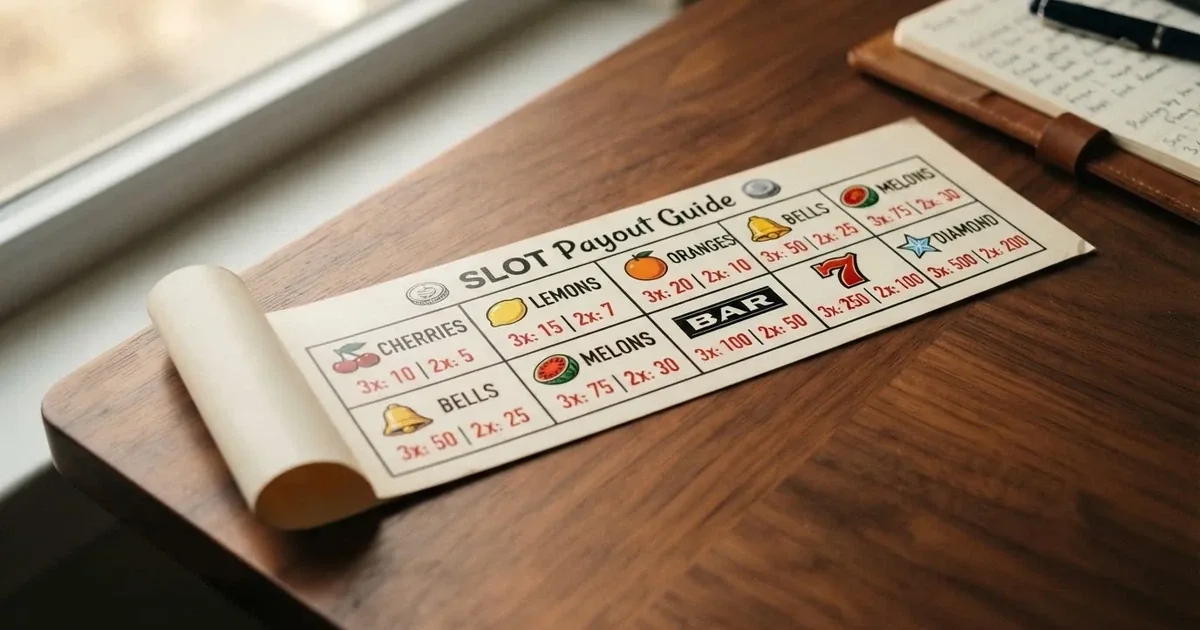
- How a 7-Reel Slot’s Reels, Symbols and Paytable Actually Work
- The Australian Offshore Landscape — What the ACMA Has Actually Done
- The Operators the ACMA Has Named — Eleven Formal Warnings
- What the Law Actually Says About Online 7-Reel Slots in Australia
- Reading the 7-Reel Format Honestly
- Frequently Asked Questions
What Responsible Play Looks Like Before Anything Else
Anyone reading this because 7-reel slots have started to feel like a problem rather than a pastime should know that free, confidential help is available around the clock. Gambling Help Online runs live chat and email support twenty-four hours a day, and the National Gambling Helpline — 1800 858 858 — answers the same hours from anywhere in Australia for the cost of a local call. Both services are run by people who have heard whatever is on the line before, and neither will report a caller back to a bank, an employer or a family member.
BetStop, the National Self-Exclusion Register, has been live since August 2023 and is the formal route for a person who wants to stop being able to place wagers with Australian-licensed bookmakers. It binds every Australian-licensed online and phone wagering service, which is most of what a punter sees when they open a sportsbook. It does not bind an offshore casino, and an offshore site is not connected to the register in any technical sense. A person who has registered with BetStop and then opens an offshore casino account has set up a parallel problem the register cannot see. Anyone reading this who is already on BetStop should treat that gap as the reason not to open an offshore account at all.

The same principle applies to a player who has not registered but is starting to feel the pull of chasing losses, betting more than was set aside, or lying about play to people close to them. The cost of any 7-reel slot session, offshore or otherwise, is set by the house edge and the number of spins played, and neither number is small. The helplines above are the first call to make when that arithmetic starts to bite.
Bonuses and Free Spins on 7-Reel Formats — What an Offer Really Demands
Every offshore casino in this space wraps its 7-reel slots in a welcome package that pairs a deposit match with a bundle of free spins. The shape of these offers is consistent enough across the market that the headline figures — “100% up to A$500 plus 200 free spins” or “150% up to A$1,000 plus 150 free spins” — have become the marketing vocabulary rather than the comparison. The cost of claiming one is not in the headline but in three clauses that sit deeper in the terms.

The first clause is the wagering requirement, set as a multiple of the bonus amount (and sometimes of the deposit too). A 35-times bonus multiple on a A$500 bonus is A$17,500 of wagering before any of the bonus money can be withdrawn. On a 7-reel slot running at a house edge of roughly 4% — a fair midpoint for the format — that A$17,500 of required play produces an expected loss of about A$700, which is more than the bonus is worth on paper. A 50-times multiple pushes the same arithmetic past A$1,000 of expected loss, again before a single dollar of winnings is taken out. The marketing word here is “free”; the cost is paid in spins the player has to complete first.
The second clause is the free-spin value. A “free spin” on a 7-reel slot is almost never a full spin at the player’s chosen stake; it is a fixed-value spin, typically A$0.10 to A$0.20, on a single named title. Two hundred such spins at A$0.10 each are A$20 of slot play, and at the same 4% house edge they produce about A$0.80 of expected loss before any cap on what they can convert to cash. The headline number is the count; the real number is the stake.
The third clause is the max-cashout cap on bonus-derived winnings. A bonus that converts winnings into withdrawable cash only up to a ceiling — often five or ten times the bonus amount — turns a lucky session into a partial payout rather than the headline-grabbing jackpot the marketing implies. On a 7-reel slot, where a single lucky spin can land a line payout of fifty or a hundred times the stake, the cap is what decides whether the spin actually pays the player or only the house.
The honest reading is that any welcome package on a 7-reel slot is a paid entry into a high-turnover game, not a gift, and that the headline numbers exist precisely because the deeper clauses cancel them out. The bonus is best understood as a commitment to play a specified number of spins at a specified house edge, with a ceiling on what those spins can pay back. None of this is unusual for the offshore market; it is the ordinary shape of the offer. The unusual thing is to read the small print before claiming.
How a 7-Reel Slot’s Reels, Symbols and Paytable Actually Work
The seven reels sit where the older three and the modern five each sat in their own time. The first automatic slot mechanism Charles Fey built in San Francisco used three reels with five symbols — horseshoes, diamonds, spades, hearts and the Liberty Bell — and three bells in a row paid the top prize of ten nickels. Three-reel slots kept that shape for almost seventy years, and Bally’s Money Honey in 1963 added a bottomless hopper so the machine could pay out up to five hundred coins without an attendant standing beside it. The first true video slot followed in 1976, when Fortune Coin Co. in Kearny Mesa built a screen-based machine that could run five or more reels with many more symbols per reel than the mechanical drums allowed.
A 7-reel slot sits between those two poles. Seven reels means seven columns of symbols spinning independently, and on most modern 7-reel titles each reel carries between ten and thirty symbols rather than the five of Fey’s original bell machine. The number of possible symbol combinations across all seven reels multiplies out fast: with twenty symbols per reel, a 7-reel slot offers roughly 1.28 billion distinct combinations on a single spin, compared with about a thousand on a classic three-reel machine with ten symbols per reel. The modern video slot can reach combinations in the hundreds of millions; the 7-reel slot sits in the same range, sometimes higher. That mathematical depth is what allows a 7-reel slot to advertise a top prize tens of thousands of times the stake — and what makes the line hit, when it lands, genuinely rare.
| Slot Format | Typical Reel Symbols | Distinct Combinations |
|---|---|---|
| 3-reel classic | ~10 symbols | ~1,000 |
| 5-reel video | ~20 symbols | ~10 million |
| 7-reel slot | 20-30 symbols | ~1 billion |
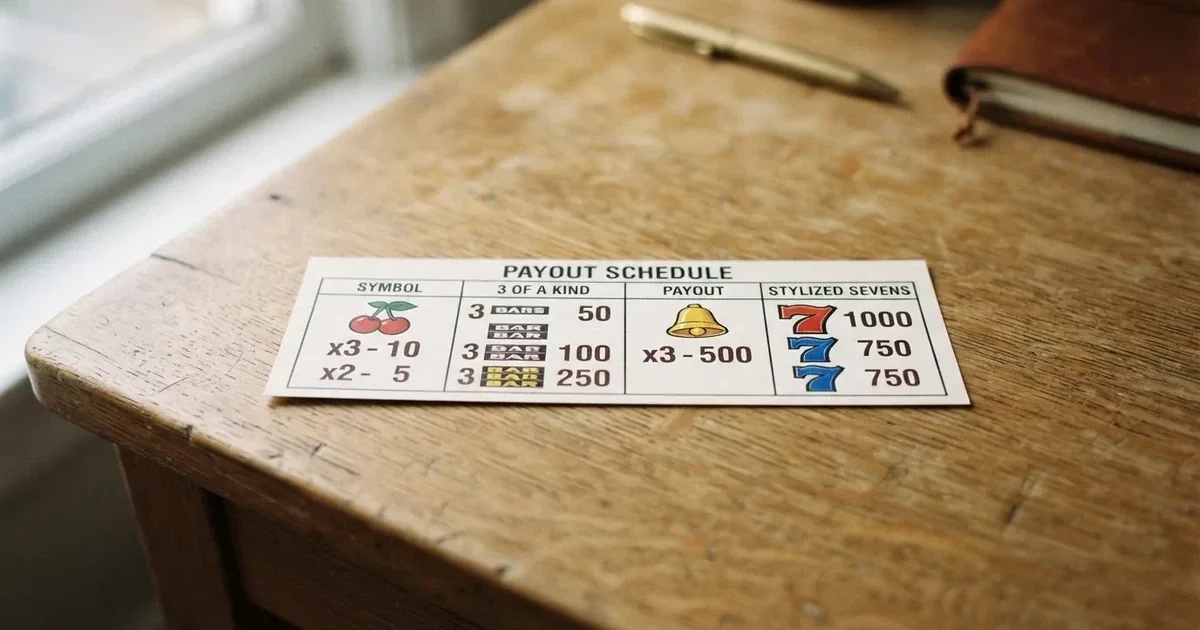
The paytable is what tells the player what each symbol is worth and which combinations pay. On a 7-reel slot the paytable is usually structured around “ways to win” rather than fixed paylines — every adjacent-reel combination from left to right counts as a win, and on a seven-reel grid with three rows that is 3 to the 6th power, or 729 ways, per spin. Some titles use a scatter-pay mechanic where three or more matching symbols anywhere on the grid trigger a payout regardless of position; others use cluster pays where five or more connected symbols form a winning group. Each format changes which symbols the player watches during a spin and which combinations the paytable treats as worth money.
The volatility profile of a 7-reel slot is generally higher than a classic three-reel game, because the same wager buys a smaller share of the much larger combination space. A player staking the same dollar amount per spin on a three-reel classic and a 7-reel video slot will, on average, hit a paying combination less often on the 7-reel title, but the wins that do land tend to be larger. This is the “high variance” or “high volatility” label the marketing copy uses, and it is not a marketing invention — it is the structural consequence of the symbol counts. The house edge still sits underneath; volatility just changes the shape of the losing streak between wins.
The Return to Player (RTP) on a 7-reel slot is typically in the 94% to 96% range, which is a house edge of between four and six percent on every dollar wagered. That figure is published in the game’s information panel on most regulated markets, and an offshore site may or may not display it prominently; if it does not, the player has no way to confirm the figure against the developer’s own published numbers. A 7-reel slot whose RTP cannot be verified is a 7-reel slot whose house edge the player is taking on trust.
The Australian Offshore Landscape — What the ACMA Has Actually Done
The Australian market for online casino games and online pokies is closed. The Interactive Gambling Act 2001, strengthened by the Interactive Gambling Amendment Act 2017, makes it an offence to provide online casino games — including 7-reel slots — to a person physically in Australia. No state or territory issues a licence for them. The only online gambling products Australian law permits are wagering on races and sport placed before the event, lotteries, and keno, and those are licensed in practice by the Northern Territory Racing and Wagering Commission, which regulates 52 online bookmakers including Sportsbet, Bet365 and Ladbrokes from a commission that has no full-time staff and meets once a month in Darwin.
The 7-reel slot a player finds online in Australia is therefore, by definition, on an offshore site operating outside Australian law. The site’s licence — Curaçao, Anjouan, the Philippines — is a licence to operate in the issuing jurisdiction, not a permission to take Australian customers. The ACMA enforces the prohibition by investigating, issuing formal warnings, and directing Australian internet service providers to block illegal sites. According to the ACMA, 1,751 illegal gambling and affiliate marketing websites had been blocked since the first blocking request in November 2019, and more than 230 unlicensed gambling services had left the Australian market since 2017. In one round alone in June 2026 the ACMA asked ISPs to block twelve more: 7Signs, ChromaBet, Donbet, Duospin, Freshbet, Slots Gem, Jacks Club, Lucky Start, Pointsbetz, Spinrise, Vinyl Casino and Wildsino.
The implication is not subtle. An offshore 7-reel casino is one formal warning and one blocking request away from being unreachable through an Australian ISP, and a balance left on the site at that moment is a balance the player has no Australian body to complain about. The site’s own regulator may or may not respond to a complaint; the Australian Communications and Media Authority will not, because the ACMA’s job was to put the site out of reach, not to mediate disputes with it.
H2 Gambling Capital’s 2025 report puts the annual cost to Australian players at roughly A$3.9 billion in losses to illegal gambling sites, with the share of gambling going through legal channels falling from 74% in 2021 to 64%. That is what the offshore market currently extracts from Australian players each year, and it is what the rest of this page is set against.
Blocking Rate — How Fast the ACMA Is Closing the Offshore Market
The arithmetic here is straightforward and the result is a band rather than a single figure, because the inputs are cumulative counts taken at different points in time. The ACMA’s first blocking request went out in November 2019; by the figures published in June 2026, a total of 1,751 illegal gambling and affiliate marketing websites had been blocked since that first request. That is 1,751 sites over roughly 79 months, or an average of about 22 sites blocked per month across the whole period.
The rate is not constant. The first few years were slow — building the legal framework, the first round of investigations, the first ISP directions — and the more recent rounds have been faster, with twelve additional sites added in a single June 2026 round. Across the whole period the average is about 22 per month; across the recent enforcement window it has run higher. A reader who treats the average as a forecast should hold it loosely: the rate depends on what the ACMA’s investigation pipeline turns up, on the willingness of ISPs to comply, and on the offshore operators’ own decisions about whether to keep trying to reach Australian customers. What the figure does say plainly is that the ACMA is not a passive regulator. The number of blocked sites moves in one direction, and that direction is up.
For a player reading this, the practical meaning is that any specific offshore 7-reel casino is a candidate for the next blocking round, not an established service the regulator has chosen to leave alone. The bonus terms and the game library on offer this month may be unreachable through an Australian ISP next month, and the balance the player has left at that moment is, in the regulator’s own frame, a balance they should not have had.
The Operators the ACMA Has Named — Eleven Formal Warnings
The eleven brands below are not a ranking and not a recommendation. Each one is named because the ACMA itself published a formal warning over it for offering prohibited online casino services to Australians. No bonus terms are quoted, because the only sources for those terms were affiliate marketing pages, and the only licence claim worth recording is the ACMA’s own statement that no online casino licence exists in Australia, whatever licence the site displays in its footer.
RocketPlay
The ACMA’s most recent formal warning over Rocketplay was issued in March 2026, addressed to Pulsup Ltd. An earlier warning, in May 2022, was issued to Dama N.V. over six brands including Rocketplay itself. The site’s product is prohibited online casino play, and the ACMA has acted against it twice within four years. For a reader, the record means the operator has had every opportunity to read the Interactive Gambling Act 2001 and has continued to take Australian business regardless. There is nothing in the published record that suggests RocketPlay is safer or more reputable than its peer set on the strength of an offshore licence alone.
Level Up Casino
Level Up was named in the same May 2022 Dama N.V. warning that covered Rocketplay, Dazard, Bambet, Wild Tornado and Cobra Casinos. The warning was a single formal action covering six brands under one operator. For a reader comparing offshore options, the right reading is not “Level Up is a single brand” but “Level Up is one of six brands run by the same operator the ACMA has formally warned once.” Nothing on the published record suggests the operator has changed its approach since.
Woo Casino
The ACMA issued a formal warning to Dama N.V. over Woo Casino in March 2025. Dama N.V. is the same operator named in the 2022 warning above, so Woo Casino sits inside an operator-level pattern rather than a one-off. For a reader, the cumulative signal matters: an operator warned once may be a bad actor; an operator warned twice over the same prohibited product is making a business decision about Australian customers. The site’s licence display is not evidence to the contrary; the ACMA is.
Spirit Casino
Spirit Casino joined Dama N.V.’s warning list in May 2025, two months after Woo Casino. The ACMA is now formally warning the same operator over different brand names, on a rolling basis, and the pattern is the data point rather than any individual brand. Spirit Casino as a separately marketed site is, in the ACMA’s own record, a re-skin of the same problem.
National Casino
The ACMA issued a formal warning to Consolutetish S.R.L. over National Casino in July 2025. Consolutetish S.R.L. is also the operator named in the same warning over Bizzo Casino, and Bizzo had already been the subject of a 2022 formal warning to TechSolutions (CY) Group Limited and TechSolutions Group N.V. The trail here is unusually long for one brand: an entity change, a re-warning under the new entity, and a prior warning under an earlier corporate parent. A reader treating offshore licences as a sign of trustworthiness will not find the ACMA’s record consistent with that reading.
Bizzo Casino
Bizzo’s record with the ACMA is the longest in this set. A 2022 formal warning to TechSolutions (CY) Group Limited and TechSolutions Group N.V., then a July 2025 formal warning to Consolutetish S.R.L. covering both Bizzo and National Casino in one action. Two formal warnings across three years, under two different corporate entities, for the same prohibited product. The brand has been warned; the operator behind it has been warned; and the product itself is what Australian law prohibits. None of that is a reason to believe a third attempt would be different.
Ignition Casino
The ACMA issued a formal warning to Bamboo Media over Ignition Casino in July 2025. Ignition markets itself in the Australian-facing affiliate space as a poker-and-casino hybrid, but the casino side of that offer is the same prohibited product the ACMA’s enforcement covers. The brand’s longevity in offshore marketing does not place it outside the regulator’s reach; the formal warning places it squarely inside it.
Instant Casino
The ACMA issued a formal warning to EOD Code SRL over Instant Casino in February 2025. Instant Casino is the earliest 2025 warning in this set, and the brand’s affiliate footprint had been growing in the Australian market through 2024. The ACMA’s action in February 2025 sits ahead of the bigger July 2025 round that named National Casino and Bizzo, which suggests the regulator’s investigation pipeline was already turning up Australian-facing operators before the mid-year cluster of warnings.
Jackbit
The ACMA issued a formal warning to Ryker B.V. over Jackbit and CasinOK in April 2026. Two brands under one operator, one warning, one date. Jackbit has marketed itself heavily in the Australian-facing affiliate space through crypto-friendly payment messaging, which is the second problem the operator carries: a crypto deposit on a site offering a prohibited product is the same prohibited product paid for through a route the licensed Australian wagering market has specifically banned.
Casino Intense
The ACMA issued a formal warning to Sterplay Holding Ltd over Casino Intense in April 2025. Casino Intense sits inside the same mid-2025 enforcement wave that named Woo Casino and Spirit Casino, and Sterplay Holding Ltd is the corporate entity the ACMA named. The brand’s offshore licence display does not address the underlying prohibition; the ACMA’s action does.
Sky Crown
The ACMA issued a formal warning to Hollycorn N.V. over Sky Crown and Blue Leo in September 2022. Sky Crown is the oldest warning in this set, and Hollycorn N.V. is the only operator here named at the parent-company level rather than the brand level — meaning the ACMA’s action covers the entire Hollycorn brand family, not just one of its sites. For a reader, the right framing is that Hollycorn was told in 2022 that its Australian-facing casino business was prohibited, and that any Hollycorn brand reaching Australian customers since then is doing so on notice.
The Landscape in One View
The eleven brands above are not a peer group on quality. They are a peer group on the ACMA’s published enforcement record: each has been the subject of a formal warning, and several have been warned more than once under different corporate entities. The point of presenting them together is not to invite a comparison of bonus sizes or game libraries — those are the things the affiliate pages optimise, and they are not what the ACMA measures. The point is to set out, in one view, the operator set the regulator itself has acted against, so a reader can see what the market looks like from the regulator’s side rather than from the marketing side.
| Brand | ACMA action and date | Operator named by the ACMA | Subject support |
|---|---|---|---|
| RocketPlay | Formal warning, March 2026; earlier May 2022 | Pulsup Ltd / Dama N.V. | No data |
| Level Up Casino | Formal warning, May 2022 | Dama N.V. | Listings-only |
| Woo Casino | Formal warning, March 2025 | Dama N.V. | No data |
| Spirit Casino | Formal warning, May 2025 | Dama N.V. | No data |
| National Casino | Formal warning, July 2025 | Consolutetish S.R.L. | Listings-only |
| Bizzo Casino | Formal warning, July 2025; earlier 2022 | Consolutetish S.R.L. / TechSolutions | No data |
| Ignition Casino | Formal warning, July 2025 | Bamboo Media | No data |
| Instant Casino | Formal warning, February 2025 | EOD Code SRL | No data |
| Jackbit | Formal warning, April 2026 | Ryker B.V. | No data |
| Casino Intense | Formal warning, April 2025 | Sterplay Holding Ltd | Listings-only |
| Sky Crown | Formal warning, September 2022 | Hollycorn N.V. | No data |
What the Law Actually Says About Online 7-Reel Slots in Australia
The Interactive Gambling Act 2001 is the operative statute, and the Interactive Gambling Amendment Act 2017 is the version that closed the loopholes the original Act left open. Together they make it an offence for an operator to provide online casino games, online pokies, or in-play betting to a person physically in Australia. The Act targets the provider, not the player — no Australian has been prosecuted for placing a wager on an offshore site — but the Act’s practical effect is that no Australian-facing casino, of any reel count, can operate legally.
The only online gambling products Australian law permits to be offered to Australians are pre-event wagering on racing and sport, lotteries, and keno. Those are licensed in practice by the Northern Territory Racing and Wagering Commission, which regulates 52 online bookmakers — including Sportsbet, Bet365 and Ladbrokes — from a commission that, as the ABC reported in April 2026, has no full-time staff and meets once a month in Darwin. A 7-reel slot is not in any of those categories.
The 2026 reform sits in the middle of this picture. The Interactive Gambling Amendment (Gambling Reform) Bill 2026 passed Parliament on 19 August 2026, and its advertising and inducement measures commence on 1 January 2027. As of 2026 those measures are law with a start date, not law in force. The Bill tightens the inducement regime around Australian-licensed wagering; it does not legalise online casino games or change the status of a 7-reel slot offered offshore. The basic prohibition is the same.
On the payment side, the rules are equally specific. Credit cards, credit-related products and digital currency have been banned as payment for licensed online wagering since 11 June 2024, with penalties up to A$247,500 for operators. The legal deposit routes for licensed wagering are debit card, bank transfer, PayID/Osko and BPAY. An offshore casino asking an Australian for a credit card or a crypto deposit is not just operating outside the Australian rules on product; it is operating outside them on payment too. Both bans apply.
The player-protection side has the same split. BetStop binds Australian-licensed wagering only. The National Gambling Helpline — 1800 858 858 — and Gambling Help Online are open to anyone, on any product, offshore or otherwise, and that is where the protective side of the system still works for a player who has opened an offshore account. The gambling reform regime does not. A person who has self-excluded through BetStop and then opened an offshore casino account has not circumvented a rule; they have stepped outside the rule’s coverage.
On tax, the position is the ordinary one for a recreational player. Gambling winnings of a recreational player are not assessable income under section 6-5 of the ITAA 1997, and losses are not deductible. The position changes if the person carries on a business of gambling, which is a question of fact rather than a question of scale — a player who treats 7-reel slots as a side income and accounts for it that way may be running a business, and the ATO is the right body to ask. A recreational player asking the same question gets the simpler answer.
Reading the 7-Reel Format Honestly
The format itself is not the problem. A 7-reel slot is a legitimate piece of game design — seven columns of symbols, a paytable that maps combinations to payouts, a house edge that runs four to six percent on most titles. Charles Fey’s three-reel Liberty Bell machine was the same kind of object, and the video slot that replaced it from 1976 onwards was the same kind of object with more reels and more symbols per reel. The structural cost — the house edge, the variance, the long losing streaks between line hits — is built into the format and is the same cost on a 7-reel slot as on any other reel count.
The problem is the route. A 7-reel slot reached through an Australian ISP on an offshore site is a 7-reel slot the Australian regulator has acted to block, an operator the ACMA has formally warned, and a balance that has no Australian consumer-protection framework behind it. The game’s arithmetic is honest; the site’s position is not. Reading the paytable is the easy part; reading the operator is the part a reader cannot do alone, and the ACMA’s published enforcement record is the closest thing to a second opinion available.
For a player whose interest in 7-reel slots is genuine but whose interest in playing them on an offshore site is the part that needs cooling, the practical order is straightforward. Step away from the offshore sites entirely, because their product is prohibited and their enforcement record is the published one. Use the 7-reel format as background reading about how slots work — the symbol counts, the paytable mechanics, the volatility profile — rather than as a shopping list. If the interest is in the play itself rather than the format, the legal Australian alternatives are wagering on racing and sport with a licensed bookmaker, lotteries and keno, and the pokies in licensed pubs and clubs in states that permit them. New South Wales alone had 87,298 pokie machines outside casinos in June 2023, with comparable totals in Victoria, Queensland, South Australia and the ACT. The legal Australian slot machine exists; the offshore 7-reel slot is not its online equivalent.
If the play has already moved past interest and into something that feels harder to stop, the helpline is 1800 858 858 and the chat is at Gambling Help Online. Both are free, confidential, and open around the clock. The cost of calling is the cost of a local call. The cost of not calling is the cost of continuing to play on sites the regulator is actively blocking.
Frequently Asked Questions
What makes a 7-reel slot different from a standard five-reel video slot?
A 7-reel slot has seven spinning columns of symbols rather than five, and on most modern titles each reel carries between ten and thirty symbols. That means a 7-reel slot offers roughly a billion distinct symbol combinations on a single spin, against about ten million on a five-reel video slot. The paytable is usually structured around “ways to win” — every adjacent-reel match from left to right counts — rather than fixed paylines.
Can 7-reel slot machines be found in licensed Australian pubs and clubs?
The pub and club pokies market in Australia is overwhelmingly three-reel and five-reel video slot machines. New South Wales alone had 87,298 pokies outside casinos in June 2023, with comparable totals in Victoria, Queensland, South Australia and the ACT. The 7-reel format is uncommon on Australian pub floors; it is much more common as an online category, where it sits on offshore sites offering prohibited services.
Do 7-reel slots typically pay out differently than newer five-reel formats?
Yes, in shape rather than in long-run cost. A 7-reel slot generally has higher volatility than a five-reel video slot — paying combinations land less often, but the wins that do land tend to be larger. The Return to Player on most 7-reel titles sits in the 94% to 96% range, which is a house edge of four to six percent per dollar wagered, broadly comparable to other reel counts. The difference is in the streak length between wins, not in the long-run percentage.
Is a 7-reel slot online the same game as a 7-reel machine on a casino floor?
Not necessarily. A physical 7-reel machine in a licensed venue runs under the rules of that venue’s regulator, with a published RTP and a physical payout mechanism. An online 7-reel slot on an offshore site runs under the rules of whatever jurisdiction issued the site’s licence, with an RTP that may or may not be displayed, and a payout process that has no Australian consumer-protection framework behind it. The reel count can be identical and the game can still be a different proposition.
Are 7-reel slots for real money available legally from an Australian-based site?
No. The Interactive Gambling Act 2001 prohibits the provision of online casino games, including 7-reel slots, to a person in Australia. No Australian state or territory licenses online casino games, and there is no Australian-based site where a player can legally wager on a 7-reel slot for real money. The legal Australian online gambling products are pre-event wagering on racing and sport, lotteries, and keno.
Is reel count still a useful way to compare volatility between older and newer slots?
It is one useful way, not the only one. Reel count and the number of symbols per reel set the combination space, which is the underlying driver of variance. But two 7-reel slots with the same reel count can sit at very different volatility points depending on how the paytable is structured, whether the game uses “ways to win” or fixed paylines, and how the bonus features are weighted. Reel count is a starting point for comparison, not a conclusion.
Prepared by the Instant bank transfer casino Australia editorial staff.