
A Curaçao licence and the people playing from Australia: where the line sits in 2026
Current as of 7 November 2026 · verified against the ACMA formal-warning register and the Interactive Gambling Act 2001 as published on the Federal Register of Legislation.
A Curaçao-licensed online casino has no legal standing to offer casino games or online pokies to a person in Australia. That sentence is the entire shape of this page, and the rest is what the Australian Communications and Media Authority has done about it: blocking requests to ISPs, formal warnings over individual brands, and an enforcement tally that, by the regulator’s own count, now runs into four digits.
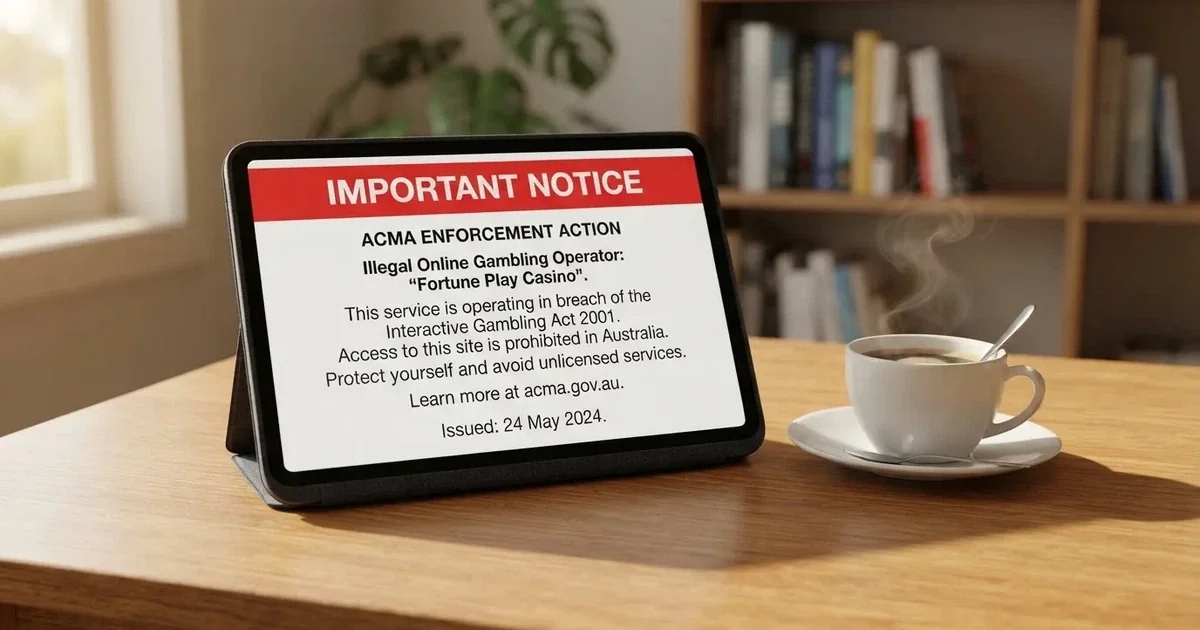
The detail below matters because the licence on a site’s footer is not the protection players tend to assume it is. A Curaçao master licence, a sub-licence under one, or the newer LOK framework that took effect after the 2024 reform — none of them is recognised by Australian law as a basis for offering the product at all. The Interactive Gambling Act 2001 prohibits the supply of online casino games and online pokies to people in Australia regardless of where the operator is licensed, and the regulator has been steadily closing in on offshore operators that nevertheless market into the country. What follows is the picture those actions draw: which brands have been named, what protections a Curaçao-licensed site cannot offer an Australian customer, and what the realistic cost of playing on one looks like once a withdrawal stalls or the site disappears behind a block.
Table of Contents
- Responsible gambling: what an offshore site does not connect a player to
- The brands the ACMA has named: how a Curaçao-licensed site lands on the regulator’s list
- What the licence on the footer is, and what it isn’t
- The Australian legal frame, set out plainly
- Where an Australian player actually has recourse
- What the licence on the footer costs the player
- A practical guide to the situation an Australian customer is in
- Frequently asked questions
Responsible gambling: what an offshore site does not connect a player to
The first question any honest comparison has to settle is the one a Curaçao footer cannot answer: when the player wants help, what is actually attached to the account? On an Australian-licensed wagering service, three things sit on the other end of the connection. They do not sit on an offshore casino.

BetStop — the National Self-Exclusion Register — went live in August 2023 and binds every Australian-licensed online and phone wagering service. A person who registers with BetStop is excluded by every participating provider at once, and the operator is required to close the account, refund any balance and refuse to market to them. The register is enforced through the licensed wagering channel. An offshore casino operating under a Curaçao licence is not a participant and cannot honour a BetStop registration. Self-exclusion on the offshore site itself is voluntary, can be lifted by the customer at the operator’s discretion, and disappears entirely if the operator changes its platform, is sold, or has its domain blocked.
Deposit and time limits are similar. The Australian regime requires licensed wagering services to offer pre-commitment tools — deposit ceilings, session timers, loss limits — that the customer can set without contacting support and that the operator cannot quietly relax. Curaçao-licensed sites often offer similar-looking tools in their responsible-gambling pages, and a few enforce them with the same rigour. None of them is required to. When the player disputes a withdrawal, the dispute does not go to an Australian regulator; it goes to whatever ADR body the operator’s terms name, if any, sitting under Curaçao law rather than Australian consumer law.
The third thing is the part that costs nothing to install and everything to skip: the National Gambling Helpline on 1800 858 858, free, 24/7, with web chat at Gambling Help Online. Both are reachable from Australia regardless of where a person’s account sits, and the counsellors are trained for the offshore case as well as the onshore one. Where the practical gap opens is in the conversation that follows a self-exclusion request. On a licensed Australian bookmaker, the operator has to act on it within a defined window and confirm in writing; on an offshore casino, the player is hoping the operator does. That difference is what responsible-gambling policy is for, and it is exactly the difference an offshore site does not close.
The brands the ACMA has named: how a Curaçao-licensed site lands on the regulator’s list
The table sets out the eleven Curaçao-connected brands the ACMA has issued formal warnings over for offering prohibited interactive gambling services to Australians. The warnings are not advisory notes; they are the regulator’s stated basis for asking ISPs to block the brand’s domains, and several of the brands in the table have already been blocked.

| Brand | ACMA action and date | Operator named by the ACMA | Subject support |
|---|---|---|---|
| RocketPlay | Formal warning, March 2026; earlier warning to Dama N.V., May 2022 | Pulsup Ltd | listings-only |
| Level Up Casino | Formal warning, May 2022 | Dama N.V. | listings-only |
| Woo Casino | Formal warning, March 2025 | Dama N.V. | no-data |
| Spirit Casino | Formal warning, May 2025 | Dama N.V. | no-data |
| National Casino | Formal warning, July 2025 | Consolutetish S.R.L. | listings-only |
| Bizzo Casino | Formal warning, July 2025; earlier warning to TechSolutions, 2022 | Consolutetish S.R.L. | listings-only |
| Ignition Casino | Formal warning, July 2025 | Bamboo Media | no-data |
| Instant Casino | Formal warning, February 2025 | EOD Code SRL | listings-only |
| Jackbit | Formal warning, April 2026 | Ryker B.V. | no-data |
| Casino Intense | Formal warning, April 2025 | Sterplay Holding Ltd | listings-only |
| Sky Crown | Formal warning, September 2022 | Hollycorn N.V. | no-data |
Three things the table is showing. First, the operator name on a Curaçao licence is rarely the brand name a customer typed into a search box. RocketPlay’s March 2026 warning names Pulsup Ltd as the operator; Woo and Spirit Casino’s warnings name Dama N.V., which is also the operator named in earlier warnings over RocketPlay, Level Up, Wild Tornado, Cobra and Bambet. The same parent operator can sit behind half a dozen skins, which means the player who switches to a “new” brand to dodge a block is, often as not, depositing into the same legal entity the ACMA has already written to.
Second, the table’s date column reads as a steady drumbeat rather than a single event. Between September 2022 and April 2026 the ACMA issued formal warnings over at least twelve Curaçao-connected brands across at least nine operator entities. Two of those operators (Dama N.V. and TechSolutions / Consolutetish S.R.L.) have been warned before over different brands and warned again — the pattern the regulator describes when it talks about “repeated non-compliance” in its enforcement notes.
Third, the “Subject support” column is honest about what the research turned up. Where the listings-only tag appears, payment-method directories or affiliate pages carry the brand but the regulator’s warning is the only place the brand is documented for Australian readers. The no-data tag means the brand does not appear in mainstream Australian payment-method listings at all, which is a quieter kind of warning in itself: a Curaçao-licensed casino that does not list a PayID or a major-bank-friendly deposit route for Australians is not, by accident, choosing to ignore that audience.
How a site ends up on the list
The mechanism is straightforward. The ACMA investigates, usually after a tip-off or a complaint, identifies the operator behind the brand, and writes a formal warning naming both. The warning is published on the ACMA’s website. If the operator does not stop offering the prohibited service to Australian customers, the ACMA can ask the Federal Court for an order directing Australian ISPs to block the brand’s domains at the DNS level. The block is implemented within days and applies across participating ISPs, which covers the great majority of Australian residential connections.
What the block does not do is reach the operator’s funds, the operator’s other brands, or the operator’s other domains. A blocked site routinely reappears at a slightly different address, and the cycle — warning, blocking request, new domain, new warning — is what the regulator has been running since 2017. The total under the ACMA’s published count is what gives the cycle its weight: more than 230 unlicensed services have left the Australian market since enforcement was strengthened in 2017, and 1,751 illegal gambling and affiliate marketing websites had been blocked since the first blocking request in November 2019, by the regulator’s count in a round reported on 26 June 2026.
What the licence on the footer is, and what it isn’t
A Curaçao gaming licence is an authorisation to offer gambling services from Curaçao, issued under the National Ordinance on Games of Chance. Until late 2024 the licence sat with the Curaçao eGaming authority; since the reform it sits with the Curaçao Gaming Authority (CGA) under the LOK framework, with the Gambling Control Board handling supervision and the National Treasury taking a fee share. The application fee for either a B2C or a B2B licence under LOK is EUR4,592; the B2C annual fee is EUR47,450, split as EUR24,490 to the National Treasury and EUR22,960 to the CGA, with the B2B annual fee at ANG48,000 and no monthly component.
These are not small numbers relative to other offshore jurisdictions, and the LOK reform tightened the perimeter around what a Curaçao licence does and does not cover. The reform did three things worth understanding. It required every operator that wanted to keep offering games from Curaçao to re-apply under LOK by the deadline. It put the supervisory function under a single named authority rather than the older patchwork of master-licence holders sub-licensing to operators. And it tied the licence to Curaçao’s own AML/CFT regime, which rests on the National Ordinance on Identification and the National Ordinance on Unusual Transactions, with licensed operators reporting through the goAML portal established under PB 2020 no. 157.
None of that gives a Curaçao-licensed operator standing to offer online casino games to a person in Australia. The Australian position is set by the Interactive Gambling Act 2001, which prohibits the supply of online casino games and online pokies to people in Australia regardless of the operator’s home jurisdiction. The Interactive Gambling Amendment Act 2017 strengthened the prohibition and clarified that the supply is the offence, not the player’s act of gambling. What an Australian-licensed wagering service can offer is narrower than what a Curaçao-licensed site can offer: pre-event wagering on racing and sport, lotteries and keno, and (since the 2024 credit-card ban) only via debit cards, bank transfer, PayID/Osko and BPAY.
The licence on the footer therefore answers a question the player did not ask. It tells the player that the operator is authorised to offer its product from Curaçao, subject to Curaçao’s rules. It does not tell the player that the operator is authorised to offer that product to an Australian customer, because no Australian regulator has granted that authorisation and no Australian regulator can. The Curaçao licence is real. The inference players draw from it — that it constitutes some kind of consumer protection in Australia — is not.
The cost the marketing copy skips
The product a Curaçao-licensed casino sells in Australia is, by Australian law, not licensable to be sold. That asymmetry is the entire reason the marketing copy is heavy: the operator has to attract a customer who has been told, by the regulator of the customer’s own country, that the product is not for them. The marketing budget is the substitute for the licence the operator does not have, and the brand promise it sells — the welcome package, the cashback ladder, the VIP host — is being sold against a backdrop that the operator is hoping the customer will not look at.
The arithmetic of what the welcome package costs the player is the part the marketing copy tends to skip. A typical Curaçao-licensed welcome package of A$1,000 plus 100 free spins carries a wagering requirement somewhere in the 35x to 50x range applied to the bonus amount, with the free spins usually locked to a single high-house-edge slot, a max-bet cap during wagering, and a maximum cashout ceiling on the bonus-derived winnings. Required turnover, using the lower end of that range, is A$35,000 — that is the amount the player has to wager before any of the bonus balance converts to withdrawable cash. At A$1 per spin across online pokies at roughly 96% RTP, that is 35,000 spins, taking close to 49 hours at the standard five-second spin interval, on which the expected house take is 4% of turnover — A$1,400 in expected loss against an A$1,000 bonus. The bonus itself is being paid for by the player, in expectation, with about A$400 left over from the bonus once the house has taken its 4% over the wagering period. That is the bonus the marketing copy was selling. None of those terms is hidden; they are simply not on the landing page that put the bonus in the player’s hand.
What an Australian dispute looks like in practice
A player who disputes a refused withdrawal on a Curaçao-licensed casino has, broadly, three routes, and none of them goes through an Australian regulator. The first is the operator’s own internal dispute process, the terms of which the player agreed to on signup. The second is whatever Alternative Dispute Resolution (ADR) body the operator’s terms name — sometimes a Curaçao-based ADR, sometimes an e-gaming mediation service, sometimes nothing at all. The third is a private legal action in Curaçao, which is where the operator’s terms typically place the forum. None of these is the ACMA. None of them is the Australian Financial Complaints Authority. None of them is a state and territory consumer protection office, in the way a complaint about a mis-sold financial product would be.
A useful comparison is what happens on the licensed side of the Australian market. A wagering dispute with an Australian-licensed bookmaker can be raised with the operator, escalated to AFCA if unresolved, and pursued under Australian consumer law and the operator’s Australian licence conditions. The bookmaker’s Australian licence is at risk if it mishandles disputes systematically, which is the regulator’s lever. There is no equivalent lever on a Curaçao-licensed casino because the operator does not hold an Australian licence. The ACMA’s lever is the block, which protects future Australian customers and does not compensate the customer who has already lost the disputed balance.
The Australian legal frame, set out plainly
The Interactive Gambling Act 2001 (the IGA), as amended in 2017 and again in 2023, prohibits the supply of online casino games and online pokies to people in Australia. The offence sits with the provider, not the customer: a person in Australia who places a bet with an offshore casino is not committing an offence under the IGA. What is the prohibition is the operator’s act of offering the product. The 2017 amendments clarified the position on in-play betting and gave the ACMA the explicit power to issue formal warnings and seek blocking orders from the Federal Court.
What can be licensed and supplied legally is narrower. Pre-event wagering on racing and sport, lotteries and keno are licensable, and in practice they are licensed by the Northern Territory Racing and Wagering Commission (NTRWC), which regulates 52 of Australia’s online bookmakers — including Sportsbet, Bet365 and Ladbrokes — under arrangements that are largely tax-driven. The NTRWC has no full-time staff and meets once a month in Darwin, a structure that has drawn attention in 2026 as part of a Northern Territory reform bill. Land-based casinos — Crown Melbourne, The Star Sydney, the Queensland and South Australian casinos, the Canberra casino — are licensed and supervised by their state or territory regulator separately.
The age floor is 18 across Australia for any gambling product, including the offshore case. The 2024 reforms added the prohibition on credit cards and credit-related products as payment for licensed online wagering, with effect from 11 June 2024 and penalties up to A$247,500 for operators that breach the prohibition. The ban reaches digital wallets funded by credit, because the restriction is on the credit-product funding, not on the wallet as such. A licensed wagering customer depositing via Apple Pay using a credit card in the wallet is in breach; using a debit card or a direct bank transfer is not. Cryptocurrency was also caught by the 2024 reforms as a payment method for licensed wagering, leaving debit card, bank transfer, PayID/Osko and BPAY as the legal deposit routes for an Australian-licensed wagering account.
A site that asks an Australian customer for a credit card or a crypto deposit is, by virtue of that ask, operating outside the Australian rules regardless of the licence it displays. The licence on the footer is irrelevant to that question; what is relevant is whether the site accepts the payment routes the 2024 ban prohibits. Most Curaçao-licensed casinos accept both credit cards and crypto because their business model is built around customers the Australian rules do not reach; that is not a sign the site is licensed to do so, and it is a sign the site is not licensed in Australia at all.
The 2026 reform
The Interactive Gambling Amendment (Gambling Reform) Bill 2026 passed Parliament on 19 August 2026. Its advertising and inducement measures commence 1 January 2027. The bill is law with a start date, not law currently in force. On a page read in late 2026, the reform’s measures are coming into force rather than operative. The earlier reforms are operative: the 2017 amendments, the 2023 amendments, the 2024 credit-card ban. The 2026 bill’s consumer-facing measures — the inducement restrictions, the advertising restrictions — are the next change a reader should expect to see in operation from the start of 2027.
Enforcement in numbers
By the ACMA’s count as reported on 26 June 2026, 1,751 illegal gambling and affiliate marketing websites had been blocked since the first blocking request in November 2019. More than 230 unlicensed gambling services had left the Australian market since enforcement was strengthened in 2017. The blocking rate over that period — a useful band for an Australian player to hold in mind — runs from the first blocking request in November 2019 to the June 2026 tally: roughly 80 months, during which 1,751 sites were blocked. That is an average of close to 22 sites blocked per month, or one site blocked every 33 hours or so across the period as a whole. The rate is not constant; the ACMA issues blocking requests in rounds of a dozen or so at a time, and a single round can move the monthly figure materially. As a band rather than a point: between roughly 18 and 26 sites per month across the period since November 2019, with material month-to-month variation driven by the regulator’s batching. That is the pace at which the regulator is closing the gap, and it is the pace at which an offshore brand’s address in a player’s bookmarks can become unreachable.
A useful sanity check on those numbers sits one level up. H2 Gambling Capital’s 2025 estimate puts the annual loss to illegal gambling sites in Australia at roughly A$3.9 billion, with the share of gambling going through legal channels having fallen from 74% in 2021 to 64%. The legal channel is shrinking as a share of the total even as the regulator is blocking more sites, which is consistent with the offshore market responding to blocking by rotating domains rather than by exiting. The blocking-rate band is the regulator’s response; the share-of-spend figure is the size of what the response has not yet reached.
Where an Australian player actually has recourse
When something goes wrong on a Curaçao-licensed casino accessed from Australia, the practical options narrow quickly. The ACMA does not take individual complaints about offshore operators; it investigates and acts on the operator’s conduct, not on the player’s loss. The Australian Federal Police do not investigate individual gambling disputes. The state and territory consumer protection agencies can take complaints about misleading conduct, but the conduct in a refused withdrawal is usually a contractual dispute governed by the operator’s terms, not a misleading-and-deceptive-conduct case under Australian Consumer Law.
The options that remain are the operator’s internal process, the ADR body named in the operator’s terms (if any), and a private action in the operator’s chosen forum. For most refused withdrawals, the dispute is small enough that the cost of private action exceeds the balance in dispute, and the operator knows this. A Curaçao-licensed casino is not a charity, but it is also not subject to the AFCA-membership and Australian-licence conditions that make a refusal to pay a regulator-detectable breach on the Australian-licensed side. That asymmetry is the cost the player pays for the bonus and the game library the marketing copy offered.
The licensed side of the Australian market, by contrast, is supervised by the ACMA and the state and territory regulators, with AFCA as the external dispute resolution body for financial disputes. A wagering dispute with an Australian-licensed bookmaker can be raised with the operator, escalated to AFCA, and pursued with the operator’s Australian licence as the regulator’s lever. Crown Melbourne and The Star Sydney sit under the Victorian Casino and Gaming Authority and the New South Wales Independent Casino Commission respectively, with their own dedicated dispute processes for casino customers. Land-based and licensed-online customers are supervised customers. Offshore customers are not.
What the licence on the footer costs the player
The honest framing of a Curaçao-licensed casino, for an Australian customer, is as an offshore site that displays a licence to operate from Curaçao and offers its product in breach of Australian law. The product is the same product the customer would find on a licensed Australian wagering service, with three structural differences. The licence does not apply in Australia. The dispute resolution does not apply in Australia. The consumer protection does not apply in Australia. The customer carries the cost of all three.
The marketing copy is built around closing the player’s eyes to that cost. The bonus is paid for in expected loss against the wagering requirement, with the player keeping the difference between the bonus and the expected house take over the wagering volume. The game library is the same library the Australian-licensed market offers in wagering, with the addition of online casino games and online pokies — the products the IGA prohibits — which is precisely what the marketing copy leans on. The VIP host is the substitute for the regulator the customer does not have. None of this is hidden. It is simply not on the page that sold the customer the bonus.
The single most useful thing an Australian player can do
The single most useful thing an Australian player can do, on any of the brands in the table above, is to register with BetStop before depositing. BetStop is free, takes a few minutes, and excludes the customer from every Australian-licensed online and phone wagering service for the chosen period. It does not exclude the customer from an offshore Curaçao-licensed site — that is the gap. But the customer’s Australian-licensed wagering accounts are closed, the balances refunded, and the marketing stopped, which removes the licensed-wagering path from the customer’s options and forces the question that the marketing copy was designed to avoid: do I want to play on a site whose licence does not apply where I live, whose dispute resolution does not apply where I live, and whose consumer protection does not apply where I live?
For customers who are not ready to register with BetStop, the National Gambling Helpline on 1800 858 858 — free, 24/7, with web chat at Gambling Help Online — is the next-most-useful thing. The counsellors are trained for the offshore case as well as the onshore one, and the conversation that follows a call is not a sales pitch and not a regulator’s letter. It is a conversation, and it is the conversation the marketing copy was designed to make unnecessary. That is also the conversation a Curaçao-licensed casino cannot have with the customer, because the casino’s interest is in the customer not having it.
The brand-by-brand picture
Each of the brands in the table above has been the subject of an ACMA formal warning, and the warning is the regulator’s stated basis for the next step, which is the blocking request. For RocketPlay, the warning history is the most informative: the brand was first named in a May 2022 warning to Dama N.V. and then named again in a March 2026 warning to Pulsup Ltd, after the brand had moved operator in the interim. The customer typing “RocketPlay” into a search box in 2026 is being served by Pulsup Ltd; the customer who typed the same in 2022 was being served by Dama N.V. The licence changed, the regulator’s position did not, and the brand’s compliance did not.
Woo Casino and Spirit Casino are the second Dama N.V. cluster. The March 2025 warning over Woo and the May 2025 warning over Spirit both name Dama N.V. as the operator, joining the earlier Dama N.V. cluster that included Level Up Casino and the broader RocketPlay / Dazard / Wild Tornado / Cobra set. A player who opened an account with Level Up Casino in 2022 and was warned by the ACMA, and who then opened an account with Spirit Casino in 2025 and was warned again, has been the customer of an operator the regulator has now warned over more than half a dozen brands. The single-brand fix the operator has run — closing one skin and opening another — has not changed the underlying position.
National Casino and Bizzo Casino are the Consolutetish S.R.L. cluster, both named in the July 2025 warning, with Bizzo also having been the subject of a 2022 warning to TechSolutions (CY) Group Limited and TechSolutions Group N.V. The earlier operator name on the Bizzo warning — TechSolutions — was itself a familiar name in Curaçao-licence circles. The pattern is again the same: a brand moves operator, the regulator names the new operator, the cycle continues. The licensing chain on a Curaçao footer is, for these brands, several layers deep.
Instant Casino is the EOD Code SRL warning from February 2025, with no prior ACMA action against that operator in the published warnings. Jackbit is the Ryker B.V. warning from April 2026, again with no prior ACMA action against Ryker B.V. Casino Intense is the Sterplay Holding Ltd warning from April 2025, again a first warning to that operator. Ignition Casino is the Bamboo Media warning from July 2025. Sky Crown is the Hollycorn N.V. warning from September 2022, paired with the Blue Leo warning from the same period.
Two of these brand-operators — Dama N.V. and Consolutetish S.R.L. (with TechSolutions as its earlier name) — are repeat offenders on the ACMA register. The other nine are first-time warnings to the named operator, which does not mean the operator is new to Curaçao; it means the operator is new to the ACMA’s published warnings. A new warning to a new operator is, in the regulator’s terms, an enforcement escalation rather than a continuation, and the next step for each of those operators is the blocking request if they do not stop offering the product to Australians.
What the warning does not say
The formal warning is a public document. It names the operator and the brand, sets out the prohibited conduct, and gives the operator a defined period to stop. It does not name individual customers, refund individual balances, or set out the operator’s terms. The customer who has a balance on the brand at the moment of the warning has, in practice, the same options the customer had the day before the warning: the operator’s internal process, the ADR body in the operator’s terms, and the operator’s chosen forum. The warning changes the regulator’s posture; it does not change the customer’s position.
The blocking request, when it comes, changes the customer’s position materially. A blocked domain is unreachable on the participating ISPs, and the customer’s account on the operator’s platform is now stranded on a domain the customer cannot reach without a workaround. The operator’s response, where it has one, is to rotate to a new domain and contact existing customers by email. The customer who has a balance at that point is in a familiar offshore-customer position: the operator still has the money, the regulator has done what it can do, and the customer is hoping the operator’s new domain is functional and the operator’s payment routing still works. The marketing copy does not put that scenario on the landing page.
A practical guide to the situation an Australian customer is in
The Australian customer who has decided to play on a Curaçao-licensed casino, despite the ACMA’s position, has a narrower set of practical questions than the marketing copy implies. The first is whether the brand is on the ACMA’s list. The table in this page is current as of 7 November 2026 and verified against the ACMA’s published formal warnings; the ACMA’s own register is the live source. The second is what the operator’s payment routes are. Credit cards and crypto are not legal deposit routes for an Australian-licensed wagering account, and a site that accepts them is, by that fact, not an Australian-licensed wagering site. The third is whether the operator’s terms name an ADR body and a forum the customer can use in practice. The fourth is what the customer does if the operator refuses to pay. The answer to that question, on the offshore side, is the operator’s terms, and the operator’s terms are not the ACMA.
The licensed Australian alternative is structurally different. The customer can deposit only via the routes the 2024 ban permits (debit card, bank transfer, PayID/Osko and BPAY). The customer cannot play online casino games or online pokies because the IGA prohibits their supply. The customer can play pre-event wagering on racing and sport, lotteries and keno, and the customer can raise a dispute with the operator and escalate to AFCA. The licensed wagering product is narrower than the Curaçao-licensed casino product; the protection attached to the licensed product is wider. The trade-off is the trade-off the IGA was designed to set, and the regulator’s enforcement record is the record of the trade-off the offshore side is offering in place of it.
Frequently asked questions
Does a Curaçao gaming licence give an operator any legal standing to serve Australian players?
No. A Curaçao licence authorises the operator to offer gambling services from Curaçao under Curaçao’s National Ordinance on Games of Chance; it does not constitute an Australian authorisation, and no Australian jurisdiction licenses online casinos. The Interactive Gambling Act 2001 bans providing online casino games and online pokies to Australian residents, and the ACMA has issued formal warnings over Curaçao-licensed brands including RocketPlay, Level Up, Woo Casino and Spirit Casino for offering prohibited services to Australians.
What changed when Curaçao’s National Ordinance on Games of Chance took effect?
The LOK framework, in force since late 2024, replaced the older master-licence-and-sub-licence structure with direct B2C and B2B licences issued by the Curaçao Gaming Authority, with the Gambling Control Board supervising and the National Treasury taking a fee share. Application fees, annual fees and the AML/CFT regime (under the National Ordinance on Identification and the National Ordinance on Unusual Transactions, with reporting through the goAML portal) were set out under the reform. The reform tightened the perimeter around what a Curaçao licence covers; it did not change the position under Australian law, which is set by the IGA.
Who is the regulator behind a Curaçao gaming licence?
The Curaçao Gaming Authority (CGA) issues licences under LOK, with supervisory responsibility sitting with the Gambling Control Board and a National Treasury fee share. The CGA is the regulator a Curaçao-licensed operator is accountable to in Curaçao. It is not a regulator an Australian customer can complain to, and it does not take individual customer complaints.
Does the ACMA treat a Curaçao-licensed site any differently from an unlicensed one?
No. The ACMA’s formal-warning register treats the operator’s home jurisdiction as immaterial to the prohibition. A Curaçao-licensed brand and an unlicensed brand both fall under the Interactive Gambling Act 2001 if they offer online casino games or online pokies to people in Australia; the ACMA’s enforcement steps — formal warning, blocking request to the Federal Court — apply equally. The first warning is to the operator; if the conduct continues, the next step is a blocking request to ISPs.
Can an Australian pursue a dispute against a Curaçao-licensed operator through an Australian regulator?
No. The ACMA does not take individual customer complaints, AFCA does not cover offshore operators, and the state and territory consumer protection agencies can take misleading-conduct cases but not contractual disputes governed by an operator’s terms. The available routes are the operator’s internal process, the ADR body the operator’s terms name (if any), and a private action in the operator’s chosen forum, typically Curaçao. None of these is an Australian regulator.