
High cashback bonus offers at Australian-facing online casinos in 2026, why the headline percentage is not the number that matters
Cashback is the cleanest bonus in any casino lobby in theory: lose, get a slice back, no rollover that swallows the headline figure. In practice for anyone reading this from Australia it is also the bonus that points most directly at the gap between what an offshore site advertises and what an Australian reader can actually recover. Offering online casino games to a person physically in Australia is prohibited under the Interactive Gambling Act 2001, the Australian Communications and Media Authority has issued formal warnings to the operators behind most of the brands that pitch high cashback to Australian email addresses, and no state or territory issues a licence for the product. The page below treats the question as the cost question it actually is — what is paid, what is returned, and what the player is left holding when the offer is finished.

Current as of 28 September 2026 and cross-checked against the ACMA’s list of formal warnings and blocking requests.
Table of Contents
- Staying in control when the offer looks generous, the reader-side safeguards that actually apply
- Crypto and anonymity at cashback casinos, why the wallet choice does not move the legal line
- Cashback bonus mechanics, the percentage on the page and the percentage that gets paid
- Ranking of the brands the ACMA has named, what the table actually shows
- How much the reader can recover, the cost side of a typical cashback week
- What is and is not legal in Australia for online casino play in 2026
- Payment methods, the rails the offer runs on and what each one costs
- Australian-facing online casinos the ACMA has warned, the per-brand picture
- What a reader in Australia can actually do, the lawful alternatives the offer is hiding
- Frequently asked questions
Staying in control when the offer looks generous, the reader-side safeguards that actually apply
Cashback is pitched as loss insurance. The marketing word is soften. The arithmetic underneath is that the player has already lost the full stake before any cashback triggers, and the percentage is applied to a net loss figure calculated on terms the operator writes. A responsible-gaming posture is what stops the offer from doing what it is designed to do, which is to keep the next deposit coming.
BetStop, the National Self-Exclusion Register, has been live since 21 August 2023. It binds every Australian-licensed online and phone wagering service, which in practice means the licensed bookmakers and lottery products the Northern Territory Racing and Wagering Commission supervises, not the offshore casino brands that send cashback emails. Registering with BetStop does not close an account at an offshore site, does not stop a credit card being attempted at one, and does not place a hold on crypto leaving a wallet to one. What it does is block access to every Australian-licensed channel the operator runs, which for a reader who uses both licensed and offshore products is the licensed side handled and the offshore side still open.

Australian banks now offer card-level gambling blocks that work at the merchant category code level, and several explicitly extend to digital wallets.
- Westpac’s gambling block refuses authorisation on transactions registered under the merchant category code Betting/Casino Gambling on eligible personal credit and debit cards.
- ANZ’s block, activated through the ANZ app, also blocks gambling transactions routed through Apple Pay or Google Pay on the same eligible card, with a 48-hour cooling-off period before the block can be removed.
- Commonwealth Bank’s CommBank app lets customers apply a gambling lock to eligible cards, with the same caveat the other banks publish: not every gambling-related transaction will be stopped, and some non-gambling transactions can be blocked in error.
The National Gambling Helpline on 1800 858 858 is free, 24/7, and chat is available at Gambling Help Online. Neither BetStop nor any of these tools needs an active casino account to be useful, and turning them on before a deposit is the cheaper of the two orderings.
The single fact the responsible-gaming shelf owes a reader is that the offshore brand does not connect to any of it. A player who has self-excluded through BetStop and then opened an account at a Curacao-licensed site the ACMA warned about in the same month is not protected by the Australian register, is not protected by the bank’s merchant-category block if the deposit is routed through a wallet the bank does not flag, and is not protected by the consumer law that applies to a locally licensed wagering operator. The cost the offer does not show is the absence of the protection that an Australian-licensed channel would carry.
Crypto and anonymity at cashback casinos, why the wallet choice does not move the legal line
A reader who has heard that crypto deposits let them keep their identity out of a casino’s database is reading about a real feature of the payment rail, not a real feature of the legal position. The blockchain transaction is pseudonymous; the lawfulness of the casino on the Australian side of the connection is not affected by what is on the other side of it.
Several points the research hands back change the picture:
- The Interactive Gambling Act 2001, as amended in 2023, prohibits offering online casino games to a person in Australia. It does not prohibit a particular payment method, but the 2024 payment rules for Australian-licensed wagering services banned credit cards and credit-related products and digital currency as funding methods, with penalties for operators up to A$247,500.
- An offshore casino is not licensed by any Australian regulator, so it is not bound by the 2024 payment-method ban and will in fact accept crypto and credit cards where a licensed bookmaker cannot.
- Paying in Bitcoin or USDT does not move the legal line because the legal line is about who is offering the product to whom, not about how the deposit was funded.
- The anonymity a crypto wallet provides is anonymity from the operator’s KYC team, not from the Australian Federal Police if a transaction is later linked to proceeds of crime, and AUSTRAC’s reporting rules still apply to fiat on-ramps and off-ramps in Australia.
There is a separate point about the casino’s own internal transparency. A cashback bonus paid in Bitcoin or USDT settles to whatever those coins are worth when the bonus is credited, not when the loss that triggered it occurred. A player who took a 20% cashback on a Saturday and tried to withdraw the following Wednesday has been paid in a coin whose price moved five per cent over the weekend, in either direction, and the bonus does not adjust for it.
What the page can honestly tell a crypto-curious reader is that crypto is the payment rail most offshore cashback casinos prefer because it lets them keep operating in jurisdictions where their banking has been cut off, and that it puts the volatility risk and the exchange-rate risk on the player rather than on the operator. The legal status of the offer does not change with the rail.
Cashback bonus mechanics, the percentage on the page and the percentage that gets paid
A cashback bonus is structured as a percentage of net losses over a defined period, credited as either real cash or bonus funds, with or without a wagering requirement on the credited amount. The headline number is the percentage. The number that determines what a player actually receives is the combination of: the calculation base (net losses on which games), the period (daily, weekly, monthly), the credited form (cash vs bonus), and the wagering multiplier attached to any bonus-funds credit.
The pattern most Australian-facing offshore brands publish, where they publish terms at all, looks like this:
- A weekly cashback of 10% to 25% of net losses on slots, with table games and live dealer typically excluded or weighted at a small fraction.
- A tiered structure where the percentage rises with VIP status, the period shortens from monthly to weekly, and the maximum cashback amount rises from a low cap to a much higher one.
- A wagering requirement of 1x to 5x on the credited amount, which is the part of the offer that determines what gets paid out and what is forfeited on withdrawal.
The cost of an unfavourable combination is straightforward. A 20% cashback on $500 of net losses over a week returns $100 in bonus funds with a 5x wagering requirement, meaning $500 of additional turnover before withdrawal. The turnover has to come from somewhere, and on a slot with a 96% return-to-player the $500 of turnover costs the player on average $20 in expected house edge, so the net value of the cashback is the $100 minus the $20 minus whatever was lost during the wagering of the bonus, which on a streak of bad luck can be the full amount. The percentage on the landing page is the gross. The percentage the player keeps is net of everything that has to be paid to release it.
Three terms that recur across the offshore brands the ACMA has warned, and that determine the real return:
| Term | Typical formulation | What it costs the reader |
|---|---|---|
| Net loss base | Losses minus wins, or losses minus deposits, or losses minus bonus credits | A narrower base pays back less on the same gross loss |
| Game weighting | Slots 100%, table games 0–10%, live dealer 0% | A reader who plays roulette does not generate cashback at all |
| Max cashout | A cap on how much of the credited cashback can be withdrawn | The rest is forfeited on withdrawal regardless of the wagering being complete |
The single sentence this shelf owes a reader who has never taken a cashback bonus is that the marketing number is a percentage of a base the operator defines, paid in a form the operator chooses, and released on terms the operator writes, and the audit of the offer is the reading of those three layers rather than the headline figure.
Ranking of the brands the ACMA has named, what the table actually shows
No Australian-facing ranking of online casinos offering high cashback bonuses can honestly function as a recommendation, because the product is prohibited under the Interactive Gambling Act 2001 and the ACMA has issued formal warnings to every operator on the list below. What a ranking can do is line the brands up by the same metric the regulator uses, which is the warning itself, and let a reader see which operators the ACMA has acted against most recently, which are repeat offenders, and which the regulator has named alongside others run by the same holding company.
| Brand | ACMA action and date | Operator named by the ACMA | Subject support |
|---|---|---|---|
| RocketPlay | Formal warning, March 2026 | Pulsup Ltd (RocketPlay) | Listings report payment methods only |
| Level Up Casino | Formal warning, May 2022 | Dama N.V. | Listings report payment methods only |
| Woo Casino | Formal warning, March 2025 | Dama N.V. | — |
| Spirit Casino | Formal warning, May 2025 | Dama N.V. | — |
| National Casino | Formal warning, July 2025 | Consolutetish S.R.L. | Listings report payment methods only |
| Bizzo Casino | Formal warning, July 2025; prior 2022 | Consolutetish S.R.L. (2025); TechSolutions (2022) | Listings report payment methods only |
| Ignition Casino | Formal warning, July 2025 | Bamboo Media | — |
| Instant Casino | Formal warning, February 2025 | EOD Code SRL | Listings report payment methods only |
| Jackbit | Formal warning, April 2026 | Ryker B.V. | — |
| Casino Intense | Formal warning, April 2025 | Sterplay Holding Ltd | Listings report payment methods only |
| Sky Crown | Formal warning, published September 2022 | Hollycorn N.V. | — |
The pattern the table holds, once it is read across the rows, is that the ACMA’s enforcement is concentrating on a small number of holding companies. Dama N.V. appears three times in this set (Level Up, Woo, Spirit), Consolutetish S.R.L. twice (National, Bizzo), and the regulator’s recent actions have been almost entirely on operators that run more than one brand from the same corporate vehicle. A reader comparing these offers on cashback percentage is comparing offers from a small number of operators who have been told, in formal correspondence published on the ACMA website, that offering online casino games to Australians is prohibited, and who have continued to do so.
The most expensive thing on this page is not the cashback percentage. It is that the offer is being made by an operator the Australian regulator has told to stop.
How much the reader can recover, the cost side of a typical cashback week
The blocking rate the ACMA has applied to illegal gambling sites, from the first blocking request in November 2019 to the round reported on 26 June 2026, gives a window into the scale of the action rather than the speed of any single enforcement. The research carries a running total of 1,751 blocked sites over that period; the blocking cadence implied by that figure, applied across the roughly 79 months between November 2019 and the June 2026 report, sits in a band of roughly 22 blocked sites per month on average, with the recent rounds running hotter than the early ones and the early rounds running colder. As a band the rate matters more than the midpoint, because it shows the regulator’s posture is sustained rather than intermittent: blocks are issued in rounds of roughly a dozen sites several times a year, with a cumulative total that has been climbing in roughly straight lines since 2019.
The same arithmetic frames what the player loses by choosing the offshore channel. A reader who plays at a licensed Australian venue — a pub poker machine, a land-based casino in one of the states that allows them, a licensed wagering operator on a race or sporting event — is operating inside a system where the ACMA’s blocking rate is irrelevant because the product is licensed. A reader who plays at a site on the table above is operating inside a system where the ACMA’s blocking rate is the only enforcement the player has any chance of seeing, and the rate does not move fast enough to cover the number of sites offering the product.
The cost side of a single week at a typical offshore cashback casino can be sketched with the figures the research does carry. On $500 of net losses through slots over a week, at a 20% cashback rate with a 5x wagering requirement on the credited $100, the additional turnover needed to clear the bonus is $500 at the slot’s RTP of roughly 96%, which costs about $20 in expected house edge. The expected net return to the player, before counting the losses during the wagering of the bonus, is the $100 cashback minus the $20 expected cost of clearing it, on top of the $500 already lost. A 20% gross becomes roughly 16% net, before any streak variance, and any bonus-clearing losses reduce it further.
The conclusion the calculation supports is that the cashback percentage is the gross, not the net, and the net is what determines what the player actually keeps.
What is and is not legal in Australia for online casino play in 2026
Australian law on interactive gambling has not changed in its core shape since the Interactive Gambling Act 2001 was amended in 2017, but the operational picture has tightened. The headline points a reader needs:
- Online casino games, online pokies and in-play betting cannot be offered to anyone in Australia. No state or territory issues a licence for them, and no offshore licence (Curacao, Malta, the Isle of Man) changes that.
- What is licensable is wagering on races and sport placed before the event, lotteries and keno. In practice the Northern Territory Racing and Wagering Commission supervises 52 of Australia’s online bookmakers — Sportsbet, Bet365, Ladbrokes among them — and the commission has no full-time staff, meets once a month in Darwin, and licenses operators for tax reasons rather than for consumer-protection reasons.
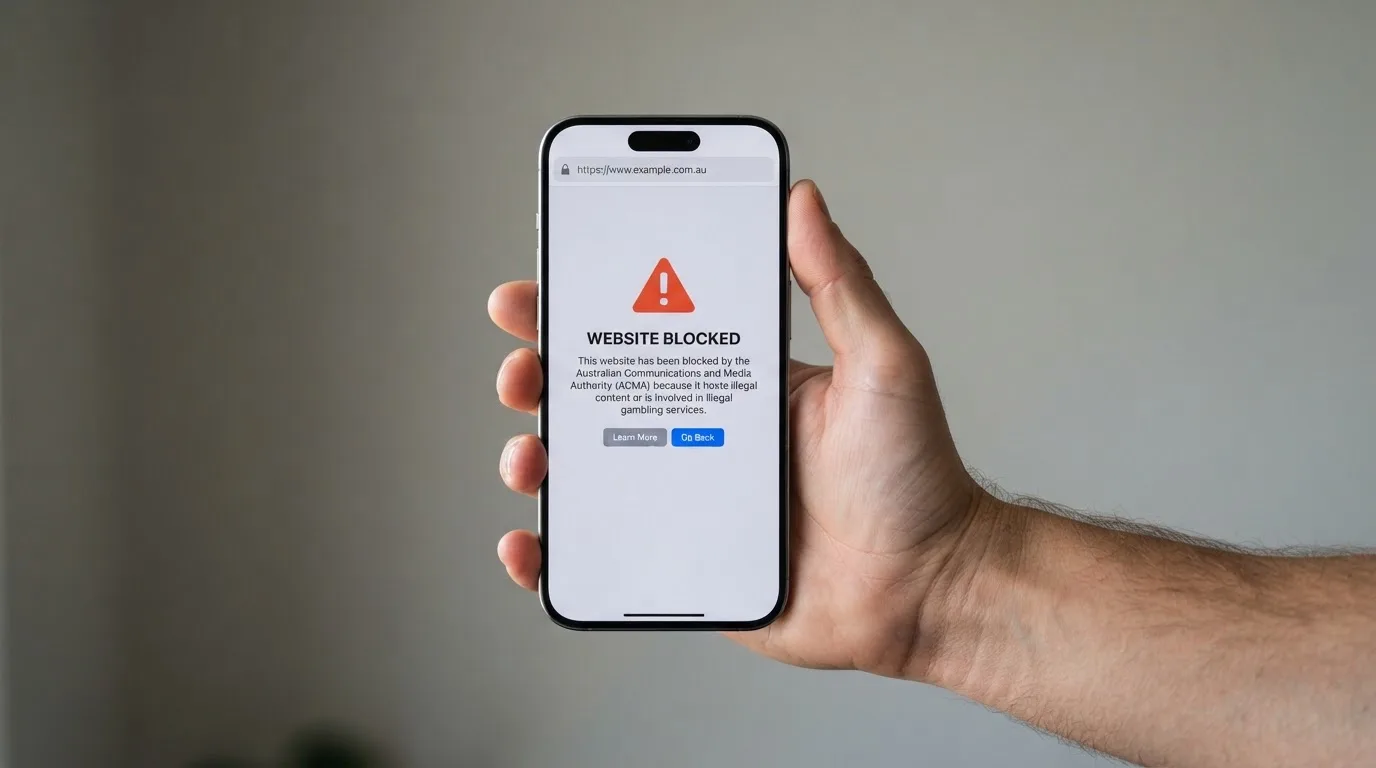
- The ACMA’s enforcement is directed at the provider, not the player. A formal warning is the first step; the second is a request to Australian internet service providers to block the site; the third is referral for civil penalty proceedings. The player is not prosecuted, but a blocked site can hold an unsettled balance.
- The Interactive Gambling Amendment (Gambling Reform) Bill 2026 passed Parliament on 19 August 2026, with advertising and inducement measures commencing on 1 January 2027. Law with a start date, not yet in force on a 2026 page.
A reader who lands on a casino landing page that advertises a Curacao or Anjouan licence, displays a “players from Australia welcome” badge, and offers a 25% weekly cashback with a $10,000 maximum is looking at a site the ACMA has likely already warned, may already have blocked, and which offers no Australian consumer protection. The cost of the offer, in the language of this page, is the absence of every safeguard an Australian-licensed channel carries.
Payment methods, the rails the offer runs on and what each one costs
Cashback bonuses are paid by the same methods a casino accepts for deposits, and the choice of rail affects how much of the credited amount the player actually receives. The research gives the following figures for the Australian payments landscape, and they apply to the deposit a reader would make at any of the brands above:
- PayID, run by Australian Payments Plus, is available at over 100 Australian financial institutions. Paying to a PayID shows the name of the account holder before the transfer is sent, which is one of the reasons AP+ warns that a request to transfer money to a PayID on an illegal gambling site almost certainly indicates a scam site.
- Osko, also by AP+, settles bank transfers between participating Australian banks in under a minute, 24/7. More than 25 million PayID identifiers were registered on the New Payments Platform as of April 2025.
- BPAY, owned equally by ANZ, Commonwealth Bank, National Australia Bank and Westpac, is available in the online banking of over 140 institutions and accepted by over 95,000 businesses. It is a bill-payment service using a Biller Code and Customer Reference Number.
- Apple Pay, Google Pay and Samsung Pay accounted for around 45% of all card payments in Australia by number at the end of 2025. Apple does not charge consumer fees for Apple Pay; any surcharge is the merchant’s card-processing fee, and the Reserve Bank of Australia’s July 2025 review proposes removing surcharges on eftpos, Mastercard and Visa transactions but explicitly leaves American Express outside the scope of the proposed ban.
For Australian-licensed wagering, credit cards and digital currency are banned as funding methods, and that ban extends to linked digital wallets. For an offshore casino the rules are different: credit cards and crypto are accepted, which is part of why an offshore brand is easy to deposit with and impossible to complain to if the withdrawal is refused. A bank-level gambling block on a Westpac, ANZ or Commonwealth Bank card may stop the transaction at the merchant-category-code level, may not, and the bank publishes the caveat that some non-gambling transactions may be blocked in error.
The cost side of the payment rail is the practical one. A deposit routed through PayID is fast, traceable, and visible to the player’s own bank. A deposit routed through a credit card at an offshore casino incurs the card’s interest rate from the transaction date if it is not paid in full, and any cashback credited back to the same card arrives against a balance that has been compounding interest. A deposit in Bitcoin or USDT arrives net of network fees, exchange fees on the way in, exchange fees on the way out, and any difference between the rate at deposit and the rate at withdrawal — and the cashback credited in the same coin is settled at the rate on the day it is credited, not the rate on any of the days the player was losing the money it is credited against.
Australian-facing online casinos the ACMA has warned, the per-brand picture
The eleven brands below are not a ranking of cashback value. They are the brands the ACMA has named in formal correspondence for offering prohibited services to Australians, and the patterns in the table above become sharper when each is read on its own row.
RocketPlay
Pulsup Ltd received a formal warning in March 2026 over RocketPlay. Dama N.V., the operator behind a separate cluster of brands on this list, was warned over a different Rocketplay entity back in May 2022. Reaching the player via a different corporate vehicle after a prior warning is the pattern enforcement has been documenting across this market, not an isolated event. For an Australian reader the brand carries no Australian consumer protection, no BetStop binding, and no bank-side recourse if the withdrawal stalls. The verdict this section owes is that RocketPlay is the row on the table where the warning is the most recent, and that recency is the only signal a reader comparing rows can lean on.
Level Up Casino
Dama N.V. was warned in May 2022 over Level Up Casino alongside five other brands. The 2022 warning is older than most of the others on this list, and the regulator’s most recent actions on Dama N.V., in 2025, were directed at different brands the same holding company runs. A reader who is evaluating Level Up on its own terms is evaluating a brand whose operator has been told once in 2022 and has continued to operate; the cost of doing business with a brand on that footing is not visible in any cashback percentage.
Woo Casino
Dama N.V. received a further formal warning in March 2025 over Woo Casino. This is one of the two 2025 actions that followed the 2022 batch over Dama’s portfolio, and the cumulative picture is that a single holding company is generating a disproportionate share of the regulator’s enforcement work on this side of the market. The picture a reader comparing rows sees is one of an operator the ACMA has named, rewarned, and continued to engage with across more than three years.
Spirit Casino
Dama N.V. was warned again in May 2025, this time over Spirit Casino, two months after the Woo Casino warning. The two 2025 Dama N.V. warnings are part of the same enforcement arc, and Spirit Casino is the second of the two. The cost to a reader of an offer from a brand on this trajectory is not the cashback percentage, which any of the brands can match. It is the absence of any path back to the player’s own consumer-protection framework if the credited amount is contested.
National Casino
Consolutetish S.R.L. was warned in July 2025 over National Casino. The same operator was also warned the same month over Bizzo Casino, which makes National Casino one of two brands tied to the same July 2025 enforcement event. The handful of payment-method listings that exist for National Casino name PayID, eftpos and BPAY among the deposit rails, which is one of the reasons an Australian reader can reach the deposit page at all; it is not a reason to expect the rail’s protections to extend to a withdrawal.
Bizzo Casino
Business for Bizzo Casino carries the longest enforcement history on the table: a 2022 warning to TechSolutions (CY) Group Limited and TechSolutions Group N.V., and a July 2025 warning to Consolutetish S.R.L. Two operators across two holding entities, both told to stop offering online casino games to Australians, both continuing to operate. For a reader who treats the second warning as the most informative single data point on the brand, Bizzo is the row that shows what an unremediated warning looks like three years on.
Ignition Casino
Bamboo Media received a formal warning over Ignition Casino in July 2025. The brand sits alongside National Casino and Bizzo Casino in the same month’s enforcement round, which on this market is what a single regulator action against a single operator cluster looks like at the brand level. The pattern is consistent: a holding company, two or three brand names, one warning that names each one separately.
Instant Casino
EOD Code SRL was warned in February 2025 over Instant Casino. The brand is the earliest 2025 warning in the set, and the payment-method listings for it name crypto and PayID among the deposit options. Both rails work at an offshore casino; neither rail gives a reader any Australian consumer protection on a withdrawal that is delayed, reduced, or refused.
Jackbit
Ryker B.V. was warned in April 2026 over Jackbit and a second brand, CasinOK, in the same action. Jackbit is the most recent enforcement action on the table alongside RocketPlay, and the operator named is a different holding company from any of the others on the list. A reader scanning the table for recency sees Jackbit at the top alongside RocketPlay; what that recency signals is that the ACMA is still adding brands, not that the existing warnings are being remediated.
Casino Intense
Sterplay Holding Ltd was warned in April 2025 over Casino Intense. The brand sits between the February 2025 Instant Casino warning and the July 2025 National/Bizzo/Ignition batch, and the listings that exist for Casino Intense name BPAY and PayID among the deposit rails. The cost framing the page applies here is the same as it is elsewhere: the rail works at deposit, the rail does not work at withdrawal dispute.
Sky Crown
Hollycorn N.V. was the subject of a formal warning, published in September 2022, over Sky Crown and Blue Leo. The warning is one of the older entries on the table but is the only one tied to Hollycorn N.V., and the operator sits alongside the other holding companies the regulator has returned to more than once. A reader comparing Sky Crown to the rest of the table sees an older warning and a holding company that has not, on the evidence of the ACMA’s published actions, generated the same volume of follow-up enforcement as Dama N.V. or Consolutetish S.R.L.
What a reader in Australia can actually do, the lawful alternatives the offer is hiding
The cost framing of this page has been that the cashback offer on an offshore site is not the deal the marketing word cashback suggests, because the offer itself is being made in breach of Australian law. The natural next question is what an Australian reader who wants to play casino-style games can do lawfully, and the answer is shorter than the offer page at any of the brands above:
- Licensed wagering on races and sport, pre-event only, through one of the 52 operators licensed by the Northern Territory Racing and Wagering Commission. Cashback-style promotions exist on licensed wagering in the form of bonus bets and refund-if-loss offers, and they sit inside the Australian consumer-protection framework.
- Land-based casinos in the states and territories that license them, and licensed pokies venues. The product is the same as the offshore lobby in category terms, the venue is regulated, and the safeguards apply.
- Lotteries and keno, through the state-licensed operators. No cashback, but no marketing word promising one either.
The single thing the lawful alternatives do not do is offer a 25% weekly cashback on net losses with a $10,000 maximum and a five-second spin interval. The reason they do not is that in an Australian-licensed channel the marketing of loss-refund offers is regulated, the inducement provisions of the 2026 reform bill will tighten that further from 1 January 2027, and the offer terms cannot be written to favour the operator at the expense of the consumer. The cost the page names is the difference between those two regimes, and the cost is paid by whichever reader picks the wrong one.
Frequently asked questions
What is the difference between a cashback bonus and a deposit match bonus?
A deposit match bonus credits a percentage of what the player deposits as bonus funds, typically with a wagering requirement of 30x to 50x. A cashback bonus credits a percentage of what the player has already lost as either cash or bonus funds, typically with a wagering requirement of 1x to 5x. The cashback percentage is lower; the playthrough is lower; the player has already lost the base the percentage is applied to.
Is cashback paid as real money or as bonus funds?
It depends on the operator and the tier. Lower-tier weekly cashback at most offshore brands is paid as bonus funds with a wagering requirement; higher-tier VIP cashback is often paid as real cash with no playthrough. The marketing page rarely states which one applies to the offer the reader is looking at, and the term is in the cashier or the bonus terms page.
Is it legal for an online casino to offer cashback to players in Australia?
No. Online casino games cannot be offered to anyone in Australia under the Interactive Gambling Act 2001, regardless of the licence the offshore operator displays, regardless of the payment method used, and regardless of the size of the cashback. The ACMA has issued formal warnings to every operator named on this page for offering prohibited services to Australians.
Can a crypto casino offer cashback in the same way as a fiat one?
The mechanics are identical — a percentage of net losses over a defined period. The differences are that the credited cashback is paid in the same coin the player deposited, settled at the rate on the day of credit rather than the day of loss, and that the Australian-licensed-wagering payment-method ban does not apply to the offshore brand, which is why the offshore brand accepts crypto where a licensed bookmaker cannot. The legal status of the offer does not change.
What terms usually cap how much cashback a player can earn?
Three, and they recur across the offshore brands on this list. The first is the calculation base — net losses on which games, with table games typically weighted at zero. The second is the period — daily, weekly or monthly — and a longer period usually pays a lower percentage. The third is a maximum cashout cap on the credited cashback, above which the remainder is forfeited on withdrawal regardless of the wagering being complete.
Does a high cashback percentage make up for unfavourable bonus terms?
Not usually. A 25% cashback with a 5x wagering requirement on the credited amount, a $500 maximum, and table games excluded is a worse deal for a table-game player than a 10% cashback with no wagering and no game exclusions. The percentage on the landing page is the gross. The number the player keeps is determined by everything else around it.