
Casino promo codes in Australia in 2026: how offshore offers reach you, and what they take
Data current as of 16 October 2026 · licence claims checked against the ACMA register of formal warnings.

A casino promo code is a string of letters and numbers an offshore operator hands you at sign-up, in a welcome email, or via an affiliate page. Type it in at the cashier, and the site credits a bonus on top of whatever you deposited. In every other regulated gambling market that sentence describes a normal commercial arrangement. In Australia, it describes a transaction the operator is barred from offering you in the first place. That gap between the marketing and the law is what this page is about — not how to play, but what sits underneath the offer when it lands.
The Interactive Gambling Act 2001 makes it an offence to supply online casino games, online pokies and in-play betting to a person physically in Australia. No Australian state or territory licenses the product. The legal alternative is wagering on races and sport placed before the event, lotteries and keno — licensed in practice by the Northern Territory Racing and Wagering Commission, which oversees fifty-two online bookmakers including Sportsbet, Bet365 and Ladbrokes. A “casino promo code” only exists on the unlicensed side of that line.
The ACMA enforces. By the middle of 2026, the authority had asked Australian internet service providers to block 1,751 illegal gambling and affiliate marketing websites since the first blocking request in November 2019. In the most recent round, twelve more names went on the list at once: 7Signs, ChromaBet, Donbet, Duospin, Freshbet, Slots Gem, Jacks Club, Lucky Start, Pointsbetz, Spinrise, Vinyl Casino and Wildsino. More than 230 unlicensed gambling services have left the Australian market since enforcement was strengthened in 2017, and H2 Gambling Capital’s 2025 estimate puts annual losses to illegal sites at around A$3.9 billion — a figure that grew as the legal share of total gambling fell from 74 per cent in 2021 to 64 per cent in 2025.
This page does not print a working bonus code, promo or voucher token — describing what an offer is worth is the page’s job, and a code is how you claim it, which is a different one. The eleven offshore brands named below are named because the ACMA itself issued formal warnings over them, not because any of them is a place to play. Every one of them displays a licence of some kind, often Curaçao or Anjouan, and none of those licences authorises the supply of casino games to a person in Australia.
Table of Contents
- What a promo code is, and why the category exists
- The Australian legal frame, in plain language
- Enforcement as it has actually played out
- The eleven ACMA-warned brands, side by side
- What the offer actually costs the player
- How fast the page turns off — the blocking rate, 2026
- How Australian payment rails treat the transaction
- The responsible-gambling layer, and where it does and doesn’t reach
- The individual brand entries
- How a reader should think about the offer
- Frequently asked questions
What a promo code is, and why the category exists
A casino promo code is a marketing handle. The operator attaches a string — a word, a number, often a short mash of both — to a specific bonus or free-spin package, and that string is the only thing the cashier checks. The code is the marketing person’s fingerprint on the offer, and it exists for the same reason any retailer uses a SKU: it lets the operator know which campaign pulled a player in, and it gives the affiliate who referred them a basis to claim a commission.

The mechanics on the page look simple. You register, you enter the code at deposit or in the bonus field, and the site credits the offer. Most codes are time-limited and most are tied to a first deposit; reload codes, no-deposit codes and free-spin codes exist, and the conditions attached to each of them are different. The visible part of the transaction — the headline number of dollars or spins — is the smallest part of what the player actually signs up for. The invisible part is what makes the offer worth anything to the operator at all: a wagering requirement, a maximum bet during the bonus, a withdrawal cap, an expiry window, a list of games that don’t contribute to clearing the bonus, and often a maximum cashout on winnings derived from a no-deposit offer. The code is the front door; the terms behind it are the house.
A permanent welcome offer and a promo code are not the same thing, and the difference matters. A permanent welcome offer is whatever the homepage displays the moment you land on it — typically a percentage match on the first deposit, sometimes a fixed cash bonus plus free spins, applied automatically with no entry required. A promo-code offer is gated by a string the player has to know in advance, which is why codes travel through email, SMS, affiliate sites and influencer channels and permanent offers don’t. From the player’s side both look like the same product; from the operator’s side the code is the instrument that ties the bonus to a specific acquisition source.
Codes are also a workaround. Permanent offers have to compete with every other site’s permanent offer on the same homepage; a code lets an operator run a smaller, sharper promotion to a known traffic source without lowering the headline rate on the public page. From the player’s side the distinction looks cosmetic. From the operator’s side it is the difference between an offer anyone can claim and an offer only the audience that came in through a particular channel ever sees.
The Australian legal frame, in plain language
The Interactive Gambling Act 2001, strengthened by amendments in 2017 and again in 2023, makes it an offence to provide online casino games and online pokies to a person in Australia. Wagering on races and sport is licensable and is licensed, in practice by the Northern Territory, and lotteries and keno are licensed at state level. A site offering a casino promo code to an Australian is offering a product that has no licence anywhere in the country — whatever licence that site displays in its footer is a licence issued by another jurisdiction, often Curaçao or Anjouan, and that licence does not extend to supplying the product to a person in Australia. The ACMA’s action against an operator is the regulator making the point publicly.
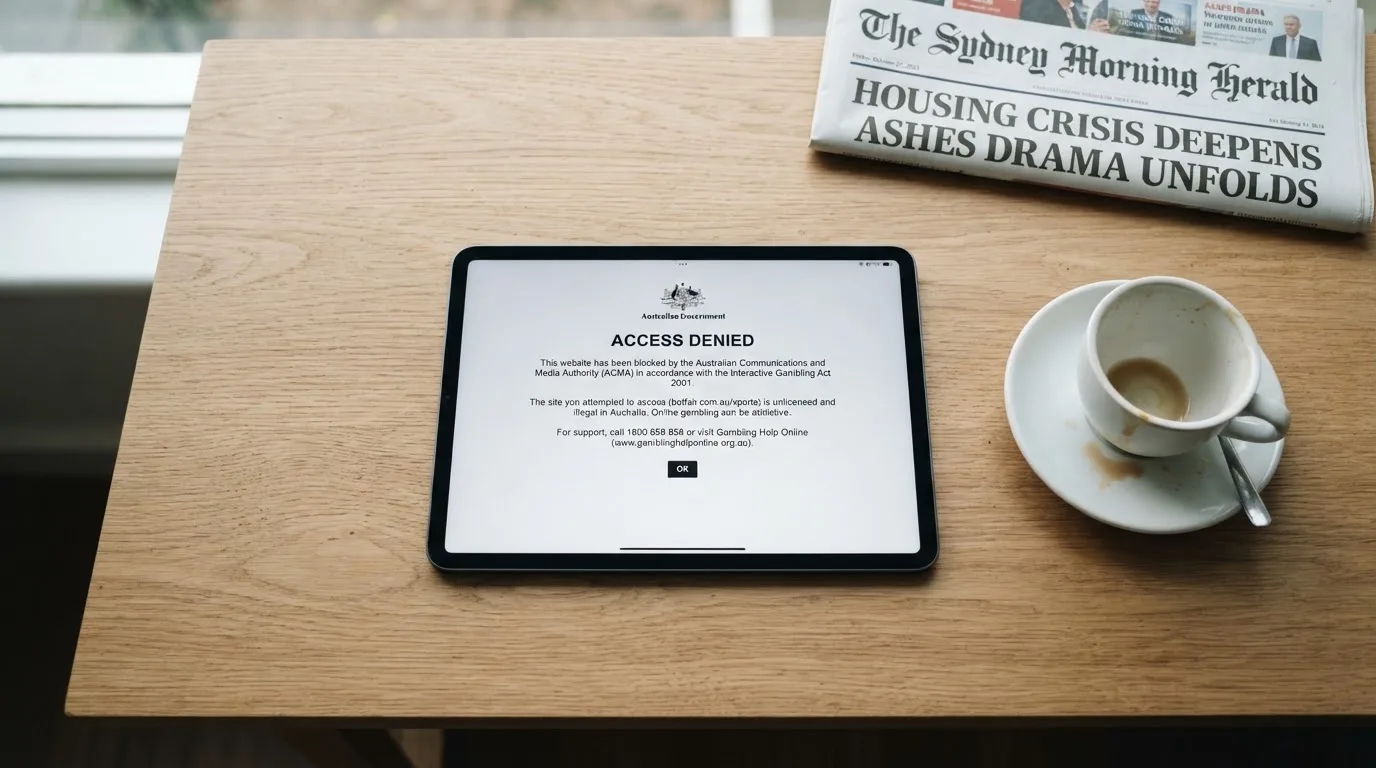
The IGA targets the provider, not the player. An Australian punter does not commit an offence by opening an account on an offshore site. The site does, and the consequences flow to the site. That asymmetry is what keeps the offshore market alive: the consumer-side enforcement is essentially zero, so the demand side of the market does not adjust. The cost of the asymmetry lands elsewhere — on players who find their balance stranded when the site is blocked, on the regulator that has to issue a fresh blocking request for every new mirror, and on the legitimate Australian wagering sector that competes with offshore marketing while paying full Australian tax on revenue the offshore side simply does not.
The Interactive Gambling Amendment (Gambling Reform) Bill 2026 passed Parliament on 19 August 2026. Its advertising and inducement measures commence on 1 January 2027 — law with a start date, not yet in force on a page read in 2026. Until those measures take effect, an inducement is governed by the existing rules: the ACMA can and does act against operators running prohibited inducements, and the published register of formal warnings is the public record of those actions. The eleven names in the table below all sit on that register.
Enforcement as it has actually played out
The ACMA’s tools are investigation, formal warning, and direction to internet service providers to block. The first blocking request went to ISPs in November 2019. The cumulative count of blocked illegal gambling and affiliate marketing sites reached 1,751 by the middle of 2026, and twelve more names were added in a single round reported on 26 June 2026 — 7Signs, ChromaBet, Donbet, Duospin, Freshbet, Slots Gem, Jacks Club, Lucky Start, Pointsbetz, Spinrise, Vinyl Casino and Wildsino. The list is also a portrait of how the offshore market moves: when one skin is blocked, another opens on the same backend, and the regulator re-issues a blocking request for the new domain. The number is high because the re-issuance rate is high.
A formal warning is the step before blocking. The ACMA publishes each warning with the operator name and the date. The pattern is consistent: a single operator often runs several skins, and a warning over one skin is usually followed within months by a warning over another, because the underlying conduct — supplying prohibited casino games and inducements to Australians — has not changed. Dama N.V. was warned in May 2022 over six casino brands — Bambet, Dazard, Level Up, Rocketplay, Wild Tornado and Cobra Casinos — and was warned again in March 2025 over Woo Casino and in May 2025 over Spirit Casino. TechSolutions (CY) Group Limited and TechSolutions Group N.V. were warned in 2022 over Bizzo Casino; Consolutetish S.R.L. was warned in July 2025 over National Casino and Bizzo Casino. Bamboo Media was warned in July 2025 over Ignition Casino. EOD Code SRL was warned in February 2025 over Instant Casino. Sterplay Holding Ltd was warned in April 2025 over Casino Intense. Hollycorn N.V. was warned over Sky Crown and Blue Leo. Ryker B.V. was warned in April 2026 over Jackbit and CasinOK. Pulsup Ltd was warned in March 2026 over Rocketplay. The list of operators is short; the list of skins is long, and the skins rotate.
Blocking is the regulator’s bluntest instrument. Once a site is blocked at the ISP level, the Australian audience can no longer reach it through a normal connection. The blocking holds for that domain until the site moves, and the site moves — which is why the cumulative count of blocked sites grows the way it does. Players with a balance on a blocked site are not refunded by the ACMA; the ACMA has no power to compel a refund from an offshore operator, and the operator’s own terms typically disclaim any obligation once a player has accepted a bonus. This is the asymmetry in practice: the operator keeps the marketing rights, the player keeps the loss.
The eleven ACMA-warned brands, side by side
The table below lists every offshore casino brand the ACMA has named in a formal warning published on its own register. The page’s editorial line is the same on every row: a casino promo code only exists where online casino games are supplied unlicensed, and every brand on this list is in that category. The column set is the matter of each warning, not the matter of each brand’s offer.
| Brand | ACMA action and date | Operator named by the ACMA | Subject support |
|---|---|---|---|
| RocketPlay | Formal warning, March 2026 (Pulsup Ltd); earlier May 2022 (Dama N.V.) | Pulsup Ltd, Dama N.V. | Listed by gambling trade sources; not endorsed |
| Level Up Casino | Formal warning, May 2022 | Dama N.V. | Listed by gambling trade sources; not endorsed |
| Woo Casino | Formal warning, March 2025 | Dama N.V. | — |
| Spirit Casino | Formal warning, May 2025 | Dama N.V. | — |
| National Casino | Formal warning, July 2025 | Consolutetish S.R.L. | Listed by Australian self-exclusion and regulator sources; not endorsed |
| Bizzo Casino | Formal warning, July 2025 (Consolutetish S.R.L.); earlier 2022 (TechSolutions) | Consolutetish S.R.L., TechSolutions (CY) Group Ltd, TechSolutions Group N.V. | Listed by gambling trade sources; not endorsed |
| Ignition Casino | Formal warning, July 2025 | Bamboo Media | — |
| Instant Casino | Formal warning, February 2025 | EOD Code SRL | Listed by payment-method pages; not endorsed |
| Jackbit | Formal warning, April 2026 | Ryker B.V. | — |
| Casino Intense | Formal warning, April 2025 | Sterplay Holding Ltd | Listed by gambling trade sources; not endorsed |
| Sky Crown | Formal warning, September 2022 | Hollycorn N.V. | — |
A “—” in the right-hand column means the page does not attach the subject support listing to that brand; either no Australian- or operator-published source was found in the research, or the page chooses not to cite an affiliate listing to fill a gap it would have to qualify. The decision to leave a cell empty is editorial: a write-up that announces a missing specification reads unfinished, and a write-up that fills a missing specification from a marketing source reads worse than that.
What the offer actually costs the player
A casino promo code looks like free money. It is not free money. It is a loan against future play, and the cost of the loan is the wagering requirement multiplied by the house edge on the games the player uses to clear it. The arithmetic is simple and the result is unflattering.
Suppose a site offers a 100 per cent match bonus up to A$500 with a 35× wagering requirement on the bonus. A player deposits A$500, the site credits A$500 in bonus funds, and the player must wager A$500 × 35 = A$17,500 before any bonus-derived winnings become withdrawable. At an average slot return-to-player of 96 per cent — a fair figure for an offshore site advertising mainstream providers — the expected loss over A$17,500 of wagering is A$17,500 × (1 − 0.96) = A$700. The headline was a free A$500; the expected cost of clearing that A$500 is A$700. The “free” money is, on average, A$200 more expensive than the deposit that produced it. This is the calculation the marketing page does not perform for you.
The same calculation reads worse under the conditions most offshore codes actually carry. A 50× wagering requirement on the deposit plus bonus takes the turnover to A$25,000, with an expected loss of A$1,000 against the headline A$500. A “no-deposit” code carries a headline of perhaps A$20 in bonus funds with a 60× wagering requirement and a maximum cashout of A$100: turnover A$1,200, expected loss A$48 to clear an offer whose maximum payout is roughly twice that. The arithmetic is the same each time, and the result is the same each time: the headline is a fraction of the cost.
The table of figures is not unique to one site; the structure is industry-wide. The only thing that varies between operators is how aggressively the conditions are stacked, and the Australian offshore market is at the aggressive end. A code is a sales tool, not a gift, and the conditions behind it are the price.
How fast the page turns off — the blocking rate, 2026
The ACMA’s first blocking request went out in November 2019. By the middle of 2026, the cumulative count of blocked illegal gambling and affiliate marketing sites was 1,751. That is the working arithmetic of the offshore market: the regulator blocks at a known rate, the offshore market re-opens on new skins at a higher rate, and the cumulative number climbs by a measurable fraction each quarter.
Treating November 2019 as month zero and the 26 June 2026 round as the most recent published figure, the regulator has added roughly 1,751 domains across about eighty months — an average in the order of twenty-two blocked domains a month, with the recent pace noticeably faster than the early pace. The exact number per month varies because blocking is reported in rounds rather than as a continuous stream, but the long-run shape is clear: the count has grown by a factor of more than five over the lifetime of the regime, and the December 2025 to mid-2026 window alone added several hundred entries. State the band rather than the figure: somewhere between twenty and thirty domains a month, with the rate running higher in recent rounds than in the first two years of enforcement. The recent round reported on 26 June 2026 — twelve sites in a single notice — sits inside that band.
The arithmetic is the page’s core message, and the policy implication is clear. A site blocked today is the same site on a new domain within weeks. A player who has accepted a bonus on a blocked skin has a balance that may or may not still be reachable through the operator’s other skins, and has no Australian complaints body to approach if the operator declines to pay. The blocking rate is the rate at which the Australian regulator removes access to the marketing surface; the re-skinning rate is the rate at which the offshore market restores that surface. They are not the same number, and the gap between them is the gap the player falls into.
How Australian payment rails treat the transaction
The credit-card ban on Australian-licensed online wagering took full effect on 11 June 2024; the same prohibition covers credit-related products and digital currency, and the regulator’s published penalty for a licensed operator accepting them is up to A$247,500. The ban does not reach an offshore casino, because the offshore casino is not licensed in Australia. It does reach the Australian’s bank.
ANZ, Commonwealth Bank and Westpac all offer gambling blocks at the card level. ANZ’s gambling block, activated in the ANZ app, blocks gambling transactions made through a digital wallet such as Apple Pay on an eligible card — not just the physical card. Once the block is on, removing it requires a 48-hour waiting period. The bank also warns that the block cannot guarantee every gambling transaction will be stopped, and that some non-gambling transactions may be blocked in error. Commonwealth Bank’s gambling lock in the CommBank app works similarly and carries the same “cannot guarantee” disclaimer. Westpac’s gambling block refuses authorisation of transactions registered under the merchant category code “Betting/Casino Gambling” on eligible personal credit and debit cards.
The reason the merchant category code matters is that it is how the bank identifies the merchant, not the player. The bank sees the MCC, declines the transaction, and the player sees a “transaction not authorised” message at the cashier. Apple Pay and Google Pay are not separate from the card underneath them in this respect: by the end of 2025 the three wallet schemes together accounted for around 45 per cent of all card payments in Australia by number, and the gambling block follows the card, not the wallet interface. The practical consequence is that an Australian trying to deposit at an offshore casino from a blocked card will see the deposit fail at the cashier rather than at the wallet.
The legal deposit routes for Australian-licensed wagering — debit card, bank transfer, PayID/Osko and BPAY — are the same set of instruments any Australian has in their everyday banking app. PayID shows the name of the account holder before a transfer is sent, and AP+ warns explicitly that being asked to transfer to a PayID on an illegal gambling site almost certainly means a scam site. Over 100 Australian financial institutions offer PayID-based instant transfers, and more than 25 million PayID identifiers were registered on the New Payments Platform as of April 2025. The instant transfer itself is fast — under a minute, 24/7 — but the receiving account is on a different audit trail from an Australian-licensed wagering operator’s account. AUSTRAC’s threshold-transaction-report rule of A$10,000 or more applies only to physical cash; ordinary electronic bank transfers are not subject to that per-transaction reporting requirement, regardless of the amount. The transfer still leaves a record in the sender’s bank statement, and the sender’s bank may apply its own monitoring.
Apple Pay and Google Pay add one more layer. Apple does not charge consumers a fee for using Apple Pay in stores, online or in apps; any surcharge comes from the merchant’s own card-processing fees. Apple states that transaction limits and PIN requirements are set by the card issuer or merchant, not by Apple itself — meaning the bank sits above the wallet in the chain of control. American Express, which issues cards and processes transactions itself as a three-party scheme rather than Visa or Mastercard’s four-party model, sits outside the Reserve Bank’s July 2025 proposal to remove surcharges on eftpos, Mastercard and Visa transactions. Amex cards are still subject to the issuing bank’s own gambling-block settings, but the scheme-level treatment of surcharging on gambling deposits is not the same.
The Reserve Bank’s July 2025 review proposes removing surcharges only on eftpos, Mastercard and Visa card transactions, explicitly leaving American Express outside the scope of the proposed surcharge ban. For an Australian punter using a Mastercard debit card to fund a deposit at a licensed wagering operator, this removes the surcharge; for an Amex-funded deposit at the same operator, the surcharge rule of the issuing bank still applies. The rule is about how a merchant is allowed to surcharge; it is not about whether a deposit is allowed in the first place.
The responsible-gambling layer, and where it does and doesn’t reach
Australian-licensed online and phone wagering services are connected to BetStop, the National Self-Exclusion Register, which has been live since August 2023. A player who registers with BetStop is excluded, by force of the operator’s licence conditions, from every Australian-licensed wagering service the register covers. The exclusion is the strongest consumer-protection tool Australia has at the federal level, and it does not extend to an offshore casino: an offshore operator is not licensed in Australia, has no obligation to consult BetStop, and has no obligation to honour a BetStop registration even if the player volunteers the information. An exclusion registered with BetStop is binding on the Australian-licensed side of the market; the offshore side is structurally outside its reach.
The same asymmetry holds for the National Gambling Helpline at 1800 858 858, free, 24/7, with chat available at Gambling Help Online. The helpline is staffed for Australian players regardless of where they play, and the operators of the helpline do not differentiate by licence status. State-level self-exclusion schemes and venue-based exclusion schemes cover land-based venues and, in some states, the licensed online wagering product, on the same model: the exclusion binds the licensed operator, not the offshore one. A player who has registered a self-exclusion and then opens an offshore account is relying on the offshore operator’s own voluntary honour system, and the published record of ACMA actions is not a record of operators that have volunteered to honour Australian self-exclusions.
The responsible-gambling layer is not a layer that closes off the offshore market. It is a layer that the offshore market does not plug into. A player thinking about an offshore promo code who has already self-excluded from Australian wagering is, from the offshore operator’s perspective, a player the Australian system has flagged; the offshore operator has no view of that flag. The Australian help services still answer the phone.
The individual brand entries
The eleven entries below are the eleven brands named in the ACMA register of formal warnings. Each one is in the same legal category as every other — an offshore operator that the ACMA has found to be supplying casino games to Australians. The differences are in the operator entity named by the ACMA, in the date of the warning, and in whether the ACMA had previously warned the same operator over a different skin. None of the eleven is a place the page recommends a reader play.
RocketPlay — two warnings, ten years of marketing
The ACMA warned Pulsup Ltd in March 2026 over Rocketplay. Dama N.V. was warned in May 2022 over Rocketplay and five other skins. The brand has been marketed into Australia for the entire life of the IGA enforcement regime, and the warning trail shows it: two named operators, ten years of marketing, the same prohibited product. The brand sits inside a long-running offshore network and carries a long-running ACMA record. A punter who values regulatory clarity is not the customer this brand is built for.
Level Up Casino — the 2022 cohort
The ACMA warned Dama N.V. in May 2022 over Level Up Casino alongside Bambet, Dazard, Rocketplay, Wild Tornado and Cobra Casinos. The 2022 cohort is the cluster the ACMA built its early warning practice around, and the cohort continues to feature in later warnings to the same operator — Dama N.V. was warned again in March 2025 over Woo Casino and in May 2025 over Spirit Casino. Level Up Casino is one of the older skins in a network that has not stood down.
Woo Casino — Dama N.V., March 2025
The ACMA warned Dama N.V. over Woo Casino in March 2025. The brand sits inside the same operator as Level Up Casino, but the warning is four years newer and is the operator’s second ACMA action. The 2022 warning covered six skins; the 2025 warning named one, with Spirit Casino following in May 2025. The pattern is the same pattern: the operator is the same operator, the skin is the new skin, the conduct is the conduct the ACMA has already found to be prohibited.
Spirit Casino — Dama N.V., May 2025
The ACMA warned Dama N.V. over Spirit Casino in May 2025. The warning follows the Woo Casino warning by two months and is consistent with the regulator’s practice of grouping follow-up actions against the same operator. A player who picked Spirit Casino on the assumption that a 2025 entry was a “cleaner” skin than a 2022 entry has read the operator name without reading the regulator’s history with the operator name.
National Casino — Consolutetish S.R.L., July 2025
The ACMA warned Consolutetish S.R.L. over National Casino in July 2025. The warning is paired with the Bizzo Casino warning issued to the same operator on the same date, and Consolutetish S.R.L. is the most recent entity to surface in the ACMA register. The brand also appears in listings indexed by Australian regulator and self-exclusion sources, which means the marketing footprint is wider than the warning trail would suggest.
Bizzo Casino — two operators, two warnings
The ACMA warned Consolutetish S.R.L. over Bizzo Casino in July 2025. TechSolutions (CY) Group Limited and TechSolutions Group N.V. were warned in 2022 over the same brand. Two operator entities, two warnings, four years apart, the same prohibited product. The brand has moved between operator structures in the period between the two warnings and has surfaced under both. A player who saw only the 2025 warning has seen half the file.
Ignition Casino — Bamboo Media, July 2025
The ACMA warned Bamboo Media over Ignition Casino in July 2025. The brand is one of the older offshore skins marketed into Australia and has cycled through operator structures over its lifetime. The 2025 warning is the regulator’s most recent action on this brand and is part of the same July 2025 cluster as National Casino and Bizzo Casino.
Instant Casino — EOD Code SRL, February 2025
The ACMA warned EOD Code SRL over Instant Casino in February 2025. The brand sits inside a payments footprint that includes Australian-relevant payment-method pages, which means the marketing surface is wider than the ACMA warning alone would suggest. A “casino promo code” landing page for Instant Casino is reachable through several affiliate channels; the regulator’s view of the underlying site is in the formal warning.
Jackbit — Ryker B.V., April 2026
The ACMA warned Ryker B.V. in April 2026 over Jackbit and CasinOK. The warning is one of the most recent on the register and is the second of the two actions issued in 2026 alongside the March 2026 Pulsup Ltd warning over Rocketplay. Jackbit markets aggressively into Australia through affiliate channels and has accumulated a following among crypto-funded players; the ACMA action does not change the marketing, it changes the regulator’s public record.
Casino Intense — Sterplay Holding Ltd, April 2025
The ACMA warned Sterplay Holding Ltd over Casino Intense in April 2025. The brand is named in listings indexed by gambling trade publications and by Australian regulator and self-exclusion sources. The warning is mid-period and fits the operator-rotation pattern visible across the rest of the register: a single operator runs several skins, and the ACMA names the operator once and the skins one at a time.
Sky Crown — Hollycorn N.V., September 2022
The ACMA warned Hollycorn N.V. over Sky Crown and Blue Leo in September 2022. The brand is the oldest on the register among the eleven and has not been re-warned under the same operator, although Hollycorn N.V. has surfaced in other regulatory actions in other markets. The 2022 warning has not been upgraded to a blocking request against the Sky Crown skin in the published rounds the page cites, which is not the same as a clean record: a warning remains on the regulator’s file.
How a reader should think about the offer
A promo code is a marketing handle on a prohibited product. The product itself is barred from being supplied to a person in Australia; the marketing handle does not change that, and the licence displayed in the site’s footer does not authorise the supply. The arithmetic of the offer — the wagering requirement times the house edge — produces an expected cost that exceeds the headline value of the bonus in the typical case. The enforcement record shows the regulator acting against the operator, not the player, and the consumer-protection layer — BetStop, the helpline, the state exclusions — binds the Australian-licensed side of the market and not the offshore one. A player who decides to ignore all of that is a player the offshore market is built for; a player who reads the offer carefully first is a player the offer was built to overcome.
The page’s last word is not “don’t”. The page’s last word is the cost. The cost is on the page; it is in the arithmetic; it is in the regulator’s file; it is in the responsible-gambling layer that does not reach the offshore side; and it is in the card-level gambling block that may decline the deposit before the cashier even shows the bonus field. A casino promo code in Australia is a thing that exists because the marketing has an audience and the law has a limit, and the distance between the two is the space the offer lives in.
Frequently asked questions
How does a casino promo code differ from a permanent welcome offer?
A permanent welcome offer is whatever the homepage displays by default and is usually applied at deposit with no entry required. A promo code is a string the player must enter — at sign-up, at the cashier, or in a bonus field — and the string exists so the operator can attribute the player to a specific acquisition source. Functionally the player sees the same kind of credit; commercially the code is the mechanism that lets an operator run a sharper offer to a known channel without lowering the headline rate on the public page.
Are promo-code offers from offshore casino sites subject to any Australian consumer protection?
No. The Interactive Gambling Act 2001 prohibits the supply of online casino games to a person in Australia, and offshore operators are not licensed in Australia. There is no Australian complaints body with jurisdiction over an offshore operator, no Australian recourse if a withdrawal is refused, and no guarantee that a balance on a blocked skin is recoverable. The ACMA’s tools are investigation, formal warning and directing ISPs to block; the ACMA does not refund player balances and does not arbitrate disputes with offshore operators.
What’s a common maximum-bet restriction attached to promo-code winnings?
Most offshore codes carry a maximum-bet rule during the bonus — typically a ceiling on the size of any single spin or hand while the wagering requirement is being cleared. Exceeding the ceiling, even once, voids the bonus and any winnings derived from it. The exact figure varies by operator and is in the terms; a player who has not read the terms has not read the rule that decides whether the bonus pays out.
Can a promo code be combined with another offer at the same offshore site?
Usually no. The standard practice is one bonus at a time: activating a new code forfeits the active bonus and any progress toward its wagering requirement, and any winnings tied to the forfeited bonus are voided. The terms page names the rule in language that varies, but the practical effect is consistent across the offshore market. A player intending to switch offers mid-session should expect to forfeit the active one.
Why do promo codes often carry a short expiry window?
Because the code is a marketing instrument, and the marketing instrument is a discount on the headline offer. The longer the code is live, the more players the operator acquires at the discounted rate instead of at the standard rate, and the less the operator learns about which channel actually delivered the player. Expiry windows of seven to thirty days from issue are common, and the expiry applies to both the code itself and to the wagering requirement once a player has activated it. A code left unused expires; a code activated but not cleared expires; a code cleared and withdrawn expires too.
What should an Australian do before entering any personal details on an offshore promo page?
The first check is whether the operator is licensed to supply casino games to a person in Australia. Under the Interactive Gambling Act 2001, the answer for an offshore casino is no, regardless of the licence displayed in the footer. The second check is whether the player’s own bank card carries a gambling block and whether the wallet used to fund the deposit sits inside that block. The third check is whether the player has a BetStop registration or a state-level exclusion; if so, the offshore operator has no obligation to honour either. The fourth check is the terms page: wagering requirement, maximum bet during the bonus, game contribution, expiry window and maximum cashout. The arithmetic of those terms against the headline value of the offer is the cost of the offer, and reading them is the only way to know that cost before paying it.
Casino promo codes in Australia in 2026 — More on this topic at casino banking.
See also Casino VIP programs in Australia 2026.