
Instant payout online casinos in Australia: the marketing, the mechanics, the cost
The phrase “instant payout” is a marketing word built around three things Australian readers are told to want — speed, choice of payment rail, and a seamless return of winnings from an online casino. None of those things is the problem. The problem is the site itself: online casino games cannot be licensed anywhere in Australia. The Interactive Gambling Act 2001 prohibits the supply of those games to anyone physically in the country. Every site on the market that markets “instant payout” to an Australian reader is doing so from offshore, on an unregulated footing, with no Australian licence behind it. The Australian Communications and Media Authority has issued formal warnings against every operator reviewed below and continues to direct Australian internet service providers to block illegal gambling websites. That is the frame the marketing never reaches, and it is the cost the marketing does not price.
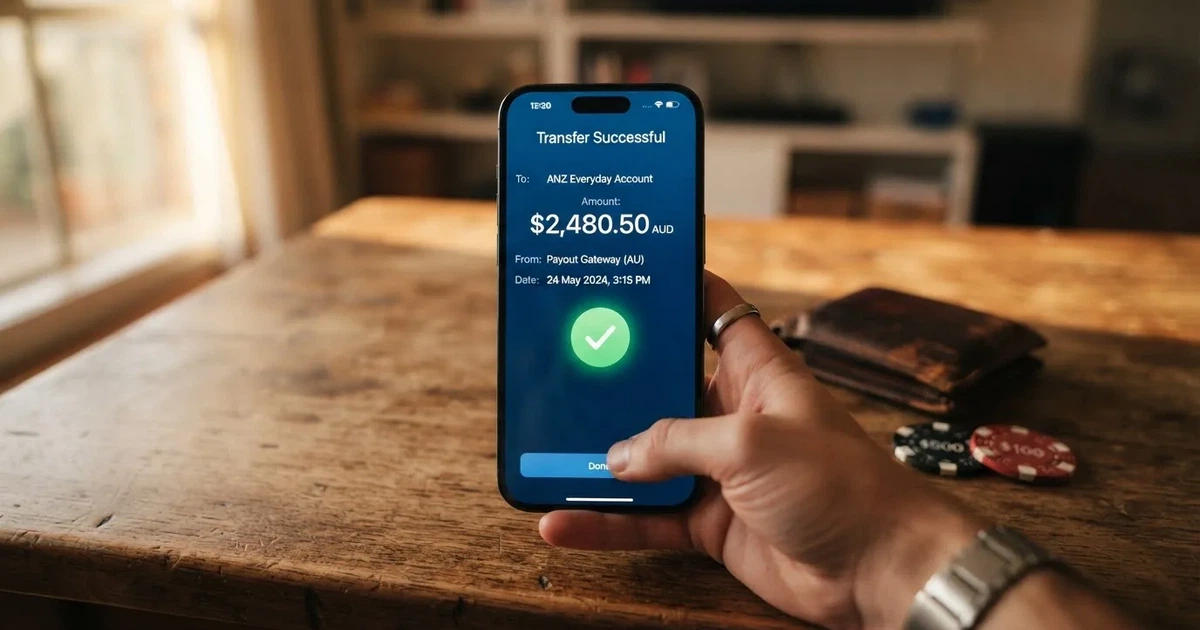
This page works through the gap. It opens with the responsible-gambling tools that bind Australian-licensed operators and the offshore casinos they don’t, moves into why crypto is paired with the instant-payout pitch and what an actual crypto withdrawal involves, then walks through how money moves on the Australian side — Osko, PayID, BPAY, the card networks, the digital wallets, the bank-side gambling blocks — before lining up the eleven brands the ACMA has formally warned. The legal frame closes the page, with the blocking-rate figure as the page’s own calculation.
As of 24 October 2026 — operator licensing claims and ACMA action dates were verified against the ACMA’s register of formal warnings and blocking notices.
Table of Contents
Where protection starts and stops: BetStop and the offshore gap
Responsible-gambling tools in Australia run on a small, well-defined set of mechanisms, all of them built around the licensed side of the market. The tool readers hear about most is BetStop — the National Self-Exclusion Register, run by the ACMA, live since August 2023. A person who registers with BetStop chooses an exclusion period — three months, six months, or up to a lifetime — and from the moment the registration is confirmed, every Australian-licensed online and phone wagering service is meant to refuse their bets, close their marketing access, and take down any saved payment details. The register is the lever that turns “I have a problem” into “the site will not take my money”. That lever does not reach the offshore casino marketing “instant payout” to an Australian reader.
BetStop is a condition of an Australian wagering licence. An offshore operator holds no such licence, sits outside the register, and is under no obligation to honour an exclusion made on it. A reader who has registered with BetStop is protected from licensed operators only. The same is true of deposit limits, time-out features, activity statements, real-time-balance displays, and the rest of the responsible-gambling toolkit that licensed wagering services and licensed pokies venues are required to offer. Offshore casinos typically run their own version of self-exclusion on their sites — a button somewhere in the account settings — but the obligation is internal, the enforcement is theirs, and there is no Australian regulator to write to if they ignore a request. The toolkit a reader has at a domestic site does not travel to the offshore site.
The phone a player in distress reaches for is the National Gambling Helpline, on 1800 858 858 — free, answered around the clock, with a chat service at Gambling Help Online. The helpline is the right call regardless of where the gambling took place. What it does not do is recover a withdrawal that an offshore site has chosen to delay, refuse, or void. That gap belongs to consumer protection, and there is none for an Australian reader at an unlicensed site. A complaint about a balance stuck at an offshore casino is not a complaint an Australian regulator can take up — the regulator has no jurisdiction over the operator, and the operator’s own dispute process is the only process on offer.
The bank-side layer
A second layer of protection sits one step further from the gambling site, at the Australian bank. It is not a feature of any responsible-gambling code; it is a card-network feature the banks have turned into a gambling-control product. Westpac’s gambling block works at the card level: it refuses authorisation of transactions registered under the merchant category code for betting and casino gambling, on eligible personal credit and debit cards. The block is set in the bank’s online banking, applies to the card number rather than to the merchant, and runs without the merchant being told why a transaction has been declined.
ANZ’s gambling transaction block, activated in the ANZ app, works similarly but with two differences a reader should know. First, it extends to a digital wallet such as Apple Pay on an eligible card, not just to the physical card — so an Apple Pay transaction on a blocked ANZ card is meant to be blocked too. Second, removing the block requires a 48-hour cooling-off period after the request is made; the bank imposes the delay so a reader cannot switch the block off in the heat of the moment. ANZ also warns that not all gambling transactions will be caught and some non-gambling transactions might be blocked in error. The warning is honest: merchant category codes do not classify every gambling merchant correctly, and the false-positive rate is part of the product.
Commonwealth Bank offers a gambling lock on eligible cards via the CommBank app, with the same caveat that not every gambling-related purchase can be guaranteed to stop. Each of these products is a barrier between the Australian reader and the offshore casino, not a feature of the casino itself. The casino sees a deposit attempt — sometimes accepted, sometimes declined — and that is the limit of how the bank-side layer intersects with the offshore product. The “instant payout” marketing does not mention it.
Where the gap actually sits
The protection gap is structural, not a feature that can be patched. BetStop binds licensed wagering. The bank-side blocks stop transactions at the merchant-category level. The helpline answers the phone. None of those things reaches into the offshore casino’s treasury to enforce a withdrawal the casino has approved, to compel a casino to honour a self-exclusion request, or to compel a casino to release a balance before the Australian internet service provider blocks the domain. The instant-payout pitch is honest about the speed and silent about the gap, and the cost of that silence is paid by the reader on the day a withdrawal stalls, an exclusion request is ignored, or a balance is stranded behind a network-level block.
Crypto and the instant-withdrawal promise
The phrase “instant payout” sits next to the word “crypto” in most affiliate listings for a reason: the marketing claims the settlement happens on a blockchain, where a transfer can be confirmed in minutes. The reality is messier, more expensive for a reader who walks in expecting what the listing says, and tied up with the legal frame in a way the marketing rarely names.
A cryptocurrency withdrawal is not a single transaction. It is three legs run in sequence. First, the casino’s treasury approves the release of funds — an internal step queued behind Know-Your-Customer checks, withdrawal limits, wagering requirements on any bonus, and “anti-fraud” reviews the casino may run. Second, the blockchain network confirms the transfer — a leg determined by the coin, the network’s load at the time, and the fee the sender has attached. Third, the recipient’s wallet or exchange credits the deposit — a leg determined by the recipient’s own wallet or exchange, and the number of confirmations it requires before crediting. Each leg has its own delay and its own failure mode.
The middle leg is the one the marketing speaks to. A Bitcoin confirmation on a quiet day can be under an hour; on a busy day, with the mempool congested and the fee market high, it can stretch into many hours. Ethereum’s mainnet runs faster, but the gas fee to move value varies with network conditions, and a low-fee transaction can sit pending for hours. Stablecoins on faster chains — USDT or USDC on networks other than Ethereum — are quicker and cheaper, but the casino has to support that coin and that chain, and the reader has to find an exchange or wallet willing to accept it without an Australian-dollar on-ramp that surfaces the source of funds. None of this is the casino’s choice. All of it is the price of using a public blockchain to move money. The cost of “instant” on crypto is the cost of choosing a coin and a chain that suit the moment, paying the gas fee that comes with it, and accepting that the on-chain leg is outside anyone’s control once the casino’s treasury has released the funds.
The licensed-operator ban
A separate cost sits on the Australian side. Under amendments to the Interactive Gambling Act 2001 that took effect in 2024, Australian-licensed online wagering services cannot accept payment by credit card or any credit-related product, and digital currency is treated as a credit-related product for these purposes. The restriction binds licensed operators only. A Northern Territory-licensed bookmaker cannot take a Bitcoin deposit from an Australian reader; an offshore casino marketing crypto withdrawals to Australian readers is operating outside the rule. A site asking for a Bitcoin or USDT deposit is doing so because it is not the kind of site that takes Australian rules seriously, and that fact is information a reader can use.
The protection gap that crypto does not close is the one that matters most. A blockchain transaction is final. There is no chargeback mechanism on a public chain, no card-network dispute process, no bank to call. If the casino’s treasury never releases the funds, the on-chain leg never begins, and the reader has no Australian complaints body to write to and no Australian regulator to escalate to. The instant-payout pitch on crypto is a pitch about the speed of the network. It is not a pitch about recourse if the casino withholds the winnings. That is the cost the marketing rarely names.
How money actually moves: PayID, Osko and the rest
The Australian retail-payments stack has a few moving parts worth naming, because every “instant payout” claim from an offshore casino eventually lands in this stack on the receiving end.
| Payment Method | Settlement Speed | Best For |
|---|---|---|
| Osko / PayID | Under a minute | Instant bank transfers |
| BPAY | Bill payment cycle | Bill payments |
| Card Payments | Standard settlement | Everyday purchases |
The leg the casino does not control is the leg the reader cares about most, and that leg runs on infrastructure built and operated in Australia, by Australian institutions, under Australian rules.
Osko is the instant-transfer service that runs on the New Payments Platform, the real-time gross settlement infrastructure that became accessible to the public on 13 February 2018. A bank transfer between participating Australian banks arrives in under a minute, twenty-four hours a day, seven days a week, addressed to a BSB and account number or to a PayID. PayID is the addressing layer on top of Osko: a phone number, an email, an ABN, or an organisation name that resolves to a bank account. Over 100 Australian financial institutions support PayID-based instant transfers. By April 2025 more than 25 million PayID identifiers had been registered on the platform.
The platform is run by Australian Payments Plus, the merger entity that brought NPP Australia, BPAY and eftpos together under ACCC authorisation in 2021, with the Reserve Bank of Australia and the country’s major banks as shareholders. Participants in the platform must keep monthly outages to no more than two minutes. It is a piece of Australian payments infrastructure — domestic, regulated, and owned by the banks the Australian reader already banks with. Offshore casinos cannot plug into it directly. What an Australian reader typically receives from an offshore casino is an Osko transfer from a local-facing Australian account the casino operates for the purpose, which is a different matter entirely.
The PayID name check
Two features of PayID matter for the instant-payout discussion. The first is that paying to a PayID shows the name of the account holder before the transfer is sent. Australian Payments Plus warns that being asked to transfer money to a PayID on an illegal gambling site almost certainly means a scam site. The warning is on the PayID page for a reason: the people most likely to ask a reader to send money to a PayID that resolves to a stranger’s account are running fraud, and an unlicensed offshore casino is not far from that pattern. A reader who sees “PayID” as a deposit option at an offshore casino should treat the deposit option as a flag, not a feature.
The second feature is the resolution itself. A PayID tied to a phone number or email is a thin identifier; the name returned is the name the bank has on file for that account. A mismatch between the name shown and the name the casino asks the reader to send to is a sign the casino is routing the deposit through a third-party account, which is what unregulated offshore sites do. The PayID name check is the closest thing the retail-payments stack has to a consumer-protection feature on the deposit leg.
BPAY and what it is for
BPAY sits alongside Osko and is sometimes confused with it. BPAY is a bill-payment service — the payer enters the Biller Code and the Customer Reference Number printed on a bill. It has been running in Australia since 18 November 1997, is available through more than 140 banks and financial institutions, and is offered by over 95,000 businesses. It is owned equally, via parent company Cardlink Services Limited, by Australia’s four major banks — ANZ, Commonwealth Bank, National Australia Bank and Westpac — and is run by Australian Payments Plus alongside Osko and PayID. BPAY is designed for paying bills, not for casino withdrawals. A reader who sees “BPAY” in an instant-payout context is usually looking at a deposit option to a licensed wagering service, not a withdrawal rail from an offshore casino. The use of BPAY in a casino deposit list is, more often than not, a sign the casino is taking Australian payment methods because it is trying to look Australian, not because it is regulated by anyone in Australia.
Digital wallets and the card surcharge landscape
Digital wallets are where a lot of the marketing effort goes, partly because they sit at the centre of how Australians actually pay. By the end of 2025, Apple Pay, Google Pay and Samsung Pay collectively accounted for around 45% of all card payments in Australia by number. Apple Pay itself does not charge a consumer fee; any surcharge comes from the merchant’s own card-processing fees, not from Apple. Apple also notes that transaction limits and PIN requirements are set by the card issuer or merchant, not by Apple.
For gambling specifically, the dynamic is different. ANZ’s gambling block extends to a digital wallet on an eligible card, not just to the physical card — so an Apple Pay transaction on a blocked ANZ card is meant to be blocked too. The bank-side blocks described in the responsible-gambling section above apply through the wallet when the underlying card is blocked. Apple Pay, Google Pay and Samsung Pay are not separate gambling-control products; they are pass-throughs for the card they wrap.
American Express sits outside most of this picture. Unlike Visa and Mastercard’s four-party network, Amex traditionally issues its own cards and processes its own transactions, dating back to its first charge card on 1 October 1958 and the company’s origins as a freight-forwarding business established in 1850. The Reserve Bank of Australia’s July 2025 review of merchant card payment costs and surcharging proposed removing surcharges only on eftpos, Mastercard and Visa transactions, explicitly leaving American Express outside the proposed surcharge ban. A reader who pays with Amex is paying under a different cost structure from a reader who pays with eftpos or Mastercard. The surcharge is not part of the instant-payout calculation on the receiving side, but it is part of the cost on the deposit side, and Amex’s exclusion from the surcharge ban is a marker of how the card-network economics differ by brand.
One threshold-shaped rule sits in the background and rarely fires. AUSTRAC’s threshold-transaction-report rule requires reporting of transfers of A$10,000 or more, but applies only to physical cash. Ordinary electronic bank transfers are not subject to that per-transaction reporting requirement, regardless of the amount. The rule is not a barrier to instant payouts; it is a marker of which transactions the financial-intelligence system is actually watching, and a transfer of any size by Osko or PayID is not one of them.
What the marketing does not price
The cost of the speed the marketing promises is mostly elsewhere. It is in the merchant-category-code bank blocks that turn a deposit attempt into a declined card. It is in the surcharge Amex may charge on a deposit. It is in the verification step the casino runs before approving a withdrawal. It is in the consumer-protection gap that opens once the funds leave the casino and the bank’s role is over. None of those costs is visible in the phrase “instant payout”. Each of them is paid for by the reader, on a different day, in a different way.
The eleven brands the ACMA has named
The eleven brands below are not a recommendation and not a shortlist to play at. They are the operators the ACMA has issued formal warnings against for offering prohibited online casino games to Australians. Each row is a published ACMA action with the date the formal warning was issued, the operator entity the ACMA named, and what an Australian reader would otherwise encounter at the brand. No bonus terms are given: the only sources for those are affiliate marketing pages, and that is not the kind of evidence this comparison stands on.
| Brand | ACMA action and date | Operator named by the ACMA | Subject support |
|---|---|---|---|
| RocketPlay | Formal warning, March 2026; earlier warning, May 2022 | Pulsup Ltd (March 2026); Dama N.V. (May 2022) | Crypto — per affiliate listings |
| Level Up Casino | Formal warning, May 2022 | Dama N.V. | — |
| Woo Casino | Formal warning, March 2025 | Dama N.V. | — |
| Spirit Casino | Formal warning, May 2025 | Dama N.V. | — |
| National Casino | Formal warning, July 2025 | Consolutetish S.R.L. | Per regulator listings at ACMA, AUSTRAC and BetStop |
| Bizzo Casino | Formal warning, July 2025; earlier warning, 2022 | Consolutetish S.R.L. (July 2025); TechSolutions (2022) | Per affiliate listings |
| Ignition Casino | Formal warning, July 2025 | Bamboo Media | — |
| Instant Casino | Formal warning, February 2025 | EOD Code SRL | EcoPayz and PayID — per affiliate listings |
| Jackbit | Formal warning, April 2026 | Ryker B.V. | — |
| Casino Intense | Formal warning, April 2025 | Sterplay Holding Ltd | Per regulator and affiliate listings |
| Sky Crown | Formal warning, September 2022 | Hollycorn N.V. | — |
Every row carries the same bottom line — the offering is a prohibited interactive gambling service, no Australian licence covers it, whatever licence the site displays — and different dates, different operator shells, different scale. The detail below each row is where the differences live.
RocketPlay
RocketPlay is the brand the ACMA has named twice, under two different operator entities. The first formal warning, in May 2022, named Dama N.V. as the operator alongside five other casino brands. The second, in March 2026, named Pulsup Ltd as the operator of RocketPlay specifically. Affiliate listings report crypto support on the brand; that is what those listings say, and nothing more. The same brand appearing twice under different operators is the operator-jumping pattern that the ACMA’s enforcement record is built around: a brand is warned, the warning does not produce compliance, the operator changes the corporate envelope, and a fresh warning is issued against the new envelope.
The cost to a reader is the cumulative one. A reader who chose the brand in 2022, accepted the warning as resolved, and saw the same brand active in 2026 has been sold the same product through the same marketing under a different operator’s letterhead. The licence the site displays has not changed. The Australian status of the offering has not changed. What changed was the corporate shell behind it.
Level Up Casino
Level Up Casino was named in the same Dama N.V. warning round as RocketPlay, in May 2022. The Westpac gambling-block page lists the merchant category codes it will not authorise; that is the context in which Westpac’s site mentions the brand, and the listing reflects the bank’s own transaction-monitoring rather than any endorsement of the brand. There is no Australian licence behind Level Up Casino. The Dama N.V. warning round covered six brands, and readers comparing across the set will see the same operator name recur across them. A brand under one operator is, in practice, a brand in a chain the operator can rotate.
Two Dama N.V. settlements: Woo Casino and Spirit Casino
The ACMA issued further formal warnings to Dama N.V. in 2025 — over Woo Casino in March 2025 and over Spirit Casino in May 2025. Both warnings name the same operator entity that the May 2022 round named for six other brands, including RocketPlay and Level Up Casino. The pattern is consistent: the operator has been warned repeatedly, the brands keep rotating, and each new formal warning carries a different brand name on the same operator’s letterhead. There is no Australian licence for either brand. The operator sits outside Australian jurisdiction regardless of the licence the site displays.
The cost to a reader is the gap between the marketing of two separate brands and the reality of one operator behind both. A reader who feels confident because they have not heard of the brand has not heard of one name on a longer list; the operator has heard of the ACMA, and the ACMA has heard of the operator.
Three fundamental cases: National Casino, Bizzo Casino and Ignition Casino
In July 2025 the ACMA issued formal warnings over three more brands: National Casino and Bizzo Casino, both operated by Consolutetish S.R.L., and Ignition Casino, operated by Bamboo Media. Bizzo Casino had already been the subject of a 2022 formal warning to TechSolutions (CY) Group Limited and TechSolutions Group N.V., a second warning three years on, an escalation the ACMA’s register records. National Casino is named in regulator listings at the ACMA, AUSTRAC and BetStop; Bizzo Casino is named in affiliate listings; Ignition Casino appears in this set once. None of them is licensed in Australia. None of them has consumer protection available to an Australian reader.

The cost to a reader is the warning churn: a brand warned under one operator in 2022, warned again under a different operator in 2025, and continuing to operate in between. The two warnings do not mean the brand was shut down between them. They mean the operator changed the envelope and the ACMA’s enforcement record kept up.
A prohibition case: Instant Casino
In February 2025 the ACMA issued a formal warning to EOD Code SRL over Instant Casino. The name is a tell — “instant” is right there in the brand, in the slot the marketing word “instant payout” usually occupies. Affiliate listings mention ecoPayz and PayID in connection with the brand; PayID on a casino deposit is the warning AP+ itself issues, that a request to transfer to a PayID on an illegal gambling site almost certainly means a scam site. The ACMA’s formal warning sits four months before the listings caught up.
The cost to a reader is the marketing’s familiarity. A brand called Instant Casino, marketing instant payouts, with PayID on the deposit list, reads as a thing that knows what an Australian reader wants. The ACMA’s record shows what it actually is.
Jackbit
Jackbit was the subject of a formal warning in April 2026, with Ryker B.V. named as the operator. Jackbit is a crypto-native brand, marketed around that positioning, and is one of the more recent additions to the ACMA’s enforcement record. There is no Australian licence behind it; the marketing sits outside Australian consumer-protection law. The brand’s positioning as a crypto-first site is also the reason the Australian-licensed wagering side will not accept its deposits — the 2024 ban on credit-related products, including digital currency, is what closes the licensed side of the market to a crypto-native product like Jackbit.
Casino Intense
Casino Intense was named in a formal warning in April 2025, with Sterplay Holding Ltd as the operator. The brand appears in regulator listings at AUSTRAC and BetStop and in affiliate listings. Like the rest of the set, it is unlicensed in Australia. The relatively short list of named sources behind this brand matches a smaller operator footprint; smaller operators do not generate the volume of affiliate coverage a Dama N.V. brand does.
Sky Crown
Sky Crown was named in a formal warning to Hollycorn N.V., published in September 2022, alongside Blue Leo. Hollycorn N.V. has run several brands under the same warning envelope; the formal warning lists them together. There is no Australian licence covering any of them. The cost to a reader is the same as for the rest of the set, and the operating pattern is consistent: one operator, several brand names, a single formal warning naming them together.
What “instant payout” actually means
“Instant payout” is a marketing phrase with three pieces inside it: the casino’s own approval of the withdrawal, the payment rail that carries the money, and the consumer-protection layer on the receiving end. The first two are where the speed lives. The third is where the cost lives.
The casino’s approval step is the most variable leg. Most offshore sites will say the withdrawal is processed “within 24 hours” or “instantly” in their marketing, and that is roughly the upper bound for the approval step — once Know-Your-Customer documents are on file, once any bonus wagering requirements have been cleared, and once any per-transaction cap or per-week cap has been respected. The first withdrawal typically takes longer than later ones, because the casino runs the verification for the first time. Subsequent withdrawals, on the same account, can be quicker. None of this is automatic; every withdrawal is a fresh approval decision by the casino’s treasury, and “instant” describes the upper bound on a smooth run, not the median experience.
The payment rail is the part the marketing is honest about, at least in part. If the rail is Osko on the Australian side, the transfer from the casino’s Australian-facing account to the reader’s account does land in under a minute. If the rail is a card, the transfer goes through the card network and takes the network’s standard settlement time. If the rail is crypto, the transfer is on-chain, and the network conditions at the time determine the leg. The fastest leg of an instant payout is typically not the one the casino controls. It is the one the Australian payments stack provides.
The verification step
The verification step is the most expensive in reader time. KYC documents — proof of identity, proof of address, sometimes proof of source of funds — are collected on the first withdrawal and reviewed against sanctions lists and PEP lists. The casino calls this a compliance step. From the reader’s side, it is a delay that can stretch from hours to days, and it is the single most common reason a “24-hour” withdrawal takes a week. A change of payment method, a large first withdrawal, or a flagged jurisdiction can each trigger a fresh review. Some sites also run “anti-fraud” reviews on withdrawals that follow a deposit made with a different method — a card deposit followed by a crypto withdrawal, for example, or a PayID deposit followed by a withdrawal to a bank account the casino has not seen before. The review is internal; the outcome is the casino’s; the reader has no Australian body to escalate to if the review stalls.
Wagering requirements, max cashout, and the bonus mechanics
Two clauses in the bonus terms of an offshore casino can each delay a withdrawal regardless of how fast the rail runs. Wagering requirements — the multiple of the bonus amount the reader must wager before the bonus, and any winnings from it, becomes withdrawable — are the first. A bonus with a 40x wagering requirement on a A$100 bonus requires A$4,000 of wagering before the bonus converts to withdrawable cash, and the wagering must be on eligible games, at eligible stake sizes, within the time window the bonus sets. Max-cashout clauses are the second: a bonus may be capped at a maximum withdrawal amount, often a small multiple of the bonus, regardless of how much the bonus wins. Both clauses are common in offshore casino terms; both are reasons a withdrawal can be queued, capped, or refused entirely.
The cost of these mechanics, to a reader who reads the bonus terms carefully, is the gap between the advertised bonus value and the amount that actually clears to withdrawable cash. The cost, to a reader who does not, is the surprise at the moment a withdrawal is approved, capped, or refused.
The cost of chasing speed
The cost of chasing speed, for an Australian reader, is the consumer-protection gap. The offshore casino that pays out in under an hour is the same offshore casino that has no Australian complaints body to answer to if a withdrawal is refused, no Australian regulator to escalate to if a balance is voided, and no Australian court of practical recourse if the site disappears with funds on it. The site can also be blocked by an Australian internet service provider at the ACMA’s direction, with the reader’s balance still on it. That is the bill for “instant”: the speed is real, the protection is absent, and the marketing does not mention the bill.
The legal frame and what enforcement has done
The frame around all of this is the Interactive Gambling Act 2001, the federal statute that prohibits the supply of online casino games to anyone in Australia. The 2017 amendments strengthened it; the 2024 amendments added the ban on credit cards and credit-related products as payment to licensed wagering; the 2026 reform bill — passed by Parliament on 19 August 2026 — adds further advertising and inducement measures that commence on 1 January 2027. None of these changes alters the underlying prohibition. Online casino games cannot be licensed anywhere in Australia; no state or territory licence covers them.
What can be licensed is wagering on races and sport placed before the event, lotteries and keno. In practice, much of Australia’s online wagering is licensed by the Northern Territory Racing and Wagering Commission, which regulates 52 of Australia’s online bookmakers — including Sportsbet, Bet365 and Ladbrokes — for tax reasons. The Commission has no full-time staff and meets once a month in Darwin. That is the de facto federal regulator of legal online wagering in Australia, and it regulates wagering only; it has nothing to do with online casino games, and the offshore brands the ACMA names do not pass through it.
The ACMA’s enforcement record
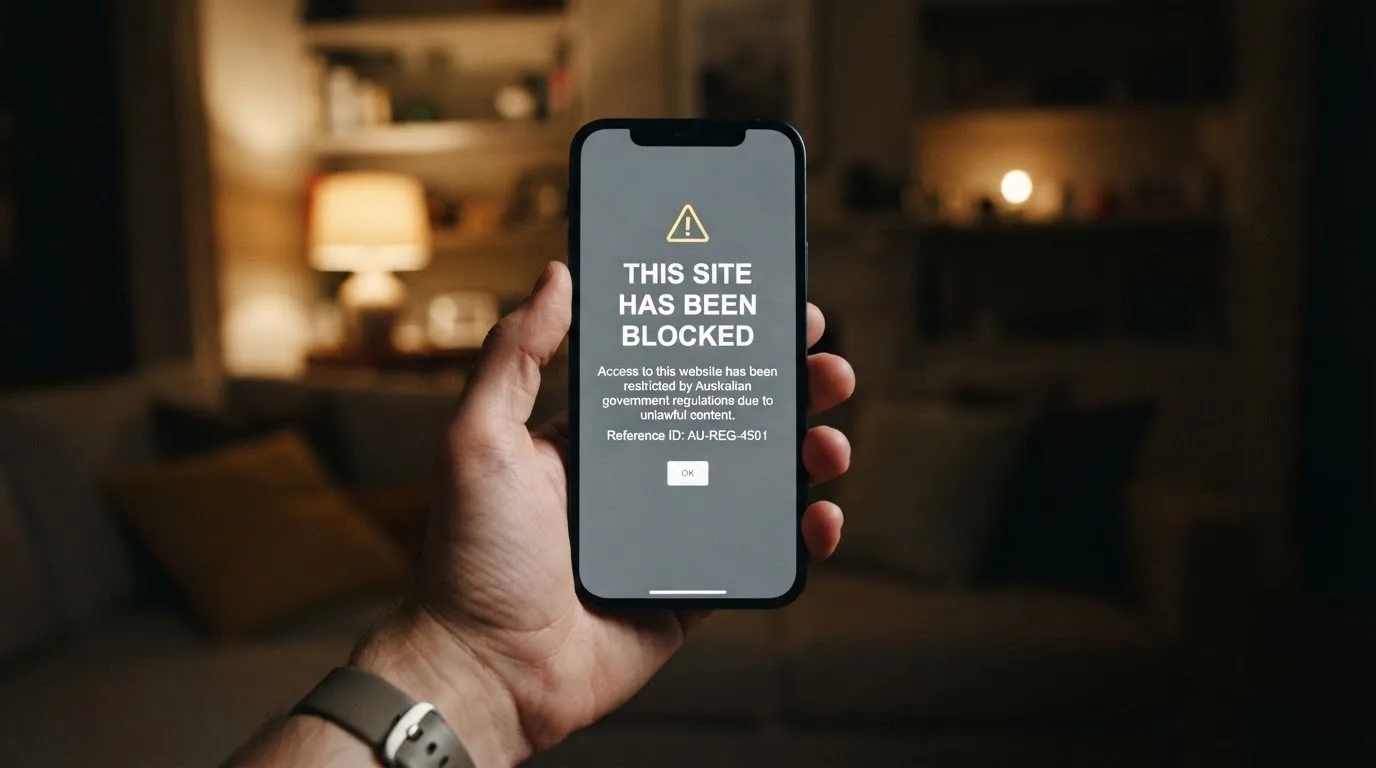
The enforcement arm is the ACMA. It investigates complaints, issues formal warnings, and directs Australian internet service providers to block illegal sites. By June 2026 the ACMA’s blocking record stood at 1,751 illegal gambling and affiliate marketing websites blocked since the first blocking request in November 2019, and more than 230 unlicensed gambling services had left the Australian market since enforcement was strengthened in 2017. The June 2026 round alone added 12 more websites to the block list: 7Signs, ChromaBet, Donbet, Duospin, Freshbet, Slots Gem, Jacks Club, Lucky Start, Pointsbetz, Spinrise, Vinyl Casino and Wildsino.
H2 Gambling Capital’s 2025 estimate puts Australian losses to illegal gambling sites at about A$3.9 billion a year, with the share of gambling going through legal channels falling from 74% in 2021 to 64%. The fall is the trajectory the legal frame is responding to: more Australians gambling, more of it through unlicensed sites, and the licensed side shrinking as a share of the total.
The blocking rate: the page’s calculation
Over the seven years from the first blocking request in November 2019 to the June 2026 total of 1,751 blocked sites, the ACMA has been adding to its block list at a rate of roughly 22 sites per month, or around 265 sites a year, the average across the full seven-year period, with monthly variation around it. Recent rounds have run larger; the June 2026 round alone added 12 sites, well within the average for a single month.
For a reader, the rate matters because it tells them what enforcement looks like in practice. The ACMA does not chase every site into court. It issues a warning, and where the warning does not produce a withdrawal from the Australian market, it directs a block. The reader’s experience of an “instant payout” site that gets blocked mid-session is the receiving end of that rate — the deposit cleared, the balance is on the site, the Australian internet service provider can no longer route traffic to the domain, and there is no Australian complaints body to write to. The pace the ACMA sets — roughly one block every 33 hours, day and night — is the pace at which the gap between “I deposited” and “the site disappeared” can close.
The individual player, and the limits of the protection
The individual player is not prosecuted. The Interactive Gambling Act 2001 targets the provider of the prohibited service, not the user. That is the protection the statute offers the player; it is also the limit of the protection the statute offers the player. The provider is offshore, often structured behind a chain of corporate entities that complicate jurisdiction, and the balance the reader has on the site is held under the site’s terms, not under Australian law. A reader with a complaint about a delayed or refused withdrawal has, in practice, no Australian recourse.
The 2026 reform bill adds advertising and inducement restrictions that commence on 1 January 2027 — law with a start date, not yet in force on a page dated 2026. The bill is part of the trajectory the legal frame is on; it does not change what is and is not licensed today. The same is true of the 2024 credit-card ban: a measure that binds licensed wagering, not the offshore casino marketing crypto deposits to Australian readers.
Tax
Tax is a separate layer. Under section 6-5 of the ITAA 1997, gambling winnings of a recreational player are not assessable income and losses are not deductible, unless the person carries on a business of gambling. That is the model; the ATO is the right place to check an individual situation. The tax rule is not a reason to play; it is a marker of what is and is not taxable when the gambling is recreational. The rule applies regardless of whether the gambling is at a licensed Australian wagering service or at an offshore casino — the income-tax treatment of recreational gambling is the same, and the consumer-protection treatment is where the two diverge sharply.
Where this leaves a reader
The legal alternative for an Australian reader who wants to place a wager sits on the licensed side: pre-event wagering with a Northern Territory-licensed bookmaker, a lottery or keno product, a land-based casino, or a licensed pokies venue. The “instant payout” pitch does not apply to any of these — pre-event wagering settles after the event, lotteries and keno pay on a draw schedule, and pokies pay at the machine. The marketing phrase belongs to the offshore site, and so does the legal gap.
The frame on this page is not “do not gamble”. It is: here is what the marketing of “instant payout” describes, here is what the law actually allows, here is what the ACMA has done about the gap, and here is the cost of the marketing’s silence. A reader who carries those four things with them is in a position to make a decision the marketing does not want them to make.
Frequently asked questions
How quickly does an offshore casino’s “instant payout” actually land?
The phrase covers three legs: the casino’s approval, the payment rail, and the receiving side. The fastest leg is typically the Australian rail (Osko via PayID, where supported, in under a minute). The slowest is usually the casino’s own verification step, which can stretch from hours to days on the first withdrawal.
Which Australian payment system handles bank transfers in under a minute?
Osko, the instant-transfer service on the New Payments Platform, settles bank-to-bank in under a minute, twenty-four hours a day, including weekends, addressed to either a BSB and account number or a PayID. Over 100 Australian financial institutions support it. PayID is the addressing layer — phone, email, ABN or organisation name — that sits on top.
Is it lawful for an unlicensed casino to market instant payouts to Australian readers?
Advertising a prohibited interactive gambling service to an Australian reader is itself the conduct the ACMA takes action against. The Interactive Gambling Act 2001 prohibits the supply of online casino games to anyone in Australia, and the ACMA’s formal-warning record shows the regulator pursuing the marketing of those services to Australian readers.
How long does a crypto withdrawal really take, end to end?
It is not a single transaction. Three legs run in sequence: the casino’s treasury approves the release, the blockchain network confirms the transfer, and the recipient’s wallet credits the deposit. Network conditions determine the middle leg — Bitcoin can be under an hour on a quiet day, or many hours when the mempool is congested.
Does the speed of a payout tell a reader anything about whether a casino is legitimate?
Speed is not a marker of legitimacy. The ACMA’s record shows formal warnings against operators across multiple brand names, often under different corporate shells. The instant-payout pitch is most loudly made by offshore sites least connected to Australian consumer protection. A fast payout only makes the gap harder to notice while the money is moving.