
Live roulette with English-speaking dealers in Australia: the house edge, the prohibition and the real cost
Data current as of 24 October 2026 and verified against the ACMA’s published list of formal warnings and blocking requests.
A live dealer calling numbers in clear English sounds like the safest possible way to play roulette online. A real wheel, a real person, no software dice in the background. The reality for an Australian resident is less comfortable. The Interactive Gambling Act 2001 makes it an offence to offer online casino games — and that includes a live-dealer roulette stream — to a person physically in Australia. The dealer speaking English is a customer-comfort feature. It does not change what the offering is in the eye of the law, and it does not bring any of the eleven brands this page covers under a regulator a punter can complain to.
That single fact changes everything else on this page. The choice of wheel still matters for the maths. The English-dealer pitch is still worth understanding as a sales technique. The payment rails — PayID, bitcoin, the rest — still settle at their own speed. But every one of those mechanics lands on a transaction the ACMA can direct an Australian internet service provider to sever, on a balance that lives with an offshore operator, and on a complaint channel that does not exist.
Table of Contents
- What a “live dealer” actually changes
- The maths: single-zero versus double-zero
- Why “English-speaking dealers” is a sales pitch
- Payment rails: PayID, bitcoin and the rest
- Responsible play on a stream the regulator cannot see
- Crypto and anonymity: what bitcoin actually buys you on a live table
- The legal frame: the Interactive Gambling Act 2001 in plain language
- The ACMA record against the brands in this list
- What an Australian reader takes from this list
- Eleven operators, one product category, one legal verdict
- The mechanics a reader cannot change
- The cost-of-play calculation: how long it actually takes to drain the bonus
- Frequently asked questions
What a “live dealer” actually changes
A live roulette table streamed over the internet is a real wheel in a real studio, with a real human calling the result. The wheel is mechanically identical to the one in a Melbourne or Gold Coast casino. What changes is everything around it: the betting interface is a click instead of a chip on the layout, the table never closes, and the minimum bet can drop to a level a physical table cannot economically offer. The dealer being fluent in English is, in practice, a marketing line drawn through three things — table announcements, side-bet explanations, and the small talk the studio wants on camera — but none of them have any bearing on the mathematics of the wheel or on whether the stream itself is lawful to view from Australia.

What carries the analysis is the wheel type, the bet type, and the rules the specific table posts. Everything else is presentation.
The maths: single-zero versus double-zero
Paytables
| Bet type | Single-zero (European) payout | Double-zero (American) payout | House edge, single-zero | House edge, double-zero |
|---|---|---|---|---|
| Straight-up (single number) | 35 to 1 | 35 to 1 | 2.70% | 5.26% |
| Red / Black, Odd / Even, High / Low (even money) | 1 to 1 | 1 to 1 | 2.70% | 5.26% |
| Dozen or Column (2 to 1) | 2 to 1 | 2 to 1 | 2.70% | 5.26% |
| Two numbers (split) | 17 to 1 | 17 to 1 | 2.70% | 5.26% |
| Three numbers (street) | 11 to 1 | 11 to 1 | 2.70% | 5.26% |
The story is not in the columns — both wheels pay 35 to 1 on a single number, and a casual player rarely notices the second green pocket. It is in the row underneath. A double-zero wheel takes nearly twice as much from every bet, on average, because the casino’s edge is built into the gap between the true odds of hitting a number and what the table pays for that hit. A straight-up bet on a single-zero wheel is a 1-in-37 chance that pays 35 to 1; on a double-zero wheel the chance drops to 1-in-38 and the payout stays put. The same gap applies, in proportion, to every other bet on the layout.
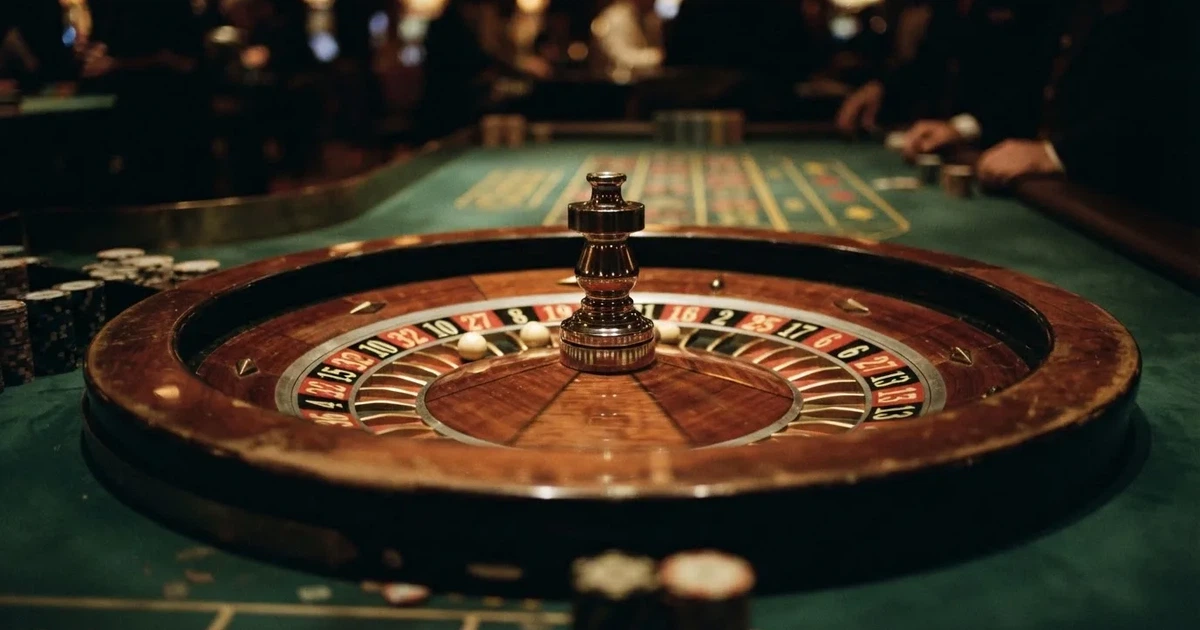
Some European tables soften that 2.70% further with two rules that only apply to even-money outside bets. Under “la partage”, the player loses half the stake when the ball lands on zero. Under “en prison”, the stake sits on the table for one more spin and is returned (without a win) if that spin also misses. Both rules roughly halve the effective edge on the bets they cover, leaving the rest of the layout unaffected. They are not universal — every studio decides which of its tables posts them, and a live stream may run one rule on the red/black layout and a different one two tables over.
A triple-zero wheel, with 0, 00 and 000 on a 39-pocket layout, sits further along the same curve at a 7.69% house edge. It is less common in mainstream studios than it was a few years ago, but it is not gone, and a table that does not announce its wheel type up front is not announcing it for the player’s benefit.
Why “English-speaking dealers” is a sales pitch
The dealer language sits in the same marketing slot as a welcome bonus and a VIP host. It answers the prospect’s question — will I understand what is happening? — without adding any feature that affects the result of a spin.
Three things the pitch tells the reader:
- The studio recognises that English is the working language of online gambling, and it has hired accordingly. For an Australian at home that means fewer misunderstandings during side-bet resolution and faster answers to “is this bet working?” questions in chat.
- The studio can run a table from a UK or European time zone, with a presenter whose natural register is the same one the player uses. A non-English table still announces results in running text on the screen; the spoken commentary is the additional layer.
- A house rule or a limit dispute gets explained in the player’s own language, which compresses a step that on a non-English table sometimes takes a chat window and a translator.
None of this changes the mechanical edge. A bet placed in clear English on a stream from a studio in Tallinn settles against the same 2.70% (or 5.26%) as the same bet placed on the same wheel under a dealer speaking Mandarin or Spanish. The pitch is value for nervous first-timers. It is not value for anyone pricing the table.
Payment rails: PayID, bitcoin and the rest
A live roulette payout goes through the same review queue as a slot withdrawal. What differs is the rail on the way in and the rail on the way out.
For an Australian using PayID, the rail is a real-time transfer between bank accounts over the New Payments Platform, settled in seconds once the casino releases it. The bottleneck is the casino’s pending period — typically 24 to 72 hours while the operator checks identity, source of funds and bonus terms — not PayID itself. Once released, the funds arrive in the player’s account in seconds; there is no clearing window to wait out at the bank end.
For an Australian funding a table with bitcoin, the rail is a blockchain transfer that may take minutes to confirm on the way in and a slower, often multi-stage manual process on the way out. Bitcoin casinos typically convert the deposit into a house balance on receipt; the payout is paid in bitcoin, with the casino acting as the exchanger. The conversion spread, the network fee and the casino’s own withdrawal review are the three layers of cost, and they are all drawn from the same balance that the wheel will, on average, drain at 2.70% a spin.
Either way, the rail does not change the wheel. The deposit clears faster on PayID; the withdraw queue is the same length on PayID. Bitcoin adds exchange-rate exposure on top of the table’s edge. Credit cards and credit-related products have been banned as a payment method for licensed online wagering since 11 June 2024, with penalties up to A$247,500 for operators who take them — a ban that binds licensed Australian wagering services and is ignored by every offshore casino on this list.
Responsible play on a stream the regulator cannot see
Responsible play is the section that is hardest to write honestly, because the responsible-play advice that exists in Australia is built for licensed wagering services, and an offshore live casino is, by definition, not one. BetStop — the National Self-Exclusion Register, live since August 2023 — binds Australian-licensed online and phone wagering services. It does not bind any of the operators on this page. A punter who has self-excluded through BetStop can still log into one of these sites, deposit, and play, because the offshore operator has no way to read the Australian register and no obligation to.
That is why the conventional responsible-play tooling does not translate cleanly. A session limit set inside the casino’s own software is enforced by that casino and by nobody else. A deposit limit set on a debit card belongs to the bank, not to the operator, and an offshore site is not going to refuse a deposit because the player’s bank would. The Gambling Help Online service and the National Gambling Helpline on 1800 858 858 are free, 24/7 and Australian — they offer counselling, financial advice and referral regardless of where the gambling happens, because the problem is the gambling, not the licence.
For a player on a live stream, the disciplined move is harder than it is on a slot machine, for a single mechanical reason. A slot machine is software and the spin is fast; a live roulette wheel takes longer between results, and the spin itself is visible from release to settle. The player watches the ball for ten or fifteen seconds and the mind looks for patterns — what colour came up, what dozen, what third of the layout. There is no pattern. Each spin is independent, the wheel has no memory, and the gambler’s fallacy is the official name for the thought that it does. A fixed loss limit, set before the stream is opened, is the one piece of responsible-play advice that the maths agrees with: stop at the limit, because the wheel does not care that the last three spins were black.
Crypto and anonymity: what bitcoin actually buys you on a live table
Bitcoin at a live roulette table changes the payment rail and nothing else. The wheel is the same physical wheel. The studio filming it is the same studio. The croupier calling the result is the same human. The only thing bitcoin alters is how the balance gets onto and off the table — and, by extension, who can see it.
For an Australian, that means three concrete differences from a card or PayID deposit, and they are mixed:
- Speed on the way in. A bitcoin deposit can clear in minutes; a PayID deposit is faster still. Neither beats the manual review on the way out.
- No bank statement line. A bitcoin deposit does not appear as “CASINO BRAND 14 MARCH” on a bank statement. The Gambling Help Online service reports that this is one of the cited reasons players prefer it, alongside the social privacy angle.
- No Australian consumer protection on the way out. A bitcoin withdrawal is an irreversible blockchain transaction. If the offshore operator delays, partial-pays, or simply refuses, the player has no local regulator to complain to and no chargeback route through a card issuer. The balance that left the casino’s wallet is gone.
The “anonymity” pitch understates the second and third points. It is accurate on the deposit — a card or PayID payment does leave a footprint a third party can read; a bitcoin transfer does not — but it is silent on what happens when the withdrawal stalls. For a punter in a jurisdiction that prohibits the offering in the first place, that asymmetry is the central fact about crypto on a live table: the privacy runs only one way.
The legal frame: the Interactive Gambling Act 2001 in plain language
Australia’s online gambling law is built around a single distinction: wagering on races and sport, placed before the event, may be licensed; online casino games — including a live-dealer roulette stream — may not. The Interactive Gambling Act 2001 (IGA), as tightened by the Interactive Gambling Amendment Act 2017, makes it an offence to provide online casino games, online pokies or in-play betting to a person physically in Australia. No state or territory issues an Australian licence for an online casino product, and there is no carve-out for a live-dealer stream.
The 2026 reform (the Interactive Gambling Amendment (Gambling Reform) Bill 2026, passed by Parliament on 19 August 2026) tightens advertising and inducement rules around what survives; those measures commence on 1 January 2027 and are law on paper but not yet in force on this page. They do not create an online casino licence. They constrain how licensed wagering services and their affiliates can market to Australians.
Enforcement of the IGA runs through the Australian Communications and Media Authority (ACMA). The ACMA investigates complaints, issues formal warnings under section 254 of the Act, and — most visibly — directs Australian internet service providers to block illegal services at the network level. A first blocking request was issued in November 2019; the cumulative count since then, as of the ACMA’s most recent published round in June 2026, is 1,751 blocked gambling and affiliate marketing websites, with more than 230 unlicensed services having exited the Australian market altogether since enforcement was intensified in 2017. The individual player is not prosecuted — the IGA targets the provider, not the customer — but the operator’s exposure is real and ongoing.
What this frame means for a punter in Australia:
- A live roulette stream from an offshore operator is an illegal offering under the IGA, irrespective of the licence the operator displays on its footer.
- The licence the operator shows — Curaçao, Anjouan, Kahnawake — is real as a foreign credential; it is not an Australian licence because none exist for this product.
- An Australian consumer protection body cannot compel a payout from an offshore operator. The operator has no registered presence in Australia, no Australian licensee to discipline, and no Australian bank account to seize.
- A blocking order can arrive while a balance is on the site. The site does not pre-warn its customers; it stops loading in Australian browsers, and the operator’s customer-service inbox stops being answered.
- BetStop, the National Self-Exclusion Register, binds the Australian-licensed wagering services an Australian can actually use. It does not bind these offshore operators.
The ACMA record against the brands in this list
Each brand below has been the subject of a formal warning under the Interactive Gambling Act 2001, issued by the ACMA and published on its website. The date given is the date the warning was issued; the operator named is the legal entity the warning was addressed to. None of the listed offerings is now lawful in Australia, and none is now licensed in Australia. The list is not a ranking and not a recommendation — it is the ACMA’s own published enforcement record against brands that have offered live roulette (and other casino games) to Australian residents.
| Brand | ACMA action and date | Operator named by the ACMA | Subject support |
|---|---|---|---|
| RocketPlay | Formal warning, March 2026 | Pulsup Ltd (RocketPlay), with an earlier warning to Dama N.V. in May 2022 | — |
| Level Up Casino | Formal warning, May 2022 | Dama N.V. | Listed by BGaming as carrying BGaming titles |
| Woo Casino | Formal warning, March 2025 | Dama N.V. | — |
| Spirit Casino | Formal warning, May 2025 | Dama N.V. | — |
| National Casino | Formal warning, July 2025 | Consolutetish S.R.L. | Listed in coverage references on Wikipedia |
| Bizzo Casino | Formal warning, July 2025 (earlier to TechSolutions, 2022) | Consolutetish S.R.L. | — |
| Ignition Casino | Formal warning, July 2025 | Bamboo Media | — |
| Instant Casino | Formal warning, February 2025 | EOD Code SRL | — |
| Jackbit | Formal warning, April 2026 | Ryker B.V. (covering Jackbit and CasinOK) | — |
| Casino Intense | Formal warning, April 2025 | Sterplay Holding Ltd | Listed in Australian media coverage and on the ACMA’s own pages |
| Sky Crown | Formal warning | Hollycorn N.V. (covering Sky Crown and Blue Leo) | — |
Several operators in the table sit under the same parent company. Dama N.V. accounts for four of the brands listed — RocketPlay, Level Up Casino, Woo Casino and Spirit Casino — and the ACMA’s warnings to that operator span from May 2022 through May 2025. Consolutetish S.R.L. accounts for two (National Casino and Bizzo Casino), both warned in July 2025 and with Bizzo also having been the subject of a 2022 warning to a different parent. The pattern matters: a parent with a published warning does not stop offering to Australians automatically, and a brand that has been warned once may continue to operate under a different licence or a different domain until that, too, is acted against.
The “subject support” column reflects what the underlying sources actually carry. A “—” marks a brand on which the page has no third-party confirmation of dealer language support and no listing entry that ties it specifically to live roulette; a non-dash entry means the brand appears in at least one third-party listing on the subject. The column is not a recommendation, and a brand with “—” is no less warned-against for the silence.
What an Australian reader takes from this list
The list is not a buyer’s guide. Each row is a brand that the ACMA has named publicly as the subject of a formal warning, and any balance a reader held at any of these operators sits outside the protections the Australian system has built up around licensed wagering. There is no recourse through the ACMA itself — the regulator’s mandate is to investigate providers, not to mediate player disputes — and no recourse through the operator’s own foreign licence if it is slow to pay, changes its withdrawal terms mid-flight, or simply stops answering email.
What an Australian who wants to gamble online can do, lawfully, is narrower than this list:
- Wager on a race or sporting event with an Australian-licensed bookmaker — Sportsbet, Ladbrokes, bet365 among them — licensed by the Northern Territory Racing and Wagering Commission. The commission has no full-time staff and meets once a month in Darwin, which is a fact the ABC has reported on directly.
- Buy a lottery ticket or a keno entry through a state-licensed channel.
- Visit a physical casino in a state or territory that licenses one — Crown Melbourne, for example, with table games regulated by the Victorian Gambling and Casino Control Commission since 1 July 2022.
For a punter whose interest is specifically in roulette, the lawful path is a physical table at Crown Melbourne, the Star Sydney, the Star Gold Coast, Crown Perth, or the equivalent in their state. Online, the lawful path closes at the door of any live roulette stream — Australian-licensed or otherwise — because no such stream is licensed in Australia. The English-dealer pitch is the customer-comfort feature on a product that does not exist in this jurisdiction, and the only version of the offer on this page is the offshore one the ACMA has been warning against for years.
Eleven operators, one product category, one legal verdict
RocketPlay — the most recent ACMA action on the list
RocketPlay is the brand on this page with the freshest ACMA action: a formal warning to Pulsup Ltd over RocketPlay in March 2026. That warning sits on top of an earlier May 2022 warning to a different parent (Dama N.V.) for the same product. Two warnings, three years apart, against the same brand is unusual in the public record and points to a brand that has continued to market to Australians after a first brush with the regulator. The page makes no claim about the brand’s current payment rails, bonus structure or game catalogue; the only verifiable fact here is the ACMA action itself, and a reader who arrived looking for a rocket-fuelled signup bonus would do better to read the ACMA’s warning notice than the affiliate marketing that surrounds it.
Level Up Casino — first formal warning against this parent
The May 2022 warning to Dama N.V. over Level Up Casino (along with five other brands) was one of the ACMA’s first actions against Dama, and it is the entry on this page that marks the operator as an established target of Australian enforcement. Background listings on third-party game-provider sites mention Level Up as a venue for a software provider’s catalogue, which tells a reader how the brand reaches punters but not whether the brand pays them. The closing line on Level Up is the same as on every brand on this page: it is unlawful to offer live roulette to a person in Australia, the ACMA has said so in writing, and the licence the operator displays overseas is not an Australian licence.
Woo Casino — the warning that escalated the Dama action
Woo Casino earned its own ACMA warning in March 2025, more than two years after the original Dama action. A second warning to the same parent for a different brand is not a duplicate; it is an escalation, and the regulator’s willingness to issue it again is the signal a reader should weight most heavily here. The mechanics — single-zero or double-zero wheel, payout table, side bets — are uniform with every other Dama-run live roulette studio, because the studios are shared infrastructure. What changes between brands is the marketing surface: welcome package, VIP tier, themed table lobby. None of those change the regulatory status of the offering.
Spirit Casino — the May 2025 warning
Spirit Casino’s warning arrived in May 2025, two months after Woo Casino’s. The two warnings, taken together, give the ACMA’s enforcement record a steady pulse against Dama N.V. over 2025. As with the other Dama brands on this page, the offering is the standard offshore live-dealer roulette product and the legal exposure is identical. A reader who arrived at Spirit Casino through an affiliate link would not have seen the warning before clicking through; an Australian regulatory record is not a marketing-blocked asset, and affiliate pages do not embed ACMA notices.
National Casino — a fresh entry under a new parent
National Casino’s formal warning was issued to Consolutetish S.R.L. in July 2025, alongside its sister brand Bizzo. A warning to a relatively new parent (compared with Dama) suggests the operator structure behind these brands was reorganised after the earlier round of warnings and is now under fresh regulatory pressure. The Wikipedia page for National Casino is what carries the brand on the third-party listing side; the regulatory page is what carries it on the subject of this article.
Bizzo Casino — warned twice under two parents
Bizzo is the only brand on this page that appears in two distinct ACMA warning records: the 2022 warning to TechSolutions (CY) Group Limited and TechSolutions Group N.V., and the July 2025 warning to Consolutetish S.R.L. Two warnings, two parents, one brand. That tells a reader the legal entity behind the brand has been rotated while the player-facing product has not been — a common pattern in the offshore market when an old parent becomes hard to bank. The product offering, the payout rails and the wheel offered are unchanged across the parent rotation; the regulatory status is unchanged, too.
Ignition Casino — a July 2025 action under a fresh operator
Ignition Casino’s warning was issued to Bamboo Media in July 2025, the same month as the National Casino and Bizzo warnings. Three brands warned in one month, across two parents, points to a coordinated enforcement round rather than three independent decisions. For a reader, the relevant line is not the parent or the date; it is that live roulette, offered by any of these names, is the product the ACMA has now publicly named as unlawful in Australia on at least three occasions in a single month.
Instant Casino — the February 2025 entry
Instant Casino is the brand warned earliest in 2025, with the ACMA’s formal warning to EOD Code SRL going out in February 2025. As a single appearance on the regulator’s list, it sits lower in the visual hierarchy than the multi-warning parents (Dama, Consolutetish S.R.L.), but the regulatory status of the product it offers is identical. A reader comparing the brands by “how many ACMA warnings?” is comparing one form of regulatory history; a reader comparing them by “is the offering lawful in Australia?” gets the same answer on every line.
Jackbit — fresh action in the current cycle
Jackbit’s warning is to Ryker B.V. and was issued in April 2026, covering Jackbit and CasinOK together. That makes Jackbit, along with RocketPlay, one of the two most-recent entries on this page. The freshest two warnings sit at the top of the list, and they are both for live roulette and online casino products that the ACMA has now named in the same year as this page is read. The pattern is clear: the ACMA does not stop at one warning, and a parent who has been warned once has a meaningful probability of being warned again.
Casino Intense — the April 2025 entry, with Australian press coverage
Casino Intense was warned in April 2025, and the warning appears on the ACMA’s own pages and was picked up in Australian media coverage. A brand that surfaces in ABC reporting is, by definition, more visible to Australian readers than a brand whose warning sits only on the regulator’s site, and that visibility cuts both ways: the reader is more likely to find the brand through normal search and more likely to encounter the warning if they do. The brand’s third-party presence — coverage on Wikipedia and in Australian press, a regulatory record on the ACMA’s site — is what the listings-only column tracks. It is information about how widely the offering is marketed; it is not information about whether to take it up.
Sky Crown — earliest parent on the list
The Hollycorn N.V. warning over Sky Crown and Blue Leo is the entry with the longest provenance on this page, published by the ACMA in September 2022. Hollycorn is one of the more prolific parent companies in the offshore market, and the warning predates the bulk of the enforcement rounds that have shaped the list since. For a reader, the age of the warning is less informative than its continued presence in the ACMA’s published list — a warning that has been on file for three years and the brand has not been removed from the regulator’s archive.
The mechanics a reader cannot change
Five mechanics, all of them drawn from the wheel itself and none of them negotiable at the table:
- The house edge is fixed for the wheel type. A single-zero wheel pays 2.70% to the house on every bet, on average, over a long run. A double-zero wheel pays 5.26%. The player cannot negotiate the edge by changing the bet type or the bet size; the proportion holds across the layout.
- There is no skill. No progression, no pattern, no “section shooting” can change the distribution of outcomes on an unbiased wheel. Betting systems that claim otherwise are martingale-style devices — they change the timing of a loss, not its probability.
- The wheel has no memory. Each spin is independent. The probability of red on spin N+1 is the same whether the last spin was red, black, or zero. The casino’s edge compounds because the player keeps playing through the runs.
- Side bets raise the edge. Most roulette tables offer side bets — on the layout, on the felt, in the studio’s UI. These are not advertised as having a higher house edge, but they almost universally do. The 2.70% baseline is the best edge available on a single-zero table; anything else on the felt is worse.
- The croupier does not “control” the wheel. Live-dealer marketing sometimes implies that an experienced croupier can influence where the ball lands. They cannot. The mechanical edge of the wheel dominates any individual input from the throw, and the casino does not pay the croupier to skew results — it pays them to deal.
The cost-of-play calculation: how long it actually takes to drain the bonus
The page’s calculation is the blocking rate: how fast the ACMA’s enforcement is shutting down the offshore market. The total count of blocked websites since the first blocking request in November 2019 is 1,751. With 1,751 sites blocked over the period from November 2019 to June 2026 — roughly 79 months — the running rate is around 22 blocked sites per month, or one every day and a half at the steady-state end of the curve.
The band, with its condition: somewhere between 20 and 25 blocked gambling and affiliate marketing websites every month, with the band reflecting that the rate was slower in the early enforcement years and faster from 2024 onward as the ACMA moved from single-site actions to multi-site rounds like the 12-site batch in June 2026. The legal exposure for any given brand is not a one-off warning — it is the slow, predictable narrowing of a market that already lists more than 1,750 of its peers in the regulator’s blocked-sites archive.
The calculation belongs beside the section that discusses blocking, and it is the only quantitative claim on the page that depends on an arithmetic step. It is not a forecast: it is a backward-looking band derived from a stated count and a stated start date, and a reader who wants to verify it can check those two numbers against the ACMA’s published enforcement record.
Frequently asked questions
Is it legal to play live roulette for real money at an online casino in Australia?
No. The Interactive Gambling Act 2001, as tightened by the 2017 amendments, makes it an offence to offer online casino games — and that includes a live-dealer roulette stream — to a person in Australia. The licence the operator displays overseas is not an Australian licence, because none exist for this product.
What is the practical difference between a single-zero and a double-zero roulette wheel?
The single-zero wheel has one green pocket out of 37 and pays an average house edge of 2.70%. The double-zero wheel has two green pockets out of 38 and pays 5.26%. The payouts on every bet are the same, so the player sees no difference on a single spin — the difference shows up across thousands of spins as a higher long-run take for the house on the double-zero layout.
Why might a live roulette table specifically advertise English-speaking dealers?
Because “English-speaking” answers the prospect’s question — will I understand what is happening? — without altering the result of a spin. The pitch tells the player the studio hires presenters whose natural register is the same as the player’s; it changes nothing about the wheel or the paytable. A bet placed in clear English on the stream settles against the same 2.70% as the same bet on the same wheel under a non-English-speaking dealer.
Does a bitcoin-funded live roulette table use a different wheel to a card-funded one?
No. The wheel is a physical piece of equipment in a studio, and it is shared across all the payment rails the operator accepts. Bitcoin changes how the balance gets onto the table — no bank statement line, no chargeback route, and no Australian consumer protection on the way out. The 2.70% (or 5.26%) the wheel takes on every spin is identical.
Can betting patterns based on previous spins improve the odds on a live roulette table?
No. Each spin is independent and the wheel has no memory. A run of black outcomes does not make red “due”; the probability of red on the next spin is the same as it was on the previous spin. Betting systems that claim otherwise change the timing of a loss, not its probability, and they do not touch the house edge.
How is a live roulette payout processed compared with a slot machine payout?
It depends on the rail, not on the game. A PayID payout on a licensed Australian wagering account is held for the operator’s pending period (commonly 24 to 72 hours) and then lands in the player’s bank account in seconds. A bitcoin payout is a manual, multi-stage review paid in the chosen cryptocurrency, with the conversion spread and network fee taken from the same balance. The game that produced the payout does not change either queue.