
Offshore casinos taking CashtoCode in Australia — and the price an Australian resident pays for using one
A short eVoucher, twenty digits, no name attached, sold in over 25 currencies at convenience-store counters and online platforms. That is the surface of CashtoCode, and on the surface it solves a problem a player in Australia may genuinely have: a payment that bypasses the credit-card ban, slips past the bank-level gambling block on a debit card, and never asks for a personal detail that a Curacao-registered operator could be expected to keep private. Underneath the surface is a longer problem. None of the offshore casino sites that list CashtoCode as a deposit method may lawfully serve an Australian resident, and the regulator the reader will eventually hear from is not the operator’s licensing body — it is the Australian Communications and Media Authority, which has spent the last seven years compiling a list of those same sites and asking Australian internet providers to take them offline.
Current as of 30 October 2026; licence and blocking claims verified against the ACMA’s published register of formal warnings and the igamingbusiness.com report on the most recent blocking round.
Table of Contents
- What “trusted” costs the reader here
- How a CashtoCode deposit actually moves the money
- What a withdrawal looks like at the same sites
- What the page compares and what it does not
- The ACMA enforcement record on CashtoCode-accepting brands
- How fast the regulator has moved
- What CashtoCode does and does not change about the legal picture
- The credit-card ban, in one paragraph
- Where the legal deposit routes actually run for an Australian-licensed wagering service
- What an Australian resident actually loses when an offshore site refuses a withdrawal
- What the ACMA’s blocking record says about the size of the market
- The NTRWC, in one paragraph
- What an offshore licence claim actually means here
- What the 2026 reform does and does not change
- The recurring fact, in one place
- The eleven brands
- What the reader actually carries out of this page
- Frequently asked questions
What “trusted” costs the reader here
The word travels with this market the way the word “exclusive” travels with a casino welcome bonus. Every offshore marketing page that accepts CashtoCode and targets Australian players calls itself a trusted CashtoCode casino site somewhere in its first screen. The trust is performative. There is no Australian trust regime for an offshore site, because there is no Australian licence regime for any online casino game: the Interactive Gambling Act 2001 makes the provision of online casino games, online pokies or in-play betting to a person in Australia an offence, and no state or territory issues a licence for them. The single official register an Australian resident can use, BetStop, binds only Australian-licensed wagering services, and an offshore casino is not on it. The single complaints body an Australian resident can ring, the National Gambling Helpline at 1800 858 858, is free and runs 24/7, but it cannot force a withdrawal from a site that is not subject to it.

So “trusted” in the market sense of the word is not a quality the reader can verify. It is a marketing word, and the arithmetic that decides it is the regulator’s, not the operator’s. The Australian Communications and Media Authority issued formal warnings over every CashtoCode-accepting brand reviewed on this page, in some cases more than once. Read those warnings before trusting any site safety claim — every operator below names the operator the ACMA named, the date of the warning, and the brand the warning covered.
How a CashtoCode deposit actually moves the money
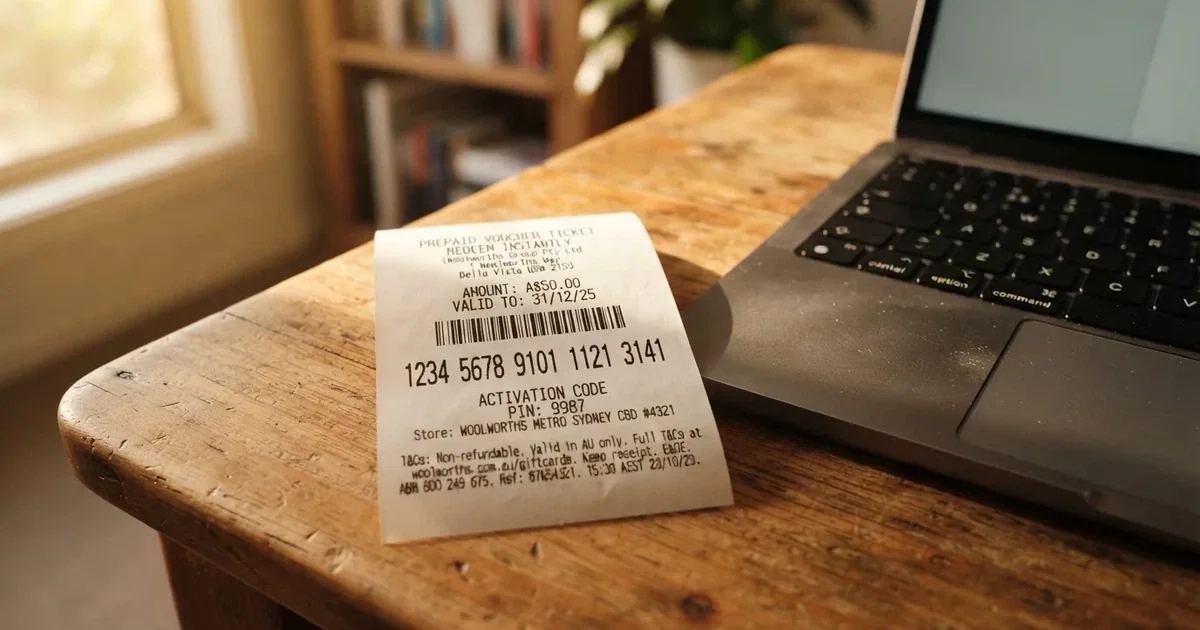
The mechanism is plain, which is its appeal. A player walks into a reseller — a convenience store, a fuel station, an online reseller — and buys a CashtoCode eVoucher for a chosen amount. The voucher arrives as a twenty-digit code, holds no name against it, and is sold with no usage fee; any unused balance keeps its full value. At the cashier of a participating site, the player enters the code, the deposit is credited in the local currency of the casino (the eVoucher covers more than 25 currencies), and no card or bank account touches the page. From the player’s side, that is the whole transaction. From the bank’s side, it never happened — the gambling-block tool NAB, Commonwealth Bank, Westpac, St George and ANZ offer works at card level, and CashtoCode sits outside the card network entirely, so the block does not see the transaction and does not refuse it.
What the deposit does not do is change the legal status of the site receiving it. CashtoCode markets itself to gambling operators as a deposit method, listing providers such as Pragmatic Play, Evolution, NetEnt and Playtech among the game studios it serves; that is the payment side, not the licensing side. The brand holding the casino licence, the regulator that issued it, and the jurisdiction whose dispute resolution applies to a refused withdrawal are still the casino’s own, and not Australia’s.
What a withdrawal looks like at the same sites
CashtoCode is deposit-only. The official CashtoCode site offers no withdrawal product, and no CashtoCode casino reviewed here markets one. A player who wants to cash out has to set up a separate withdrawal route on the casino side, and the speed of that route is the casino’s own, not the voucher’s. Across the offshore market, this is where the longest delays live: the casino’s anti-fraud checks, its bonus-wagering clearance verification, its source-of-funds review for larger payouts, and any banking-side processing on top. None of this is CashtoCode’s domain, and none of it is fast by default. A withdrawal request from any of these sites still waits on the operator’s manual checks before settlement lands back in an Australian account.
What the page compares and what it does not
Eleven offshore brands that have appeared on the ACMA’s enforcement record over the last four years, each accepting CashtoCode as a deposit method (where listings confirm) and each operating from outside Australia in a jurisdiction the IGA does not recognise. The comparison is about enforcement, jurisdiction, and what the regulator’s published record actually says about each brand. It is not a recommendation to play, and no operator is reviewed as a place to deposit.
The ACMA enforcement record on CashtoCode-accepting brands
The Australian Communications and Media Authority investigates complaints about prohibited interactive gambling services and can issue formal warnings, ask Australian internet service providers to block the offending sites, or refer matters for civil penalty proceedings. The list below is the enforcement record, not a recommendation.
| Brand | ACMA action and date | Operator named by the ACMA | Subject support |
|---|---|---|---|
| RocketPlay | Formal warning, March 2026; earlier warning over the same brand to Dama N.V., May 2022 | Pulsup Ltd (Rocketplay.com.au) | — |
| Level Up Casino | Formal warning, May 2022 | Dama N.V. | CashtoCode listed by an Australian third party (Westpac) |
| Woo Casino | Formal warning, March 2025 | Dama N.V. | — |
| Spirit Casino | Formal warning, May 2025 | Dama N.V. | — |
| National Casino | Formal warning, July 2025 | Consolutetish S.R.L. | CashtoCode listed by AUSTRAC and a Wikipedia payments article |
| Bizzo Casino | Formal warning, July 2025 (second formal warning on the brand; earlier 2022 to TechSolutions) | Consolutetish S.R.L. | — |
| Ignition Casino | Formal warning, July 2025 | Bamboo Media | — |
| Instant Casino | Formal warning, February 2025 | EOD Code SRL | CashtoCode listed by an Australian third party (PayID) |
| Jackbit | Formal warning, April 2026 | Ryker B.V. | — |
| Casino Intense | Formal warning, April 2025 | Sterplay Holding Ltd | CashtoCode listed by AUSTRAC and Australian banking sources |
| Sky Crown | Formal warning, September 2022 | Hollycorn N.V. | — |
A dash in the rightmost column is the explicit acknowledgment that the ACMA record carries the warning, but no Australian third-party source confirms a CashtoCode deposit path for that brand. The column does not assert the brand accepts or refuses CashtoCode; it reports what the consulted Australian sources recorded.
The brands that do show a confirmation trace are the ones the Australian payments ecosystem has touched. Level Up Casino appears in Westpac’s merchant category code coverage for gambling blocks. National Casino sits in AUSTRAC’s threshold transaction report guidance and in a Wikipedia summary of online payment methods at offshore sites. Instant Casino appears in PayID’s consumer guidance on scams involving illegal gambling sites. Casino Intense surfaces in AUSTRAC’s published material, in ITNews reporting on the Australian gambling block landscape, and in NAB’s own gambling block guidance. None of these listings is an endorsement — they are reasons the brand appears on Australian-side documents. Several appear specifically because Australian authorities were warning about them, not recommending them.
How fast the regulator has moved
The blocking record is a straightforward calculation. The ACMA’s first blocking request went out in November 2019; the running total of blocked sites reported by igamingbusiness.com in late June 2026 was 1,751. These figures offer context on the scale of the enforcement, not a recommendation.
Assuming a steady pace from the first blocking request through to the June 2026 snapshot, the cumulative running total of blocked sites works out to roughly 260–270 sites per year over the seven-year span, with the round reported on 26 June 2026 alone removing twelve more in one batch: 7Signs, ChromaBet, Donbet, Duospin, Freshbet, Slots Gem, Jacks Club, Lucky Start, Pointsbetz.com, Spinrise, Vinyl Casino and Wildsino. The range reflects the irregular cadence of the ACMA’s blocking rounds — quiet months punctuated by requests that take down a dozen at a time. A reader weighing the alternative uses the same range: the regulator’s pace has been measured in years, but the operator’s exposure is measured in days, because a single blocking request can put a brand’s domain out of reach for Australian customers without notice.
The pace matters for one practical reason. A CashtoCode deposit cleared today does not guarantee the site stays reachable next week, and a balance held on a blocked domain is held against a domain that has just been put out of reach. BetStop does not apply; the National Gambling Helpline cannot return funds from a blocked site; and the operator’s own licence is from a jurisdiction that does not sit inside the Australian enforcement frame.
What CashtoCode does and does not change about the legal picture
The Interactive Gambling Act 2001 prohibits the provision of online casino games and online pokies to a person physically in Australia. The offence sits with the provider, not the player — an Australian resident is not prosecuted for placing a bet at an offshore site — but the consequence for the player is real and one-sided: no Australian consumer protection, no complaints body with jurisdiction, and no recourse if the operator refuses a withdrawal. None of that changes when the deposit is a CashtoCode eVoucher. The IGA does not care which payment instrument carried the stake; it cares whether the service being paid for is a prohibited interactive gambling service supplied to a person in Australia. CashtoCode does not convert a prohibited service into a permitted one. It changes how the money arrives.
It does, however, change who sees the money arrive. The bank-level gambling block from Westpac, NAB, Commonwealth Bank, St George and ANZ works at card level — the bank refuses authorisation of transactions registered under the merchant category code for betting and casino gambling on eligible personal credit and debit cards. CashtoCode sits outside that network, so the block does not see the transaction. ANZ’s block also covers a digital wallet such as Apple Pay on an eligible card, but it cannot cover a payment instrument the card network never touches. That is the practical appeal of the voucher, and the practical reason the brand lists it on the cashier page. It is also the reason the operator lists it: deposits clear that an Australian-licensed wagering provider could not accept under the credit-card ban that took effect on 11 June 2024.
The credit-card ban, in one paragraph
From 11 June 2024, Australian-licensed online wagering services have been banned by law from accepting credit cards, credit-linked digital wallets or digital currencies as payment, with ACMA enforcement and penalties of up to A$247,500 for non-compliance. Legal deposit routes for a licensed Australian wagering service are debit card, bank transfer, PayID/Osko and BPAY. CashtoCode is not on that list, because it is not a deposit route for a licensed wagering service. It is a deposit route for an unlicensed one — which is precisely the market an Australian resident looking for an offshore casino is shopping in. The credit-card ban closes the door on the licensed side; the voucher opens a different door on the unlicensed side, and the IGA sits between them.
Where the legal deposit routes actually run for an Australian-licensed wagering service
The legal alternatives are not theoretical. Osko, the instant transfer service that runs over the New Payments Platform, clears a bank transfer between participating Australian banks in under a minute, twenty-four hours a day, including weekends, addressed either to a BSB and account number or to a PayID. The platform went live to the public on 13 February 2018 and is owned by New Payments Platform Australia Ltd, a non-profit whose shareholders include the Reserve Bank of Australia and the country’s major banks. More than 25 million PayID identifiers had been registered on the platform as of April 2025, and PayID-based instant transfers are available at over 100 Australian financial institutions. Paying to a PayID shows the name of the account holder before the transfer is sent; Australian Payments Plus warns that being asked to transfer money to a PayID on an illegal gambling site almost certainly means a scam.
Apple Pay, Google Pay and Samsung Pay collectively accounted for around 45 per cent of all card payments in Australia by number by the end of 2025, and Apple’s own terms make clear that the card issuer or the merchant — not Apple — sets transaction limits and PIN requirements. Apple does not charge consumer fees for using Apple Pay in stores, online or in apps; any surcharge is the merchant’s. American Express, which sits outside the four-party card networks, was established in 1850 as a freight-forwarding company, launched its first charge card on 1 October 1958, and runs its own three-party scheme. The Reserve Bank of Australia’s July 2025 review of merchant card payment costs proposes removing surcharges only on eftpos, Mastercard and Visa card transactions, leaving American Express outside the scope of the proposed surcharge ban. None of these instruments turns an unlicensed offshore site into a licensed one. They are the instruments the licensed side of the Australian market already runs on, and the rest of this market runs outside it.
What an Australian resident actually loses when an offshore site refuses a withdrawal
The arithmetic of the IGA is asymmetric. The provider faces the prohibition; the player faces the absence of a remedy. An Australian resident who holds a balance on a CashtoCode-accepting site that refuses to pay out has, in practical terms, three doors — and none of them is the ACMA, which does not enforce consumer contracts, and none of them is BetStop, which binds only Australian-licensed services. The first door is the operator’s own complaints process, run from a jurisdiction the player does not live in. The second is the licence body’s dispute resolution, which is the licence body’s discretion. The third is civil action in the operator’s jurisdiction, which is expensive and slow and rarely attempted. The National Gambling Helpline at 1800 858 858 can talk the player through the situation; it cannot move the money. None of this is unique to a CashtoCode deposit — it is the position any Australian resident is in at any unlicensed offshore site. The voucher changes only the deposit instrument, not the structural exposure.
What the ACMA’s blocking record says about the size of the market
The total of 1,751 blocked sites and affiliate marketing pages since November 2019 is a measure of the regulator’s activity, not the size of the offshore market itself. H2 Gambling Capital’s 2025 report estimated that Australians lose about A$3.9 billion a year to illegal gambling sites, and that the share of gambling going through legal channels fell from 74 per cent in 2021 to 64 per cent. The two figures together describe a market that the regulator has been narrowing for seven years without closing — every blocking round removes a slice, and the market keeps refilling from new domains and new operators. The 26 June 2026 round alone named twelve, and the next round will name another dozen. The reader looking for a stable address in this market is shopping in a market whose addresses keep falling out from under it.
The NTRWC, in one paragraph
The only Australian regulatory body that licenses online wagering at scale is the Northern Territory Racing and Wagering Commission, which regulates 52 of Australia’s online bookmakers — Sportsbet, Bet365 and Ladbrokes among them — for tax reasons. The commission has no full-time staff and meets once a month in Darwin. It licenses wagering on races and sport placed before the event, lotteries and keno. It does not license online casino games or online pokies, because no Australian jurisdiction does. The reader who reaches a CashtoCode casino through an Australian-facing marketing page is therefore looking at a service no Australian regulator has ever been asked to license, and that an Australian regulator is actively asking internet providers to block.
What an offshore licence claim actually means here
Every CashtoCode-accepting brand on this page carries a non-Australian licence on its footer — typically Curacao, sometimes Anjouan, sometimes the Kahnawake Gaming Commission. None of these is an Australian licence. None of them brings the brand within the Australian consumer protection framework, none of them binds the brand to BetStop, and none of them is enforced by the ACMA. The licence is a marketing asset on the cashier page; it is not a regulatory anchor for an Australian resident. The footer is accurate in the sense the licence body issued it; the footer is misleading in the sense a reader may take from it, which is that a regulator an Australian can complain to is standing behind the offer.
What the 2026 reform does and does not change
The Interactive Gambling Amendment (Gambling Reform) Bill 2026 passed Parliament on 19 August 2026; its advertising and inducement measures commence on 1 January 2027. The reform is law with a future start date, not law in force on a 2026 page. What the reform adds on its commencement is a tighter regime on advertising, inducements and the promotion of prohibited services to Australian residents — measures aimed at the marketing layer an Australian resident meets before any deposit. The reform does not legalise online casino games or online pokies, and it does not create an Australian licence for them. The offshore CashtoCode casino remains, after the reform commences, exactly what it was before: a service no Australian resident may lawfully be supplied.
The recurring fact, in one place
Wherever an offshore CashtoCode-accepting casino is reviewed below, the same two points hold, and they are stated here in full once and referred back to in the operator blocks by their heading words: an Australian resident is not prosecuted for placing a bet at an unlicensed offshore site, but the resident has no Australian consumer protection, no Australian complaints body, and no Australian recourse if a withdrawal is refused; and BetStop, the National Self-Exclusion Register, binds only Australian-licensed services and does not cover an offshore casino. The self-exclusion or monitoring register of the operator’s own jurisdiction does not sit inside the Australian frame.
The eleven brands
Each block below records what the ACMA’s register actually says about the brand, what the operator was named as, and the date of the warning. The blocks are not a recommendation, and the closing judgement answers a different question each time.
RocketPlay — warned twice across two operators
Pulsup Ltd was the operator named by the ACMA in March 2026, covering Rocketplay.com.au; Dama N.V. was the operator named in May 2022, covering Rocketplay among six Dama brands. Two warnings across four years, two different operators named on the same brand. RocketPlay is an example of the regulator’s persistence on a brand that has changed hands — the underlying service has carried a prohibited interactive gambling offer to Australian residents long enough for the ACMA to return to it.
The verdict here is the durability of the warning, not the durability of the brand: the brand’s address changed hands and the warning followed.
Level Up Casino — the Dama N.V. cluster of six
The ACMA named Dama N.V. in May 2022, covering Level Up among six casino brands — Bambet, Dazard, Level Up, Rocketplay, Wild Tornado and Cobra Casinos. The CashtoCode deposit path is named in Westpac’s merchant category coverage of gambling blocks. Level Up sits inside a cluster of six warnings issued to one operator on the same day, which is the ACMA’s pattern when an operator runs several brands from one platform. Six warnings on one operator is not six independent risks; it is one operator carrying a portfolio of prohibited services to Australian residents.
The verdict is the cluster, not the single brand: an Australian resident looking at Level Up is looking at one of six fronts of the same underlying offer.
Woo Casino — the Dama N.V. warning of March 2025
Dama N.V. was the operator named by the ACMA in March 2025, three years after the original May 2022 cluster. A second warning to the same operator three years later, on a brand outside the original six, indicates the operator continued to supply prohibited services to Australian residents after the first warning. The ACMA’s formal warning is the regulator’s documented record of that continuation.
The verdict is the recurrence: a second warning is not the same as the first, and the regulator’s response on a third is not the same as its response on a second.
Spirit Casino — the Dama N.V. warning of May 2025
Dama N.V. was the operator named by the ACMA in May 2025, two months after the Woo Casino warning. Spirit Casino is the third Dama brand the ACMA has named since 2022, on a cadence that tightened across 2025 — March 2025 on Woo, May 2025 on Spirit, after the May 2022 cluster of six. The operator’s response to the regulator’s earlier warnings was not, on the regulator’s record, a withdrawal from the Australian market.
The verdict is the cadence: three Dama brand warnings in three years is the regulator’s documented measure of one operator’s continuing exposure of Australian residents to a prohibited service.
National Casino — the Consolutetish S.R.L. warning of July 2025
Consolutetish S.R.L. was the operator named by the ACMA in July 2025, on the same round as Bizzo Casino. The CashtoCode deposit path is named in AUSTRAC’s threshold transaction report guidance and in a Wikipedia summary of online payment methods at offshore sites. National Casino and Bizzo Casino are the two brands named on the same warning round, and the second warning on Bizzo in particular — the first having gone to TechSolutions in 2022 — gives the round a specific character.
The verdict is the pair: two brands, one operator, one warning round, and the regulator’s record of one of the two brands goes back to 2022.
Bizzo Casino — the second formal warning since 2022
Consolutetish S.R.L. was the operator named by the ACMA in July 2025; the earlier 2022 warning was issued to TechSolutions (CY) Group Limited and TechSolutions Group N.V. A second formal warning on the same brand, to a different operator entity, three years after the first, is the regulator’s record of the brand’s continued supply of prohibited services across two corporate structures. The brand has outlasted the operator’s name.
The verdict is the operator change: a warning to TechSolutions in 2022 and a warning to Consolutetish S.R.L. in 2025 on the same brand is the regulator’s record of one brand continuing under more than one corporate name.
Ignition Casino — the Bamboo Media warning of July 2025
Bamboo Media was the operator named by the ACMA in July 2025, on the same round as the Consolutetish warnings. The CashtoCode deposit path is not confirmed by the consulted Australian sources. Ignition Casino is the third brand the ACMA named in July 2025, on a round that took the form of three separate warnings to three operators on the same day. The reader looking at Ignition is looking at one of three fronts the regulator addressed in a single round.
The verdict is the round: three warnings, three operators, one day is the regulator’s documented response to a single period of activity by the offshore market.
Instant Casino — the EOD Code SRL warning of February 2025
EOD Code SRL was the operator named by the ACMA in February 2025, on a brand whose name includes the word “instant” but whose underlying settlement is not the instant the marketing implies. The CashtoCode deposit path is named in PayID’s consumer guidance on scams involving illegal gambling sites. The presence of Instant Casino in PayID’s scam guidance is a specific signal: PayID’s warning is that being asked to transfer money to a PayID on an illegal gambling site almost certainly means a scam site, and Instant Casino sits in the published examples of such a site.
The verdict is the signal: an Australian payments network has named the brand in its own consumer warning, which is a different signal from a regulator’s formal warning and one that comes from a different part of the Australian frame.
Jackbit — the Ryker B.V. warning of April 2026
Ryker B.V. was the operator named by the ACMA in April 2026, covering Jackbit and CasinOK. The CashtoCode deposit path is not confirmed by the consulted Australian sources. The Jackbit warning is one of the most recent on this page, three months before the snapshot of the blocking record on 26 June 2026, and the brand sits inside a 2026 cohort of regulator activity that also covers RocketPlay in March 2026.
The verdict is the recency: a brand warned in April 2026 is a brand the regulator reached this year, and the reader is looking at a service the ACMA’s enforcement machinery has not yet had time to follow up on a second time.
Casino Intense — the Sterplay Holding Ltd warning of April 2025
Sterplay Holding Ltd was the operator named by the ACMA in April 2025. The CashtoCode deposit path is named in AUSTRAC’s published material, in ITNews reporting on the Australian gambling block landscape, and in NAB’s own gambling block guidance. Casino Intense is the brand on this page with the broadest Australian-side documentary footprint, named in three independent Australian sources. That footprint is not a recommendation; it is the regulator’s and the banks’ and the trade press’s combined record of how much Australian-side attention the brand has attracted.
The verdict is the footprint: a brand named by the ACMA, by AUSTRAC, by the trade press, and by an Australian major bank’s own guidance has been on the Australian side of the record in a way few on this page have, and the breadth of that record is itself the answer.
Sky Crown — the Hollycorn N.V. warning of September 2022
Hollycorn N.V. was the operator named by the ACMA, covering Sky Crown and Blue Leo. The CashtoCode deposit path is not confirmed by the consulted Australian sources. Sky Crown is the earliest warning on this page by date, and the ACMA’s formal warning on Sky Crown is paired with the warning on Blue Leo, another Hollycorn brand. The brand has had the longest time on this page to be followed up on, and the ACMA has not yet named Sky Crown in a second formal warning round of its own.
The verdict is the patience of the regulator: a 2022 warning that has not yet drawn a second round is not a closed file, and a brand with no 2025 or 2026 entry in the ACMA’s register is a brand the reader should weigh against a brand that does.
What the reader actually carries out of this page
The arithmetic of the comparison is one line long. Eleven offshore brands accepting CashtoCode, eleven ACMA formal warnings, two operators named more than once on the same brand (Dama N.V. and TechSolutions/Consolutetish), eleven brands with no Australian licence, and eleven brands whose customer an Australian resident is, on the regulator’s record, by being supplied a prohibited interactive gambling service. The single most useful sentence on this page is the one the IGA itself writes: online casino games and online pokies cannot be licensed in Australia, whatever licence the site displays. Every footer on every CashtoCode-accepting brand reviewed here says otherwise, and every ACMA formal warning reviewed here says the same thing in the regulator’s own voice.
The land-based alternative is not offshore. It is the licensed club and pub pokies in the reader’s state or territory, which run under each jurisdiction’s own rules, and the licensed wagering services offered by operators the NTRWC regulates for wagering on races and sport placed before the event, lotteries and keno. The reader who reaches for a CashtoCode voucher to deposit at an offshore site is reaching for a deposit instrument that bypasses the bank-level block a reader may have set up to keep themselves out of this market. The bank-level block, where it is on, is doing the job the regulator cannot do for an Australian resident directly.
The tax point is one sentence: gambling winnings of a recreational player are not assessable income under section 6-5 of the ITAA 1997, and losses are not deductible, unless the person carries on a business of gambling. The model is the only thing a tax adviser can sign off on, and the ATO is the body that signs off on the actual answer.
Frequently asked questions
Is it legal for an online casino to accept CashtoCode from a player in Australia?
No. Under the Interactive Gambling Act 2001, it is an offence to provide online casino games, online pokies or in-play betting to a person in Australia, and no state or territory licenses those services. An offshore casino accepting CashtoCode from an Australian resident is supplying a prohibited interactive gambling service. The player is not prosecuted; the operator is.
What is the smallest deposit a CashtoCode casino site usually asks for?
CashtoCode eVouchers are sold in fixed denominations by resellers, and the smallest available value is set by the reseller’s catalogue rather than by CashtoCode itself. The minimum deposit at the casino cashier is the casino’s own setting and varies by brand. None of the eleven brands on this page has a published CashtoCode minimum confirmed by the consulted Australian sources.
Does a CashtoCode withdrawal clear any faster than a card withdrawal at these sites?
No CashtoCode withdrawal exists. The eVoucher is deposit-only, and any withdrawal from these sites uses the casino’s own payout route. Speed is set by the casino’s anti-fraud checks, its bonus clearance review and the banking rail it uses, not by the deposit instrument that went in. A CashtoCode deposit followed by a card or bank-transfer withdrawal is the typical arrangement.
Can CashtoCode be used at every offshore pokies-style site, or only some of them?
CashtoCode markets itself to gambling operators and lists game providers such as Pragmatic Play, Evolution, NetEnt and Playtech in its catalogue filters. Whether a given offshore site accepts CashtoCode is a per-site decision at the cashier. On this page, only four of the eleven ACMA-warned brands have a CashtoCode deposit path confirmed by the consulted Australian sources; the others show no Australian-side confirmation.
Does depositing with CashtoCode add an extra fee at these casino sites?
CashtoCode states the eVoucher is free of charge to the customer with no usage fees and that any unused balance keeps its full value. Whether the casino adds its own deposit fee is a per-casino setting. No CashtoCode-accepting brand on this page has a confirmed deposit fee in the consulted sources.
What should a player do if a CashtoCode deposit does not appear in a casino account?
The first step is the casino’s own support, because the credit sits on the casino’s side once the eVoucher code is accepted at the cashier. If the casino does not respond, the Australian-side recourse is the National Gambling Helpline on 1800 858 858, free and 24/7, which can talk through the situation but cannot move funds from an offshore operator that is not subject to Australian consumer protection law.