
What “best Australian online pokies” actually means in 2026
A person typing the search term expects a ranked list. A ranked list is also the thing the Australian market refuses to produce, because the product those words describe cannot lawfully be supplied to anyone in Australia. That gap is the page. It is not a workaround, and it is not a workaround dressed up as a recommendation. The Interactive Gambling Act 2001 prohibits online pokies for Australian residents outright; the closest legal equivalent is the licensed poker machine inside a pub, club or casino, which is governed state by state and is a separate product with separate rules, separate returns to player, and separate harm-minimisation obligations. This guide keeps the two apart on purpose, because most of what the reader loses by conflating them happens before any spin is taken.
The figures and operator actions below are current as of 30 October 2026 and were checked against the Australian Communications and Media Authority’s published formal warnings and the regulator’s blocking notices.
Table of Contents
- Getting help first, before any of the rest
- Paying into and out of offshore online pokies sites
- What online pokies bonuses and free spins actually mean
- Paytables, providers and what a real pokie actually shows
- The comparison this search was looking for
- The fundamentals this page is built on
- The prohibition, the blocking programme, and what it has produced
- What a person can do, lawfully, if they want to play
- Reading the ACMA’s record against the brand set
- The cost this search term asks the reader to pay
- Frequently asked questions
Getting help first, before any of the rest
If the thought of placing a bet — anywhere, on anything — is starting to feel compulsive, or is costing more than was set aside, free confidential help is one phone call away, around the clock. The National Gambling Helpline is 1800 858 858, free and open 24 hours a day. The same service runs chat and email through Gambling Help Online, and BetStop — the National Self-Exclusion Register, live since August 2023 — lets a person exclude themselves from every Australian-licensed online and phone wagering service in a single registration.
BetStop’s reach is narrower than it sounds, and that matters. It binds only operators licensed in Australia — the bookmakers and wagering services regulated under the Interactive Gambling Act. An offshore casino offering online pokies to Australians is not connected to BetStop, not covered by an Australian complaints body, and not required to honour an Australian self-exclusion request. Registering with BetStop is still worth doing, because licensed wagering is the largest single channel most people who gamble use, and self-exclusion there cuts off most of the everyday friction. It does not, on its own, cut off an offshore site.
The figure that justifies reading the rest of this page sits in the same neighbourhood: H2 Gambling Capital’s 2025 estimate puts Australian losses to illegal offshore gambling sites at roughly A$3.9 billion a year. That is the volume the offshore market is built on, and it is also the reason the ACMA’s blocking programme exists in the shape it does.
Paying into and out of offshore online pokies sites
The payments question looks simple on a deposit screen and gets less simple the moment a withdrawal is involved. For Australian-licensed online wagering — bookmakers, lotteries, keno — the legal deposit routes are debit card, bank transfer, PayID/Osko and BPAY. Credit cards, credit-related products and digital currency have been banned as payment for licensed online wagering since 11 June 2024, with penalties for operators up to A$247,500. A site asking an Australian customer for a credit card or a crypto deposit is, on that one signal alone, operating outside the Australian rules.
For unlicensed offshore sites, the practical deposit route is whatever the operator accepts, which usually means a debit card, an e-wallet, or a crypto wallet. None of those routes sits inside Australian consumer protection law. If a withdrawal stalls, the bonus terms are rewritten after deposit, or the account is closed with a balance on it, the recourse is the licence displayed on the operator’s own footer — typically Curaçao or Anjouan, neither of which runs a complaints process an Australian resident can actually use. PayID is sometimes marketed to Australian players as a sign that a site is “local” or “regulated”. It is neither. PayID is just a real-time payment rail between Australian bank accounts; an offshore operator that lists a PayID-branded deposit button is receiving funds into an account whose holder is offshore, and the rail does not confer any protection beyond the speed of the transfer.
The flow the reader is looking for is faster than the law has caught up with. Faster deposits, slower withdrawals, no Australian complaints body. That order is the one offshore sites are built around, and it is the order a reader experiences when something goes wrong.
What online pokies bonuses and free spins actually mean
Online pokies bonuses and free spins are marketing terms for two specific things, and the cost of each one is set out in the fine print a reader usually skips. A bonus credit is a balance the operator adds to the account, which the player must wager through a stated multiple before any of it — and any winnings from it — can be withdrawn. A free spins package is a fixed number of spins at a fixed stake on a fixed game, with winnings paid as bonus credit subject to the same kind of wagering requirement.
Both come with three numbers worth knowing. The wagering multiple is how many times the bonus (and sometimes the deposit too) must be staked before withdrawal. Maximum cashout caps limit how much of a bonus-derived win can ever be taken out, sometimes to a few hundred dollars on a “free” spins win. Game weighting is the share of each stake that counts toward clearing the bonus, and online pokies usually count 100% while table games count less or nothing. An offer that looks generous on a banner is usually structured so the wagering requirement clears a small slice of each spin at a time, over a long enough run that the bonus credit is statistically spent before the requirement is met.
For this page that machinery is background only. Every site on this page is one the ACMA has issued a formal warning over for offering prohibited online casino services to Australians, and describing their specific bonus packages in detail would treat them as live offers. They are not — they cannot be claimed lawfully from inside Australia — and the only sources for their bonus terms were affiliate marketing pages with a financial interest in the click.
Paytables, providers and what a real pokie actually shows
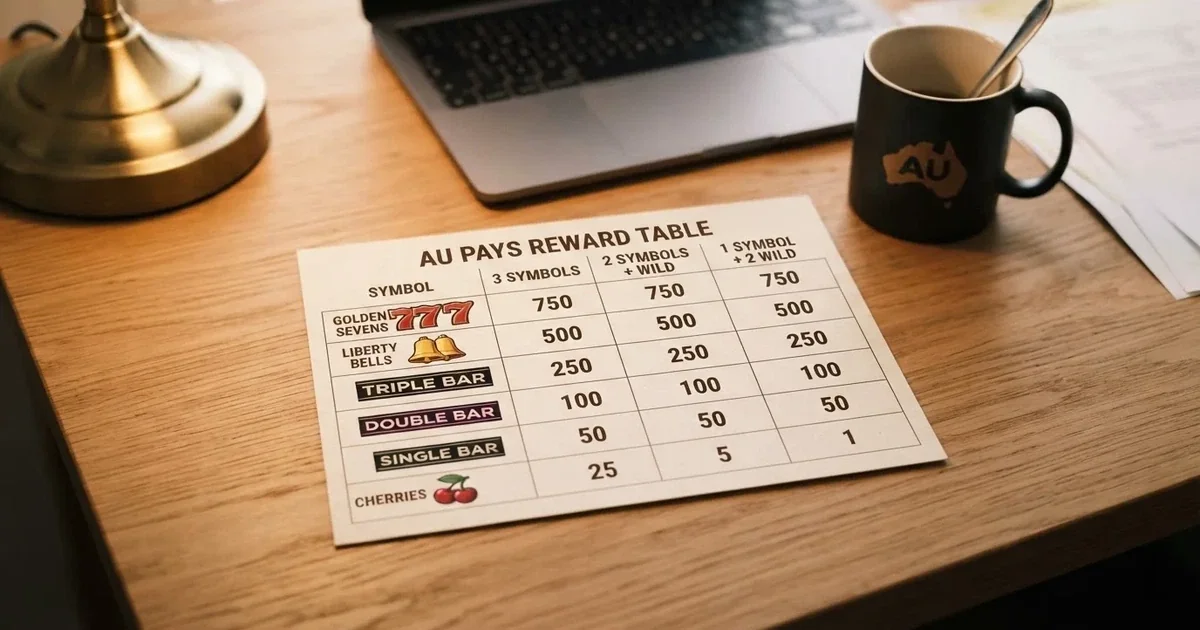
A paytable is the reference card inside a pokie that sets out what each symbol pays, how many scatters or wilds trigger a feature, and what the maximum line win is. The reader who has never looked at one is the reader the offshore marketing page is written for, because a paytable is the document that tells a player what the game actually does. The figures worth reading are three.
The return to player is the share of every dollar wagered that the game is programmed to return over a very large number of spins — typically millions. A 96% RTP is a 4% house edge, paid out slowly and unevenly. RTP is not a forecast for a single session; it is the average the game converges on over time, and a player can lose the entire stake in twenty spins without the math being wrong.
Volatility describes the shape of the payout curve. A low-volatility game pays small amounts often; a high-volatility game pays rarely, and pays more when it does. The same 96% RTP can feel like a steady drip or like nothing happening for an hour and then a big hit, depending on volatility. Both are valid designs; neither is the “better” one for a player who has not picked which one they want.
Symbol values and paylines are the mechanical layer. A modern video pokie pays on fixed or “ways” patterns rather than the single centre line of older machines, and the paytable sets out which combinations are paid and at what multiple of the line stake. Wilds substitute for other symbols; scatters usually trigger a feature; bonus symbols open a separate game. The paytable is the only place these are written down. Anything else is marketing.
These mechanics describe every pokie that exists, licensed venue or offshore. What separates a venue pokie from an offshore online pokie is not the symbol values — it is the licence, the regulator, the minimum return the regulator enforces, and the consumer protection that sits behind the spin.
The comparison this search was looking for
A ranked comparison of online pokies sites for Australian players would, in any other market, weigh three things: the licence, the payout speed, and the bonus terms. For Australia, the first of those collapses the others. No site offering online pokies to Australian residents holds an Australian licence, because no Australian licence for the product exists. The site with the best payout speed and the most generous bonus is, by definition, a site no Australian regulator has looked at.
What a fair comparison of the offshore set can still weigh is the enforcement record against them, which is published by the ACMA itself and is the closest thing to a public review an Australian reader can consult. A site the ACMA has warned is a site the regulator has examined and found to be offering prohibited services to Australians. A site the ACMA has directed internet service providers to block has gone further — typically after ignoring a warning. Both are public facts, recorded against the legal entity behind the brand, and they are the only facts about these operators that come from a source the reader does not have to take on trust.
The table below sets out eleven brands the ACMA has acted against, the date and the operator named in the regulator’s publication, and any other public source that has attached the brand to its stated product area. It is not a ranking. It is the data the ACMA itself has put on the record.
| Brand | ACMA action and date | Operator named by the ACMA | Subject support |
|---|---|---|---|
| RocketPlay | Formal warning, March 2026 (earlier warning to Dama N.V., May 2022) | Pulsup Ltd (RocketPlay) | — |
| Level Up Casino | Formal warning, May 2022 | Dama N.V. | Listings reference: BGaming |
| Woo Casino | Formal warning, March 2025 | Dama N.V. | — |
| Spirit Casino | Formal warning, May 2025 | Dama N.V. | — |
| National Casino | Formal warning, July 2025 | Consolutetish S.R.L. | Listings reference: en.wikipedia.org |
| Bizzo Casino | Formal warning, July 2025 (earlier warning to TechSolutions, 2022) | Consolutetish S.R.L. | — |
| Ignition Casino | Formal warning, July 2025 | Bamboo Media | — |
| Instant Casino | Formal warning, February 2025 | EOD Code SRL | — |
| Jackbit | Formal warning, April 2026 | Ryker B.V. | — |
| Casino Intense | Formal warning, April 2025 | Sterplay Holding Ltd | Listings reference: ABC, acma.gov.au, Crown Melbourne |
| Sky Crown | Formal warning (Hollycorn N.V.) | Hollycorn N.V. | — |
The shape of the list tells its own story. The Dama N.V. name recurs across three brands and two regulatory rounds; the same operator network was warned in 2022 over a different set of brands and warned again in 2025 over two more. Bizzo Casino appears twice in the regulator’s record — once in 2022 under TechSolutions, again in 2025 under Consolutetish S.R.L. — which is the closest the ACMA’s enforcement record comes to showing an operator moving its brands around in response to action against them. The list is not a who-is-who of the offshore market. It is a who-has-been-warned list, and it leans on the regulator’s own publication for every entry.
The fundamentals this page is built on
The fundamental the rest of this page rests on is the simplest and the least negotiable: online pokies are prohibited interactive gambling services under the Interactive Gambling Act 2001, and the prohibition has been reinforced by the Interactive Gambling Amendment Act 2017. The IGA makes it an offence to provide online casino games, online pokies or in-play betting to a person physically in Australia. It does not target the player; the player is not prosecuted. It targets the provider, and the enforcement tools are formal warnings, civil penalty proceedings, and directions to Australian internet service providers to block illegal sites at the network level.

The licensed alternative is not online at all. Electronic gaming machines — pokies — operate in every Australian state and territory, and each jurisdiction separately regulates their design, their minimum return to player, and where they can be placed. New South Wales alone had 87,298 machines outside casinos across 2,195 venues as of June 2023, with player losses of A$8.18 billion in 2022-23. Queensland had 21,122 machines in 351 venues in October 2023; Victoria had 26,380 machines outside Crown Casino across 488 venues in 2021-22, sitting under a 30,000-machine statewide cap. The numbers vary because the rules vary — Western Australia banned poker machines in pubs and clubs entirely when Crown Perth opened in 1985, and Crown Perth’s own count has since grown from about 200 machines to roughly 2,500. Tasmania ended Federal Group’s monopoly over its poker machines with legislation passed in November 2021, moving oversight to the Tasmanian Liquor and Gaming Commission, and planned mandatory pre-commitment cards that were due in 2025 after several delays.
The legal minimum return to player for venue machines varies by jurisdiction: 85% in New South Wales, the Northern Territory, Queensland and generally Victoria (87% at Crown Melbourne), 87% in the Australian Capital Territory and Tasmania, 87.5% in South Australia, and 90% in Western Australia. Those are regulator-enforced floors for a machine a person can sit down at in person. An offshore online pokie has no such floor because it has no Australian regulator enforcing one. The 96% figure on an offshore paytable is whatever the operator chose to publish, not what any authority has verified, and the audit of that figure is the operator’s own.
In 2020-21 Australians bet almost A$150 billion through gaming machines and lost A$12.18 billion on them, in a country with about 3% of the world’s pub and club poker machines and 0.3% of the global population. Australia is, by population, the most heavily concentrated pokie market on earth. That density is the supply the offshore market sits across from, and it is the reason the ACMA’s enforcement programme exists at the scale it does.
The prohibition, the blocking programme, and what it has produced
The Interactive Gambling Act 2001 prohibits the provision of online pokies to people in Australia. What enforcement looks like in practice is the ACMA’s blocking programme: a rolling programme of formal warnings, followed by directions to Australian internet service providers to block non-compliant sites at the DNS level.
The arithmetic the programme has produced so far is the closest the regulator has come to a running tally. According to the ACMA as reported in June 2026, a total of 1,751 illegal gambling and affiliate marketing websites had been blocked since the first blocking request in November 2019, and more than 230 unlicensed gambling services had left the Australian market since enforcement was strengthened in 2017. As a rate: roughly 1,750 sites blocked over about six and a half years works out to somewhere between 200 and 270 sites blocked per year on average, with the rate sitting toward the higher end of that band in the most recent reporting rounds. The band, not the point estimate, is the figure to carry: a long-run average that includes quieter years and the recent acceleration after the Interactive Gambling Amendment (Gambling Reform) Bill 2026 cleared Parliament in August 2026, with its advertising and inducement measures set to commence on 1 January 2027.
The June 2026 round alone directed Australian ISPs to block 12 more sites in a single batch: 7Signs, ChromaBet, Donbet, Duospin, Freshbet, Slots Gem, Jacks Club, Lucky Start, Pointsbetz, Spinrise, Vinyl Casino and Wildsino. Each one is on the public list because the operator behind it continued to offer prohibited services after being told to stop.
The blocking programme does two things at once. It removes a site’s reach from customers on Australian networks, which cuts off most of the casual traffic. And it puts the site’s name on a regulator’s record, which any reader can look up. The programme’s other product is information, and the table further up this page is built out of it.
What a person can do, lawfully, if they want to play
The lawful Australian pokie is the venue machine, and the lawful online Australian wagering product is the pre-event bet — racing and sport, placed before the event starts, with the operator licensed in Australia. The Northern Territory Racing and Wagering Commission regulates 52 of Australia’s online bookmakers, including Sportsbet, Bet365 and Ladbrokes; the commission has no full-time staff and meets once a month in Darwin, which is itself a small story about how thinly the regulator is stretched. The legal deposit routes — debit card, bank transfer, PayID/Osko, BPAY — are the channels licensed wagering has to use. Credit cards and crypto are out.
A person who wants to play online pokies inside Australia cannot do so lawfully, and any site offering to take their money is offering them an illegal product. A person who wants to play venue pokies is playing a regulated machine with a state-enforced minimum return to player, harm-minimisation features the regulator has approved, and a venue that is licensed to operate. Those are the two choices the law actually offers, and the cost difference between them is not the marketing word it is sometimes dressed up as.
Reading the ACMA’s record against the brand set
What follows is the regulator’s record against each of the eleven brands named in the table. Each entry is what the ACMA has published, against the legal entity the regulator named in the warning, on the date published. None of them is a recommendation, and none of them is a “best” — every one of them is a brand the regulator has found to be offering prohibited services to Australians. The point of listing them is to put the regulator’s own record on the page, in the regulator’s own language, with the dates the regulator attached.
RocketPlay
Formal warning in March 2026, naming Pulsup Ltd as the operator behind RocketPlay. A separate Dama N.V. warning had covered RocketPlay in May 2022, which means the same brand has surfaced in two enforcement rounds under two different corporate parents. The pattern — a brand moving between operators in the space between warnings — is the most useful thing the record shows here. It is also the most useful thing the record shows the reader: a brand name is not a company, and a warning to one company does not bind the next one that takes the brand over.
Level Up Casino
Formal warning in May 2022, naming Dama N.V. as the operator. Level Up Casino appears in the BGaming supplier listings as a brand that has carried that studio’s games; the listing is a commercial reference, not a regulatory one, and it tells the reader nothing about Australian licensing.
Woo Casino
Formal warning in March 2025, naming Dama N.V. The “woo” name sits in a noisy neighbourhood of bonus-led brands, and the warning is the regulator’s answer to the marketing. Woo Casino’s only meaningful footprint in this record is the line the ACMA put against it.
Spirit Casino
Formal warning in May 2025, naming Dama N.V. — the third Dama N.V. brand on this list, and the most recent in the sequence. Three Dama N.V. brands, three regulatory rounds, two of them in 2025. That is the densest cluster of warnings on the table.
National Casino
Formal warning in July 2025, naming Consolutetish S.R.L. The National Casino name appears in en.wikipedia.org references to Australian gambling, in the general context of brands that operate offshore. The reference is descriptive, not regulatory.
Bizzo Casino
Formal warning in July 2025, naming Consolutetish S.R.L. — and an earlier warning, in 2022, to TechSolutions (CY) Group Limited and TechSolutions Group N.V. The brand has cycled through two regulatory rounds under two different operators, which is the same pattern RocketPlay shows: the name is not the entity, and the regulator’s action against one entity does not bind the next.
Ignition Casino
Formal warning in July 2025, naming Bamboo Media. The Ignition Casino brand has been marketed heavily to Australian-facing traffic in the past; the warning is the regulator’s answer to that marketing.
Instant Casino
Formal warning in February 2025, naming EOD Code SRL. The warning is early in the 2025 cluster and is the first of the year against an operator in this set.
Jackbit
Formal warning in April 2026, naming Ryker B.V. — issued in the same reporting cycle as the Rocketplay warning and the ACMA’s expanding 2026 caseload. A formal warning in 2026 is also a signal of an operator still actively soliciting Australian customers at a time the blocking programme has accelerated.
Casino Intense
Formal warning in April 2025, naming Sterplay Holding Ltd. Casino Intense is one of the few brands on this list that also surfaces in mainstream Australian press references (ABC) and in the ACMA’s own register, alongside coverage of venue gaming at Crown Melbourne. The mix of references does not change the licence status; it changes who has heard of the brand.
Sky Crown
Formal warning naming Hollycorn N.V., published in the ACMA’s record of formal warnings covering Sky Crown and Blue Leo. Hollycorn N.V. is the operator the regulator named; the action covers both casino brands under the same corporate parent.
The cost this search term asks the reader to pay
Every search term has a cost. For “best Australian online pokies”, the cost is the gap between what the term promises and what the Australian market offers. The promise is a ranked list of licensed sites with fair bonus terms and fast payouts. The reality is eleven offshore brands the ACMA has warned, a prohibition that has been on the books since 2001 and tightened since, and a regulator whose blocking programme has cleared 1,751 sites off Australian networks since November 2019. The reader who treats the search term as a comparison question gets a comparison the law does not let them act on; the reader who treats it as a market question gets the answer that there is no market, only an enforcement record.
The cost to the reader who goes ahead anyway is paid in three places at once. In the wagering requirement that quietly swallows the bonus. In the blocked site the reader’s balance is sitting on the morning the ACMA’s blocking notice lands. And in the absence of any Australian complaints body to write to when the withdrawal stalls. The arithmetic on the bonus is the only one of the three the reader can do for themselves, and the only one the marketing page will walk them past.
The honest reading of the search is the one this page is built on: the best Australian online pokies site is not a site at all. It is the licensed machine in the licensed venue, with the regulator’s minimum return to player enforced and a self-exclusion register that actually binds. For everything else, the ACMA’s published warnings list is the closest thing Australia has to a public review, and it is the document this page has tried to put in the reader’s hands.
Frequently asked questions
Is there any licensed, ranked list of online pokies sites for Australian players?
No. Online pokies are prohibited under the Interactive Gambling Act 2001, and no Australian state or territory issues a licence for them. Any site offering online pokies to people in Australia is operating outside Australian law, and the ACMA’s published warnings list is the public record of which operators the regulator has examined and found to be doing so. The list this page carries is not a ranking; it is the regulator’s own enforcement record.
Does a PayID deposit option make an online pokies site any more Australian or legal?
No. PayID is just a real-time payment rail between Australian bank accounts. An offshore operator that lists a PayID-branded deposit button is receiving funds into an account whose holder is offshore, and the rail does not confer any Australian licence, regulator, or consumer protection. The transfer is fast; the protection is the same as for any other deposit to an unlicensed site, which is none.
What separates a licensed pub or club poker machine from an “online pokies” site?
The licence and the regulator behind it. A venue pokie is approved by the state or territory gambling regulator, sits inside a state-enforced minimum return to player (85% to 90% depending on jurisdiction), and operates inside a venue that is licensed to have it. An offshore online pokie has no Australian regulator, no enforced minimum return, and no venue — it is a website, and the licence it displays is whatever offshore jurisdiction the operator chose. The symbols and paylines on the screen are similar; the regulatory frame around them is not.
Can an offshore online pokies site legally advertise a sign-up bonus credit to Australians?
No. Offering online casino games — including online pokies — to a person in Australia is an offence under the Interactive Gambling Act 2001, and that prohibition covers the inducement (the bonus credit, the free spins, the deposit match) as much as the game itself. The Interactive Gambling Amendment (Gambling Reform) Bill 2026, which passed Parliament in August 2026, will tighten the advertising and inducement rules further when its measures commence on 1 January 2027. An offer that reaches an Australian inbox has, by the act of reaching them, already crossed the line.
How would payouts on an offshore online pokies site be verified as fair?
The short answer is that, from inside Australia, they cannot. The operator’s own published RTP is the operator’s own claim; the licence it displays is the licence the operator chose to take; the auditor named in the footer is the auditor the operator contracted. None of those is an Australian regulator. The verification path that exists is the regulator in the offshore jurisdiction — Curaçao, Anjouan, occasionally Malta — and the practical experience of an Australian reader who hits a withdrawal problem is that those paths are slow, expensive to pursue from the other side of the world, and not designed for the consumer at the end of them.