
Best Aussie Pokies Online Australia 2026: What the ACMA’s Record Tells You
Data current as of 31 October 2026 and verified against the ACMA’s formal-warning register and published blocking lists.
The page most readers arrive looking for does not exist. Australia has no shortlist of “best online pokies sites” because no such site can be licensed in Australia under the Interactive Gambling Act 2001. What the market offers instead is a list of brands the ACMA has named in formal warnings, and a list of brands the regulator has asked ISPs to block. This page reads both lists, sets out what the prohibition actually covers, and walks the reader through what is and is not available under Australian law in 2026.
Table of Contents
- Help Comes Before the Spin
- Why Online Pokies Have No AU Licence
- What the ACMA Has Done in 2026
- Payment Routes and What They Tell You About the Site
- Bonuses and Free Spins: The Marketing Word and the Reality
- What a Paytable Generally Shows
- The Brands the ACMA Has Named
- What Each Warning Actually Says
- What This Page Does Not Recommend
- What the 2026 Reform Changes
- Tax and the Recreational Player
- The Single Read
- Frequently Asked Questions
Help Comes Before the Spin
If any of this — comparing offshore sites, weighing a deposit, or thinking about chasing a payout — is starting to colour the day, free confidential help is one call away. The National Gambling Helpline is 1800 858 858, free, 24/7, with chat at Gambling Help Online. BetStop, the National Self-Exclusion Register, has been live since August 2023; it binds Australian-licensed online and phone wagering services, not offshore casinos, so registering with BetStop does not exclude an offshore account. The exclusion sits with the licensed product, not with the player who steps past it.

The reason this section sits first is plain. The rest of the page compares what offshore sites offer; the helpline is the part of the Australian system that works without one.
Why Online Pokies Have No AU Licence
The Interactive Gambling Act 2001 (IGA), tightened by the Interactive Gambling Amendment Act 2017, makes it an offence to provide online casino games, online pokies or in-play betting to a person physically in Australia. No state or territory issues a licence for them. What is licensable onshore is wagering on races and sport placed before the event, lotteries and keno; in practice, the Northern Territory Racing and Wagering Commission (NTRWC) regulates 52 of Australia’s online bookmakers — including Sportsbet, Bet365 and Ladbrokes — for tax reasons, and that commission runs with no full-time staff and meets once a month in Darwin.
The asymmetry is worth pausing on. A sports bettor in Australia can open a Bet365 account and place a pre-event wager on a sport. The same account cannot offer a spin on a pokies title. The bookmaker is licensed because the wager is licensed. The game is not. So when a site presents an Australian flag and the word “Aussie” in its branding, what that branding actually identifies is a marketing jurisdiction, not a regulatory one — the operator remains outside Australian law and an ACMA enforcement risk.
What “Aussie” on the Site Actually Means
A brand labelled “Aussie pokies” is not licensed to offer them in Australia. The IGA targets the provider, not the player, so the Australian punter using such a site is not personally at risk of prosecution. What they do give up is the entire Australian consumer-protection layer. There is no Australian complaints body to approach if a withdrawal is refused, no AU-licensed dispute resolution, and no Australian regulator to write to. The site is governed by whatever licence it displays offshore, under whatever jurisdiction issued it, and that jurisdiction is generally not Australian.
Calling a site “Aussie” is therefore a styling choice, not a compliance statement. The ACMA’s formal-warning register is the only authoritative Australian read on whether the brand is on the regulator’s radar.
What an AU-Licensed Pub’s Machine Looks Like, for Contrast
Land-based pokies — the electronic gaming machines in pubs, clubs and casinos — are licensed and regulated state by state. Australia had about 3% of the world’s pub and club poker machines in 2020–21, with 0.3% of the global population, and in that year gamblers bet almost A$150 billion through gaming machines and lost A$12.18 billion on them. New South Wales alone had 87,298 gaming machines outside casinos across 2,195 venues as of June 2023, with player losses of A$8.18 billion in 2022–23. Queensland had 21,122 gaming machines across 351 venues in October 2023, and Victoria had 26,380 outside Crown Casino in 488 venues in 2021–22, under a 30,000-machine statewide limit.
These machines sit inside a different regulatory regime. The legal minimum return-to-player (RTP) varies by jurisdiction: 85% in New South Wales, the Northern Territory, Queensland and generally Victoria (87% at Crown Melbourne), 87% in the Australian Capital Territory and Tasmania, 87.5% in South Australia, and 90% in Western Australia, where poker machines in pubs and clubs have been banned since Crown Perth opened in 1985 — and where Crown Perth’s own machine count has since grown from about 200 to roughly 2,500, all approved by the state’s Gaming and Wagering Commission. Tasmania, which held a single-operator monopoly over its pokies through the Federal Group from 1968, moved oversight of those machines to the Tasmanian Liquor and Gaming Commission in November 2021 and planned nation-leading mandatory pre-commitment cards, though implementation was delayed until late 2025.
That is the licensed version. None of it ships as an app and none of it is the subject of this page.
What the ACMA Has Done in 2026
The Australian Communications and Media Authority is the enforcement arm of the IGA. Its two main levers are the formal-warning register (a published list of operators the regulator has named for offering prohibited services to Australians) and the blocking regime (formal requests to Australian ISPs to make illegal sites unreachable from Australian connections). The two have run together for years, and the total runs into the thousands.
As of June 2026, the ACMA reports that 1,751 illegal gambling and affiliate marketing websites had been blocked since the first blocking request in November 2019, and that more than 230 unlicensed gambling services had left the Australian market since enforcement was strengthened in 2017. The June 2026 round alone added twelve more sites to the block list: 7Signs, ChromaBet, Donbet, Duospin, Freshbet, Slots Gem, Jacks Club, Lucky Start, PointsBetz, Spinrise, Vinyl Casino and Wildsino.
The blocking total is the headline number, but the running rate is what the player can plan around. Between November 2019 and June 2026, around 79 months, the ACMA’s blocking requests cleared an average of roughly 22 illegal sites per month across the lifespan of the regime. The rate is uneven — enforcement rounds cluster — but the average is the only honest figure to give a reader, and the condition that goes with it is that the rate has risen sharply over the period: earlier years saw far fewer blocks per month, and the 2025-2026 reporting cycles show multi-round batches of a dozen or more. Treating 22 per month as the steady-state is therefore optimistic; treating any single month’s count as the new normal is also wrong.
What the Warning Register Catches That Blocking Doesn’t
Blocking and warning are not the same instrument. A formal warning is a published record that an operator has been told, in writing, that the regulator considers it to be offering prohibited services to Australians. The warning does not, by itself, take the site offline. A blocking request does — but it requires an ISP-level action that follows its own administrative cycle.
The two together form the regulatory fingerprint. A site that has been warned and is still online is still under the ACMA’s eye; a site that has been blocked has been deemed unreachable from Australian connections at the ISP level. Either signal is something an offshore brand would prefer an Australian punter not to look at.
Where the Losses Go
H2 Gambling Capital’s 2025 report estimates that Australians lose about A$3.9 billion a year to illegal gambling sites, and that the share of gambling going through legal channels fell from 74% in 2021 to 64%. The decline in the legal share is the side of that figure the ACMA’s enforcement rounds are aimed at. The A$3.9 billion is the cost of the gap.
Payment Routes and What They Tell You About the Site
For licensed Australian wagering, the legal deposit routes since 11 June 2024 are debit card, bank transfer, PayID/Osko and BPAY. Credit cards, credit-related products and digital currency are banned as payment for licensed online wagering, with penalties up to A$247,500 for operators that take them.
An offshore site offering online pokies to Australians is not bound by that rule. Some will accept a credit card; some will accept a crypto deposit; both routes are signals that the operator has decided the Australian market is worth the risk of taking payments the licensed Australian market is not allowed to take. PayID, Osko and BPAY are Australian instant and near-instant rails and are commonly offered offshore as well — the rail itself is neutral, but a site offering PayID is not, by virtue of offering PayID, an Australian-licensed product. The licence is what governs the offer, not the payment rail.
A reader can use PayID at an Australian-licensed bookmaker and at an offshore casino; the difference between the two is the licence that sits behind the deposit page, not the rail the deposit rides on.
What a Blocked Withdrawal Looks Like
Offshore sites give no Australian recourse if a withdrawal is refused. The site can be blocked while a balance sits on it, and the Australian punter has no Australian complaints body to take the dispute to. The standard risk of a refused withdrawal on an offshore site is therefore not a hypothetical. It is the regulator’s own reason for naming the operator.
Bonuses and Free Spins: The Marketing Word and the Reality
Bonuses and free spins on offshore pokies sites are marketed with the same vocabulary the licensed industry uses, and they have none of the same constraints behind them. The Interactive Gambling Act treats the offering of an inducement to use a prohibited interactive gambling service as a prohibited act in itself, so on a licensed Australian product the inducement is regulated; on an offshore site the inducement is unregulated. The marketing line (“Bonus!”, “Free Spins!”, “200% match!”) sits on top of a wagering requirement, a max-cashout cap, and a list of game-weighting exclusions that determine what a bonus is actually worth. None of those terms are visible from the headline.
The honest reading is that the bonus is the headline and the terms are the cost. The page does not name the working code, because the only sources for those codes were affiliate marketing pages, but the shape of the offer is consistent across the offshore market: a match percentage with a turnover multiple, sometimes a free-spin bundle on a single named title, almost always a max-cashout rule that bounds what the bonus can pay out. The arithmetic of the offer is the part an Australian punter can do without ever creating an account.
The “Free Spins” Cost in Practice
A free-spin bundle on a single title is, on the licensed product, regulated; on an offshore site, it is whatever the site’s terms say it is. The wagering requirement on any winnings from the free spins, the max cashout on those winnings, and the time limit on using them are all in the terms page. The marketing does not carry them. The audit that finds them is reading the terms page the reader has not opened.
What a Paytable Generally Shows
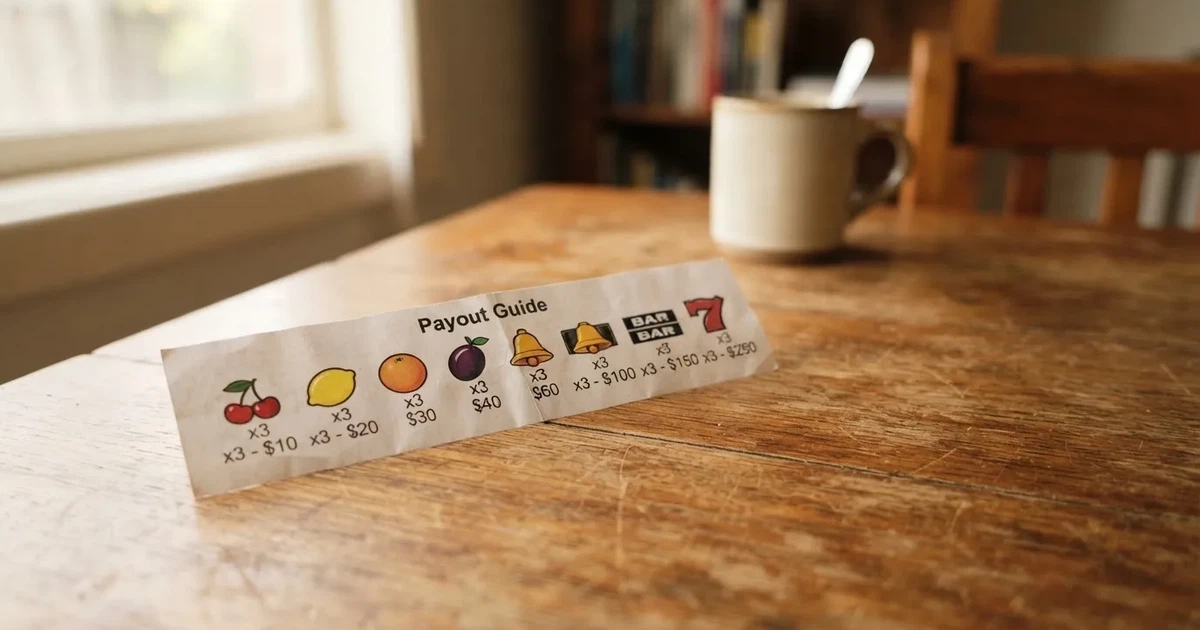
A pokies paytable — the printed or on-screen reference that lists every symbol combination and what it pays — is the same on a licensed machine in an NSW pub and on an offshore site, because the format is the genre. A 5×3 reel grid with a fixed number of paylines, a scatter symbol, a wild, and a free-spins feature, each carrying a multiplier for the matching combinations, is what a paytable describes. The catalogue on a pokies site is typically organised the same way: by provider (the studio that built the title), by theme (Egyptian, Irish, fruit machine, “Megaways”), and by volatility class (low, medium, high — i.e. how often the title pays, and how big the rare wins tend to be).
RTP, the percentage of money wagered that the title is designed to return to players over a very large number of spins, is a published figure on every well-run title. On Australian-licensed land-based pokies it has a state-by-state floor. On an offshore online title it has whatever the developer publishes — and many titles do not publish one. The reader should treat an unstated RTP as “we are not telling you,” because that is what it is.
Baccarat and Blackjack for Context
Two table games that sit alongside pokies on most offshore casinos are worth naming for the reader who arrives thinking “casino” and lands on “pokies.” Baccarat’s house edge is 1.06% on the Banker bet, 1.24% on the Player bet and 14.36% on the Tie; punto banco, the variant most played today, was developed in Havana during the 1940s and the casino banks the game at all times. Blackjack under optimal strategy carries a house edge of about 0.28% under liberal Las Vegas Strip rules (dealer stands on soft 17, double on any two cards, double after split, resplit aces, late surrender) and about 0.43% under Atlantic City rules. Both are small edges by casino-game standards, and both are available on the licensed Crown Melbourne floor as well as on offshore sites — Crown Melbourne offers three baccarat variants (Traditional Baccarat, Crown Baccarat and 2 to 1 Baccarat) as approved table games regulated by the Victorian Gambling and Casino Control Commission, which replaced the VCGLR as Victoria’s casino regulator on 1 July 2022.
The point is not the edge. The point is that the licensed and offshore products carry very different edges in terms of recourse. The same baccarat hand at the same table can be played under Victorian regulation on one side of a building or under an offshore licence on the other; only one of those offers an Australian complaints route.
The Brands the ACMA Has Named
Eleven brands make up the featured set, each the subject of a formal ACMA warning for offering prohibited services to Australians. The order is the regulator’s own publication order, not a ranking.
| Brand | ACMA action and date | Operator named by the ACMA | Subject support |
|---|---|---|---|
| RocketPlay | Formal warning, March 2026 (Pulsup Ltd); earlier May 2022 (Dama N.V.) | Pulsup Ltd | — |
| Level Up Casino | Formal warning, May 2022 | Dama N.V. | BGaming listings |
| Woo Casino | Formal warning, March 2025 | Dama N.V. | — |
| Spirit Casino | Formal warning, May 2025 | Dama N.V. | — |
| National Casino | Formal warning, July 2025 | Consolutetish S.R.L. | en.wikipedia.org listings |
| Bizzo Casino | Formal warning, July 2025 (Consolutetish S.R.L.); earlier 2022 (TechSolutions) | Consolutetish S.R.L. | — |
| Ignition Casino | Formal warning, July 2025 | Bamboo Media | — |
| Instant Casino | Formal warning, February 2025 | EOD Code SRL | — |
| Jackbit | Formal warning, April 2026 | Ryker B.V. | — |
| Casino Intense | Formal warning, April 2025 | Sterplay Holding Ltd | ABC, ACMA, Crown Melbourne listings |
| Sky Crown | Formal warning, September 2022 | Hollycorn N.V. | — |
The dashes in the right-hand column are the absence of any subject support research could cite for that brand beyond the regulator’s own record; the cells with listings names indicate where research found background references but no operator-side confirmation. The shared condition is unchanged across every row: online casino games cannot be licensed anywhere in Australia, whatever licence the site displays. The brand name is not the licence, and the licence is not an Australian one.
What Each Warning Actually Says
The formal-warning register is the regulator telling an operator, in writing and on the public record, that the ACMA considers it to be offering prohibited services to Australians. It does not by itself take the site offline. It does mean that the ACMA has the operator on its radar and that the next step — a blocking request, or a civil penalty proceeding — is the documented escalation path. Reading the register before opening an account is the cheapest piece of due diligence an Australian punter can do.
The eleven brands above are read one at a time below, in the order the regulator published them. Each entry closes on the page’s own judgement of what the record actually shows, not on the operator’s marketing.
RocketPlay
The ACMA issued a formal warning to Pulsup Ltd over Rocketplay in March 2026, with an earlier May 2022 warning to Dama N.V. covering six brands that included Rocketplay. Two warnings, separated by four years, from a regulator that does not reissue warnings carelessly, is a strong signal the operator has been told repeatedly. The site’s claim to offer online pokies to Australians is the specific service the warnings cover. What RocketPlay offers that an Australian-licensed product does not is the inducement the IGA also prohibits; what it does not offer is the Australian consumer-protection layer. A reader who values the option of Australian recourse should note that this operator has twice been named by the regulator.
Level Up Casino
The May 2022 formal warning to Dama N.V. covered six casino brands: Bambet, Dazard, Level Up, Rocketplay, Wild Tornado and Cobra Casinos. Level Up is one of six in a single Dama N.V. action, which tells the reader that the ACMA addressed Dama N.V. as a group operator rather than as a single brand. That group-level framing matters: the same operator entity sits behind multiple sites, and a brand-level “Aussie-friendly” presentation does not change the corporate structure the regulator named. This action highlights that the operator is the focus for the regulator, regardless of which brand site the player interacts with.
Woo Casino
The March 2025 formal warning to Dama N.V. over Woo Casino is one of the two follow-up actions to Dama N.V. (with Spirit Casino, May 2025). A 2022 group warning followed by a 2025 single-brand warning is the documented pattern of an operator that did not change course after the first letter. The page’s read is that Woo Casino is on the regulator’s record twice, four years apart, and the brand the reader is being offered sits inside the operator entity the ACMA has already addressed twice.
Spirit Casino
The May 2025 formal warning to Dama N.V. over Spirit Casino is the second of the two 2025 Dama N.V. follow-ups. Together with Woo Casino, it shows that Dama N.V.’s 2022 warning has not been treated as a settled matter by the regulator. Spirit Casino is on the record in its own right; the read is the same as for Woo Casino, namely that the operator entity behind the brand has been told repeatedly.
National Casino
The July 2025 formal warning to Consolutetish S.R.L. over National Casino is one of three Consolutetish S.R.L. actions in the same round (with Bizzo Casino, in the same July 2025 batch). The grouping tells the reader the same thing the Dama N.V. pattern does: the regulator has addressed the operator entity, not the brand, and the brand sits under that entity. National Casino’s record is one warning in 2025; the read is that the brand is recent to the regulator’s eye rather than a long-standing name on the list.
Bizzo Casino
Bizzo Casino carries two formal warnings: one to TechSolutions (CY) Group Limited and TechSolutions Group N.V. in 2022, and one to Consolutetish S.R.L. in July 2025. Two different operator-entity names on the warning record across three years is the strongest pattern in the table, and the read is that the brand has changed corporate hands without leaving the regulator’s list. The page’s judgement is that an operator change has not changed the regulator’s view of the offering.
Ignition Casino
The July 2025 formal warning to Bamboo Media over Ignition Casino is the only ACMA action on the record for this brand, and the entity named (Bamboo Media) is not the entity behind any of the other ten brands. The brand sits alone in the table by operator. The read is that Ignition Casino is a one-off in the regulator’s correspondence with this set of offshore pokies brands.
Instant Casino
The February 2025 formal warning to EOD Code SRL over Instant Casino was the early-2025 entry on the register, and the entity named (EOD Code SRL) is not on any other row of the table. The brand sits alone by operator. This remains a standalone entry for this corporate entity in the ACMA’s published record.
Jackbit
The April 2026 formal warning to Ryker B.V. over Jackbit is paired with a same-month warning over CasinOK, a brand outside the featured set. Ryker B.V. therefore sits behind two brands the ACMA has addressed, one inside this ranking and one outside it. The read is that the operator entity is the unit the regulator has acted against, and Jackbit is one of the two on Ryker B.V.’s record.
Casino Intense
The April 2025 formal warning to Sterplay Holding Ltd over Casino Intense is the only ACMA action on the record for this brand. Sterplay Holding Ltd is not named on any other row of the table. The read is that Casino Intense sits alone by operator in this set and the regulatory letter was a single-entity action.
Sky Crown
The September 2022 formal warning to Hollycorn N.V. covered Sky Crown and Blue Leo in a single publication, which means the regulator’s action sat across both Hollycorn N.V. brands at once. Blue Leo is not in the featured set; Sky Crown is. The verdict is that the regulatory letter covered the Hollycorn N.V. brand family and Sky Crown is one of the two named services.
What This Page Does Not Recommend
This page describes operators. It does not recommend one as a place to play. The reason is structural: a recommendation to an Australian punter to play at an offshore casino is a recommendation to use a service the ACMA has named in a formal warning or asked ISPs to block. The page does not do that. The reader’s decision, taken after reading the regulator’s record, is the reader’s decision.
What the 2026 Reform Changes
The Interactive Gambling Amendment (Gambling Reform) Bill 2026 passed Parliament on 19 August 2026, and its advertising and inducement measures commence on 1 January 2027. The reform is law with a start date, not yet in force on a 2026 page. Once in force, the inducement side of the prohibition becomes harder to enforce against offshore operators running ads aimed at Australians, and the page that ships a year from now will read the change. As of 2026 the law that is in force is the Interactive Gambling Act 2001 as amended in 2017, and that is the regime the ACMA’s enforcement rounds are running under.
Tax and the Recreational Player
Gambling winnings of a recreational Australian player are not assessable income under section 6-5 of the ITAA 1997, and losses are not deductible — unless the person carries on a business of gambling. The ATO’s own guidance is the read the page will not second-guess; “check with the ATO” is the standard answer and is the right one. The offshore question adds nothing: the Australian tax treatment of a recreational punter does not depend on whether the operator is licensed in Australia or offshore, only on whether the punter is carrying on a business of gambling.
The Single Read
Australia has a pub and club pokies sector regulated state by state, with a 30,000-machine cap in Victoria, 87,298 machines outside casinos in NSW, mandatory pre-commitment cards planned in Tasmania, and machine counts and minimum RTPs that vary by jurisdiction. It has a licensed wagering sector for pre-event racing and sport, regulated in practice by the NTRWC. It does not have an online pokies sector, because the Interactive Gambling Act 2001 prohibits one. What it has instead is an ACMA register of brands that have offered that prohibited service to Australians, an ISP-level blocking regime that has now cleared 1,751 illegal sites since November 2019, and an estimated A$3.9 billion a year in losses to illegal offshore sites.
The honest read of “best online pokies in Australia” is therefore not a shortlist. It is the regulator’s record, the cost of the gap the regulator has not closed, and the licensed onshore product the reader can reach in person.
Frequently Asked Questions
Does calling an online pokies site “Aussie” change where it is actually licensed?
No. The branding is a marketing jurisdiction, not a regulatory one. An “Aussie pokies” site is, in practice, an offshore operator that has chosen to label itself that way. The ACMA’s enforcement record treats the operator’s actual licence, not its branding.
Are the bonus credits and free spins on an “Aussie pokies” site legal to advertise here?
No. The IGA treats the offering of an inducement to use a prohibited interactive gambling service as a prohibited act. The same bonus vocabulary the licensed industry uses is unregulated on an offshore site, and the terms that govern the bonus (the wagering multiple, the max cashout, the game-weighting exclusions) are not visible from the headline. The marketing line is the offer; the terms page is the cost.
Is there a dedicated app for Aussie-branded online pokies that’s legal to install locally?
No licensed app exists. Online pokies are prohibited for people in Australia under the Interactive Gambling Act 2001, and no Australian regulator issues a licence for an app that offers them. The licensed product is the machine in the pub, club or casino, and it does not ship as an app.
Do state gaming regulators recognise any “Aussie online pokies” brand as licensed?
No. State and territory regulators regulate land-based pokies state by state, and the land-based product is the only pokies product an Australian regulator recognises. Online pokies cannot be licensed anywhere in Australia, and no state or territory issues such a licence. An offshore licence is not an Australian one regardless of which jurisdiction issues it.
How does an Aussie-branded online pokies catalogue differ from a licensed pub’s machines?
The format is the genre and is the same on both: a paytable, a reel grid, a scatter and a wild, a free-spins feature, an RTP. What differs is the regulatory frame around it. The licensed pub’s machine has a state-by-state minimum RTP (85% in NSW, the NT, Queensland and generally Victoria; 87% in the ACT and Tasmania; 87.5% in South Australia; 90% in Western Australia) and sits inside a venue that is licensed and inspected. The offshore online title has whatever RTP the developer publishes — and many titles do not publish one. The format is the same; the framework is not.
Can an Aussie-branded online pokies site accept a PayID deposit and still be unlicensed?
Yes. PayID, Osko and BPAY are Australian instant and near-instant rails; a site offering PayID is not, by virtue of offering PayID, an Australian-licensed product. The licence governs the offer, not the rail the deposit rides on. An offshore site that accepts PayID is still outside Australian law, and the ACMA’s blocking regime still applies to it.