
best progressive jackpot slots 2026: how a rising prize pool works, and what it costs the Australian punter chasing one
Currency stamp: current as of 29 October 2026; checked against the ACMA’s published formal-warning register and the Interactive Gambling Act 2001 as it stands.
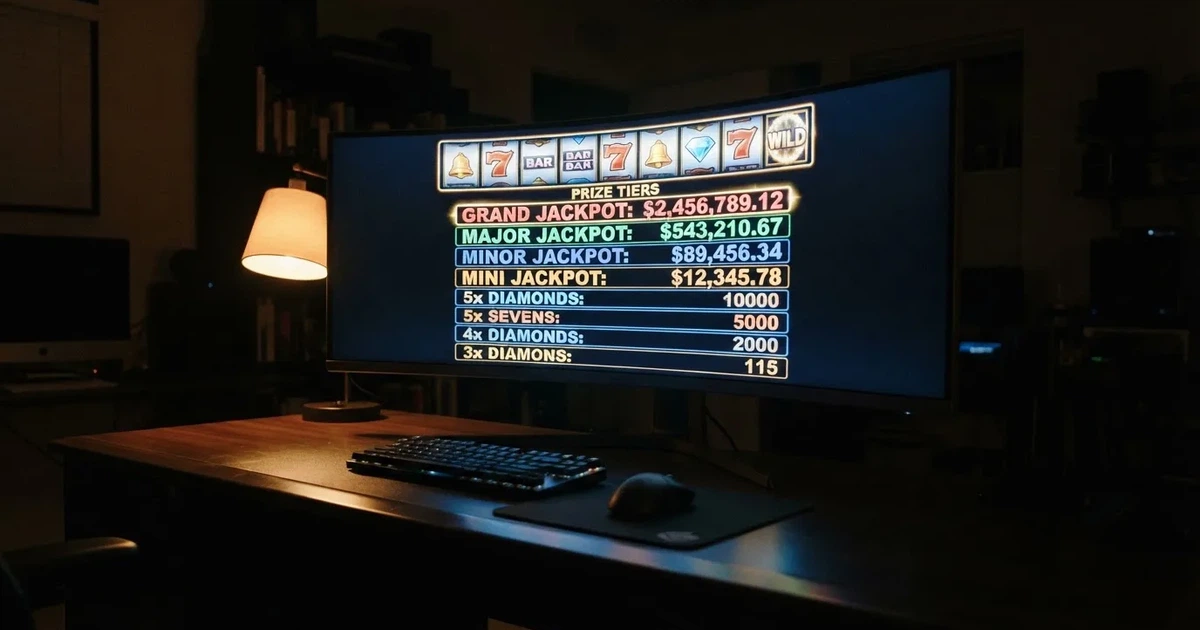
A progressive jackpot slot is the only casino game where the headline number a player chases is bigger than the game they play to win it. The reels spin like any other slot, but a fixed slice of every losing wager across a network of machines or sites feeds a single rising prize pool, and the pool keeps climbing until somebody wins it. The advertising leans on that climb — €19,430,723.60 won on a single spin in Belgium in 2021 is the kind of figure that does the marketing’s work for it. The arithmetic the marketing does not publish is what this page is about.
In Australia that arithmetic has a second layer. Online casino games, online pokies, and progressive jackpots offered online sit on the prohibited side of the Interactive Gambling Act 2001. The casino sites that advertise these jackpots to Australians — the ones that come up in any search for “best progressive jackpot slots 2026” — are offshore operators the ACMA has been moving against, year after year, with formal warnings and ISP-level blocking. A punter in Australia who signs up to one has no Australian regulator to complain to if a withdrawal is refused, and no BetStop enrolment to lean on if the play needs to stop. The page below explains the mechanics first, because that is where the cost lives, then walks through who is offering what, why the offer is the shape it is, and what enforcement against the offer looks like.
Table of Contents
- How a progressive jackpot actually grows — and why the base RTP sits lower to fund it
- Inside the wide-area progressive: Mega Moolah and the network economics behind it
- Where Australians can and can’t play progressive jackpot slots
- Responsible play around a product that advertises big numbers
- The brands advertising progressive jackpots to Australians — and what the ACMA has done about each
- The shape of enforcement: how the ACMA has been closing the gap
- How the offshore product is shaped — and why no working offer can be printed here
- The case for not chasing the progressive from Australia
- Where this leaves the choice
- Frequently asked questions on progressive jackpot slots
How a progressive jackpot actually grows — and why the base RTP sits lower to fund it
The mechanics of a progressive jackpot are short to describe and take longer to absorb. A portion of every losing wager — typically a few tenths of a percent of the stake, sometimes a full percentage point — is diverted into a shared pool instead of being kept by the house. The pool is visible on the machine or in the game window as a counter that ticks upward between wins. When the jackpot lands, the pool is paid out (sometimes as a lump sum, sometimes as an annuity), the counter resets to a seeded minimum, and the climb starts again. The technical definition is plain: progressive jackpots were first introduced in large casinos in 1986, the first Megabucks machine from International Game Technology paid out its inaugural jackpot of $4,988,842.17 on 1 February 1987, and the structure has not changed since. The number has.

What changes is the network the jackpot is wired to. A standalone progressive is contained to a single machine or a single online game title, and its pool grows only as fast as that one game is played. A wide-area progressive links machines across many venues or, online, many sites running the same software — the Mega Moolah series distributed by Games Global (the business formerly known as Microgaming) is the canonical example, and the Belgian win of 27 April 2021, paying €19,430,723.60, was on a wide-area network feeding off every spin across every operator carrying the game. The wider the network, the faster the pool climbs, and the further the headline figure gets from anything the local player is contributing. A punter spinning a €0.20 line in Adelaide is one node on a network paying out in euros to a player in another country, and the disconnect between the contribution and the prize is the structural feature of the product.
That structural feature is paid for out of the base game’s return. The RTP printed on a fixed-jackpot slot is what it is — what the player loses per spin is the difference between 100% and the figure the game publishes. A progressive slot trims the base RTP to free up a slice of every wager for the rising pool, so the game the player actually plays for ninety-nine spins out of a hundred returns less than an equivalent fixed-jackpot game would. The pool is the incentive; the base game is the cost of being eligible for it. The trade-off is visible in the maths: the slice diverted to the progressive pool is the slice the base game’s RTP is reduced by. A punter who plays a progressive slot is paying a small, ongoing premium for a long-shot chance at the pool — and the house always has an edge on the rest.
A second variant, the “must-hit-by” jackpot, hides the size of the prize until it lands. A random number generator sets the exact payout amount within a preset range (for example A$1,000–A$3,000) immediately after the previous jackpot is won, so winning it does not require landing a specific combination of symbols — the system itself decides when the threshold has been reached and triggers the prize. The pool is lower than a wide-area progressive and the win is more frequent, but the marketing has nothing to print on a counter while it climbs, which is why most of the jackpot advertising you see is for the rising kind, not the must-hit kind. Both are paid for out of the same base-RTP reduction.
Inside the wide-area progressive: Mega Moolah and the network economics behind it
Mega Moolah is the case study because the figures are public and the network is global. The series is now distributed by Games Global, the business that took over Microgaming’s distribution arm, and the headline numbers Games Global has reported across the series since the Belgian win include later payouts of £11.5 million and £13.5 million on top of the €19.4 million. The €19.4 million win at Napoleon Sports & Casino in Belgium on 27 April 2021 sits on a single spin of “Absolootly Mad: Mega Moolah”, which is a five-reel video slot in its own right and a node on the wider Mega Moolah network in parallel. Each spin at each operator contributes to the same pool; each spin at each operator has the same odds of being the winning one.

The economics of that network are why the pool climbs faster than a single-site progressive and why the base game sits at a lower RTP to fund it. A fixed-jackpot slot returning 96% to the player gives 4% to the house; the same slot stripped of 2% to fund the progressive pool returns 94% on the base game. The 2% flows up to the pool, the pool pays out infrequently, and over thousands of spins the gap between 96% and 94% is what a punter pays for the chance at the headline number. The closer the pool gets to record territory, the more attractive the marketing gets, and the more important it is to remember the rate the base game is actually paying out at.
A separate mechanic — relevant to the small handful of progressive games that include video poker or Caribbean Stud Poker variants — can push the theoretical return above 100% when the pool climbs far enough, creating a positive-expectation bet. That break-even point is real in principle and largely theoretical in practice for slot machines, because the reel layouts are not published and a player cannot calculate the exact threshold themselves. It is the one case where the long-shot math genuinely flips, and the one case the marketing never leads with.
Where Australians can and can’t play progressive jackpot slots
Australia splits the gambling product into what is licensable and what is not, and the line falls on game type rather than operator. Wagering on races and sport placed before the event is licensable, and the majority of online bookmakers holding an Australian licence are licensed by the Northern Territory Racing and Wagering Commission (NTRWC) — 52 of them, including Sportsbet, Bet365 and Ladbrokes. The Commission has no full-time staff and meets once a month in Darwin; the licence is real, and the territory’s role is closer to a tax-collection point than a day-to-day regulator. Lotteries and keno are licensable in their respective state regimes. Online casino games, online pokies and the progressive jackpot slots that appear in search results are not licensable anywhere in Australia, and have not been since the Interactive Gambling Act 2001 was tightened by the Interactive Gambling Amendment Act 2017.
The Interactive Gambling Amendment (Gambling Reform) Bill 2026 passed Parliament on 19 August 2026, and its advertising and inducement measures commence on 1 January 2027 — law on the books, not yet in force on a 2026 page. The shape of the prohibition is unchanged: the offering, not the playing, is the offence. A punter in Australia who deposits at an offshore casino is not personally prosecuted under the IGA. The provider is. The consequence for the punter is that there is no Australian regulator to complain to, no Australian complaints body, and no Australian recourse if a withdrawal is refused or a balance is held. The site can also be blocked at ISP level while a balance sits on it.
That is why the brands that turn up in any “best progressive jackpot slots” list for Australia are offshore operators, almost all running on a Curaçao or Anjouan licence that does not extend to Australian players. The site says it is licensed; the licence does not say the site can take Australian customers. H2 Gambling Capital’s 2025 report estimates that Australians lose about A$3.9 billion a year to illegal gambling sites, and that the share of gambling going through legal channels fell from 74% in 2021 to 64%. The market is large and the local product is narrow, and the gap between the two is exactly what the offshore operators fill.
Responsible play around a product that advertises big numbers
The wider the progressive, the louder the marketing, and the harder it is to keep the size of the pool in proportion to the odds of hitting it. A punter’s first line of defence is the one that does not depend on which site they end up on. BetStop, the National Self-Exclusion Register, has been live since August 2023 and binds every Australian-licensed online and phone wagering service — a self-exclusion flows through to Sportsbet, Bet365, Ladbrokes and the rest in one registration. The catch, and it is the only catch that matters here, is that an offshore casino is not connected to BetStop, so registering for self-exclusion does not stop an offshore account from accepting deposits. A punter who needs the exclusion to hold across every product they use has to combine BetStop with the offshore site’s own self-exclusion tool, and to be the one who enforces it.
The National Gambling Help Line is 1800 858 858, free, 24/7, with chat at Gambling Help Online. Both run regardless of where the gambling happens. A punter who feels the play drifting has somewhere to call that is not the site they are calling about.
The credit-card ban that came in on 11 June 2024 is the other guardrail that affects the choice. Credit cards, credit-related products and digital currency are banned as payment for licensed online wagering, with penalties up to $247,500 for operators who take them. The legal deposit routes for a licensed Australian wagering account are debit card, bank transfer, PayID/Osko and BPAY. A site asking an Australian for a credit card or a crypto deposit is operating outside the Australian rules by definition, and the payment method itself is a quick check on whether the rest of the offer is what it claims to be.
Gambling winnings of a recreational player are not assessable income under section 6-5 of the ITAA 1997, and losses are not deductible, unless the person carries on a business of gambling. A punter who hits a progressive jackpot is taxed the same way a punter who buys a lucky scratchie is taxed: the win is theirs, and the ATO does not need to be told. The model the ATO uses for gambling businesses is a separate regime and is not the right frame for a one-off punter.
The brands advertising progressive jackpots to Australians — and what the ACMA has done about each
The eleven brands below are not a recommendation and not a ranking. Each is on this list because the Australian Communications and Media Authority issued a formal warning over it for offering prohibited online casino services to people in Australia. The ACMA’s register is the source, the warnings are public, and the order below is the order the warnings are surfaced in §6 of the research, kept as it stands. What each entry shows is who the ACMA named, when, and what that means for the progressive jackpot product they are advertising. None of these brands is licensed to offer online casino games to Australians; the licence a site displays in its footer is not an Australian licence, and the prohibition in the Interactive Gambling Act 2001 does not depend on which offshore jurisdiction the operator has registered in.
| Brand | ACMA action and date | Operator named by the ACMA | Subject support |
|---|---|---|---|
| RocketPlay | Formal warning, March 2026 (Pulsup Ltd); earlier Dama N.V., May 2022 | Pulsup Ltd | — |
| Level Up Casino | Formal warning, May 2022 | Dama N.V. | listings report the brand on the BGaming site |
| Woo Casino | Formal warning, March 2025 | Dama N.V. | — |
| Spirit Casino | Formal warning, May 2025 | Dama N.V. | — |
| National Casino | Formal warning, July 2025 | Consolutetish S.R.L. | listings report the brand on en.wikipedia.org |
| Bizzo Casino | Formal warning, July 2025 (Consolutetish S.R.L.); earlier TechSolutions, 2022 | Consolutetish S.R.L. | — |
| Ignition Casino | Formal warning, July 2025 | Bamboo Media | — |
| Instant Casino | Formal warning, February 2025 | EOD Code SRL | — |
| Jackbit | Formal warning, April 2026 | Ryker B.V. | — |
| Casino Intense | Formal warning, April 2025 | Sterplay Holding Ltd | listings report the brand on ABC News, the ACMA site and the Crown Melbourne site |
| Sky Crown | Formal warning, September 2022 | Hollycorn N.V. | — |
The column on the right is the page’s honest read of what the research carried about each brand’s relationship to progressive jackpot slots specifically. For most of the eleven, no source surfaced any data on whether the brand offers a progressive jackpot product at all, and an absent finding is not an endorsement and not a denial — the page simply does not attach the subject to the brand. The three with listings-only entries are named because the listings named them, and the page reports exactly what those listings said.
RocketPlay
Pulsup Ltd received a formal warning from the ACMA in March 2026 over RocketPlay. The same brand was the subject of an earlier Dama N.V. warning in May 2022, which means RocketPlay has been on the ACMA’s radar across two operators and four years. Online casino games cannot be licensed anywhere in Australia, and the licence RocketPlay displays does not change that. For a punter comparing progressive jackpot offers, the relevant question is not whether the site carries Mega Moolah or a similar wide-area network — most do — but whether the operator behind the .com.au front is the same operator behind a site the ACMA has now told to stop serving Australian customers twice. The verdict is the page’s own: RocketPlay is the most-recently warned brand in the table and the second operator to be told to leave, which makes it the brand where the warning’s weight is heaviest.
Level Up Casino
Dama N.V. was named in an ACMA formal warning in May 2022, and Level Up Casino was one of six Dama brands named in the same round (alongside Bambet, Dazard, Rocketplay, Wild Tornado and Cobra Casinos). Level Up is the brand that surfaces on the BGaming site as part of the listings, which is what research carried on the subject-support question. The research did not surface a progressive-jackpot-specific figure for Level Up, so the page does not put one on it. The verdict: Level Up sits in a cluster of Dama brands that has been on the ACMA’s list since 2022 and that the regulator has returned to more than once since (Woo Casino in March 2025, Spirit Casino in May 2025). The brand is one node in a wider portfolio the ACMA has been moving against for four years.
Woo Casino
Dama N.V. received a further formal warning from the ACMA in March 2025 covering Woo Casino, on top of the May 2022 round. Woo is the second Dama brand on the list after Level Up and the first of the post-2022 warnings, which means the ACMA is treating Woo as an active brand worth a fresh warning rather than an inactive one the 2022 round put to bed. There is no progressive-jackpot-specific data in research for Woo. The verdict: Woo is a Dama brand with a current ACMA warning and no Australian-licence pathway, and the choice the page makes is to treat the warning as the load-bearing fact rather than guess at the jackpot product underneath.
Spirit Casino
Spirit Casino was the subject of a Dama N.V. formal warning in May 2025, two months after the Woo warning and three years after the original Dama round. The pattern — Woo March 2025, Spirit May 2025 — is the ACMA returning to a single operator and walking down its portfolio brand by brand, which is the shape enforcement takes when the operator has not changed course. No progressive-jackpot-specific data is carried for Spirit. The verdict: Spirit is the most-recent of the Dama warnings as of the research window, and the ACMA’s pace on the Dama portfolio is itself a piece of information a punter weighing the brand should weigh too.
National Casino
Consolutetish S.R.L. received a formal warning from the ACMA in July 2025 covering National Casino and Bizzo Casino in the same round. National Casino is the brand whose name surfaces on en.wikipedia.org as part of the listings, which is what research carried on the subject-support question. No progressive-jackpot-specific figure was surfaced. The verdict: National Casino sits in a paired warning with Bizzo — same operator, same month — and the ACMA is naming both brands at once because the operator behind both is the same. Treating one as a separate choice from the other is treating two surfaces of the same operator as if they were independent.
Bizzo Casino
Consolutetish S.R.L. was named in the July 2025 warning covering Bizzo Casino, and Bizzo had already been the subject of a 2022 formal warning to TechSolutions (CY) Group Limited and TechSolutions Group N.V. Two operators, two warnings, same brand — Bizzo is the clearest case on the list of an operator rotating its corporate entity after a warning and being warned again under the new entity. No progressive-jackpot-specific data is carried. The verdict: Bizzo is the brand whose ACMA history most clearly demonstrates that switching the company name does not switch the ACMA’s view, and the warning on the current operator is the one that should carry weight on the page.
Ignition Casino
Bamboo Media received a formal warning from the ACMA in July 2025 covering Ignition Casino. Ignition is the only brand in the table whose ACMA-named operator (Bamboo Media) does not recur elsewhere on the list, so the warning is the page’s only data point on the operator. No progressive-jackpot-specific figure was surfaced. The verdict: Ignition is a single-warning brand with one operator and one date, which is the minimum information a punter has to work with, and the absence of a follow-up round is not by itself a clean bill — the ACMA acts at the pace its investigations let it act, not on a publisher’s deadline.
Instant Casino
EOD Code SRL received a formal warning from the ACMA in February 2025 over Instant Casino. The warning came five months before the National/Bizzo round, and the operator (EOD Code SRL) is unique to Instant Casino on this list. No progressive-jackpot-specific data is carried. The verdict: Instant Casino is a single-warning brand on a single operator, and the relevant comparison for a punter weighing it is not the other brands on this list but the alternative of playing on an Australian-licensable product — which the operator is not.
Jackbit
Ryker B.V. received a formal warning from the ACMA in April 2026 covering Jackbit and CasinOK. April 2026 is the most recent warning date on the table apart from the March 2026 RocketPlay action, and Ryker is the operator behind two named brands in one warning. No progressive-jackpot-specific figure was surfaced for Jackbit. The verdict: Jackbit is one of the two most-recently warned brands, the ACMA’s action is current, and the warning date is the data point that does the work the absent jackpot figures cannot.
Casino Intense
Sterplay Holding Ltd received a formal warning from the ACMA in April 2025 over Casino Intense. Casino Intense is the brand whose name surfaces across ABC News, the ACMA site and the Crown Melbourne site as part of the listings — a different listing pattern from the other brands, which tend to surface on a single listings page. No progressive-jackpot-specific data was carried. The verdict: Casino Intense is the brand whose ACMA history is the most widely cross-referenced in the research, and the cross-references are exactly what the page has been honest about — listings, not jackpot data.
Sky Crown
Hollycorn N.V. received a formal warning from the ACMA in September 2022 covering Sky Crown and its Blue Leo casino service. Sky Crown is the oldest warning on the table and the one with the longest gap to the next ACMA action against Hollycorn. No progressive-jackpot-specific figure is carried. The verdict: Sky Crown is the warning with the most years behind it, and the gap to the next ACMA action against Hollycorn is not a clearance — the operator is still on the register, and the formal warning has not been withdrawn.
The shape of enforcement: how the ACMA has been closing the gap
The eleven warnings above are the ACMA’s editorial line on who is advertising to Australians. The broader picture is in the numbers. As of June 2026, the ACMA reported a cumulative total of 1,751 illegal gambling and affiliate marketing websites blocked since the first blocking request in November 2019, and more than 230 unlicensed gambling services had left the Australian market since enforcement was strengthened in 2017. In the round reported on 26 June 2026, the ACMA asked Australian internet service providers to block 12 more illegal gambling websites in one action: 7Signs, ChromaBet, Donbet, Duospin, Freshbet, Slots Gem, Jacks Club, Lucky Start, Pointsbetz, Spinrise, Vinyl Casino and Wildsino. The blocking rate is the metric that makes the cumulative number legible — and the prescribed calculation for this page.
The arithmetic. The first ACMA blocking request was issued in November 2019, and the cumulative total of blocked sites stood at 1,751 as of the June 2026 round. The total includes affiliate marketing sites as well as gambling sites, which the ACMA groups together in the published figure; the rate below treats the published total as the denominator, with the caveat that the underlying mix is not split out by the source. Spread over roughly six and a half years from November 2019 to the June 2026 report, the rate is in the band of about 270 blocked sites per year, or roughly 22 to 23 per month across the full window. In the active rounds of 2025 and 2026 the pace is materially faster than that average — the May 2022 Dama round alone covered six brands in one action, and the July 2025 round covered four — but the long-run rate is the headline the ACMA’s own framing puts on the table.
This arithmetic is meant to clarify the speed at which the ACMA is closing the gap between the offshore market and the Australian consumer. A punter searching “best progressive jackpot slots 2026” in Australia is reaching into a market the regulator is blocking at a steady rate of more than two hundred sites per year, with affiliate marketing sites in the same total as the gambling brands themselves. The shape of the enforcement is not a single takedown; it is a queue that moves every month, and the brands that come up in this year’s jackpot search are the brands the ACMA’s next blocking request is most likely to add to it.
How the offshore product is shaped — and why no working offer can be printed here
The brands above do not run the same offer in the same shape. The research did not surface wagering multiples, payout times or payment restrictions for any of them — the only sources for those would have been affiliate marketing pages, and the page does not transcribe marketing. The honest read of what the offer is for an Australian punter is structural rather than numerical. A site advertising a progressive jackpot to an Australian is, by the IGA’s own definition, an offshore operator offering a prohibited service. The licence it displays is not Australian; the regulator behind the licence is not the ACMA; the complaints body the licence points at is not a body an Australian punter can compel. A credit card or crypto deposit the site asks for is the credit-card-ban violation of 11 June 2024 by another name, and the absence of a BetStop binding is the absence of the one exclusion tool that would actually flow through to every Australian-licensable account at once.
What the page can say is what the offer is not. It is not covered by an Australian consumer guarantee. It is not connected to BetStop. It is not paid through a debit card, bank transfer, PayID, Osko or BPAY on terms the Australian rules recognise. It is not policed by the Victorian Gambling and Casino Control Commission, the NSW Independent Casino Commission, or the NTRWC for the casino product itself — those bodies regulate Australian-licensed wagering and lotteries and the in-venue pokies at Crown Melbourne and the Star Sydney, not the offshore casino sites. The progressive jackpot product that turns up in any “best of” list for Australia is offered in a regulatory space none of those bodies cover, and the ACMA’s role is to move the offer out of reach rather than to police it once a punter has reached it.
That is the angle this page takes from the operator block onward. The brands are named because the ACMA named them, the warnings are listed because the ACMA published them, and the page does not print a bonus term because no source other than affiliate marketing would carry one. The progressive jackpot a punter in Australia is being sold is the same product the Belgian player won €19.4 million off in 2021, offered by an operator with no Australian licence, sitting on a network whose base RTP is reduced to fund the pool, marketed with a headline number the punter’s own contribution to the pool will never realistically reach.
The case for not chasing the progressive from Australia
The maths a punter has to do is the maths the marketing does not publish. The base RTP of a wide-area progressive slot is lower than an equivalent fixed-jackpot slot by the slice diverted to the pool — somewhere in the region of one to two percentage points depending on the game and the network. Across thousands of spins, the difference is what the punter pays for the chance at the headline figure. The headline figure is real and the Belgian win is documented, but the Belgian win is one event on a network of millions of contributing spins, and the odds of any single spin being the winning one are set by the size of the network and the trigger condition, not by the size of the displayed pool. A pool that has climbed to €18 million is not closer to paying out than a pool that has climbed to €12 million; the trigger is random and the pool size is the marketing’s job, not the math’s.
The product for an Australian punter who wants to play a progressive jackpot is not closed — it is offshore, and the ACMA is moving against it one round at a time. The product for an Australian punter who wants a regulated gaming experience with a complaint body behind it is the licensed Australian product, which is wagering on races and sport (before the event), lotteries and keno, plus the in-venue pokies at Crown Melbourne under the Victorian Gambling and Casino Control Commission and at the Star Sydney under the NSW Independent Casino Commission. Progressive jackpots are not in the Australian-licensed online product, and the ACMA’s enforcement record is the page’s evidence that the gap between the licensed product and the advertised one is not closing in the offshore operators’ favour.
Where this leaves the choice
For a punter outside Australia, the progressive jackpot shortlist is a normal comparison: which network, which game, which RTP, which trigger. For a punter in Australia, the comparison runs through the ACMA’s register before it runs through anything else. A brand on the register is offering a prohibited service, and the ACMA’s pace at closing the gap — measured in hundreds of blocked sites per year — is the long-run rate at which the offer is being shrunk out of reach. A punter who decides the chase is worth it is making that decision against the page’s reading of the evidence, not with the page’s endorsement of it, and the responsible-play tools (BetStop for the licensed product, the National Gambling Help Line on 1800 858 858 for anything else) are the routes the page points to regardless of which way the decision goes.
Frequently asked questions on progressive jackpot slots
How does a progressive jackpot slot’s prize pool actually grow between wins?
A fixed portion of every losing wager — typically a few tenths of a percent to a full percent of the stake — is diverted into a shared pool instead of being kept by the house. The pool ticks upward on the machine or in the game window until somebody wins it, at which point it resets to a seeded minimum and the climb begins again.
What’s the difference between a standalone jackpot and a network-wide progressive jackpot?
A standalone progressive is contained to a single machine or single online game title and grows only as fast as that one game is played. A wide-area progressive links machines across many venues or, online, many sites running the same software, and the pool climbs faster as a result. Mega Moolah, distributed by Games Global, is the canonical example of a wide-area network.
Do licensed Australian pokies venues offer progressive jackpot machines?
Yes — in-venue progressive jackpot machines exist in licensed Australian casinos and clubs, and operate under state-level regulators such as the Victorian Gambling and Casino Control Commission and the NSW Independent Casino Commission. What is not licensable is offering progressive jackpot slots as an online casino product to people in Australia; that is the gap the IGA closes and the offshore operators fill.
Why do progressive jackpot slots typically have a lower base return-to-player than fixed-jackpot games?
Because a slice of every wager is diverted into the rising pool, the base game pays back less per spin than an equivalent fixed-jackpot game would. The reduction is the cost of being eligible for the jackpot; the rest of the house edge is unchanged. Across many spins, the lower base RTP is what the player pays for the long-shot chance at the pool.
How is a record progressive jackpot payout verified?
The record online slot jackpot — €19,430,723.60, won on 27 April 2021 by a Belgian player at Napoleon Sports & Casino on Microgaming’s “Absolootly Mad: Mega Moolah” — has been reported by industry outlets including European Gaming and Gaming Intelligence. Wide-area networks publish jackpot wins through the operator and the software provider, and Games Global has continued to publish later Mega Moolah wins in the £11.5 million and £13.5 million range on top of the Belgian record.