
Best RTP Slots Australia: What the Return Figure Actually Costs the Player
A slot’s return-to-player percentage is the single most quoted number on an offshore casino’s homepage, and the single least understood by the people clicking through to it. The figure looks like a measurement of fairness. It is, in fact, a long-run average across millions of spins, calculated under laboratory conditions, published by the developer and republished by every operator that hosts the game. The Australian player who lands on one of these sites is betting against that average in real sessions, on a product the Australian Communications and Casino Control Authority has acted against repeatedly, on a balance that an internet service provider can be ordered to freeze at any time. This page walks through what that figure is, what it costs the reader, and which operators the ACMA itself has named as offering prohibited services to Australians in 2026.
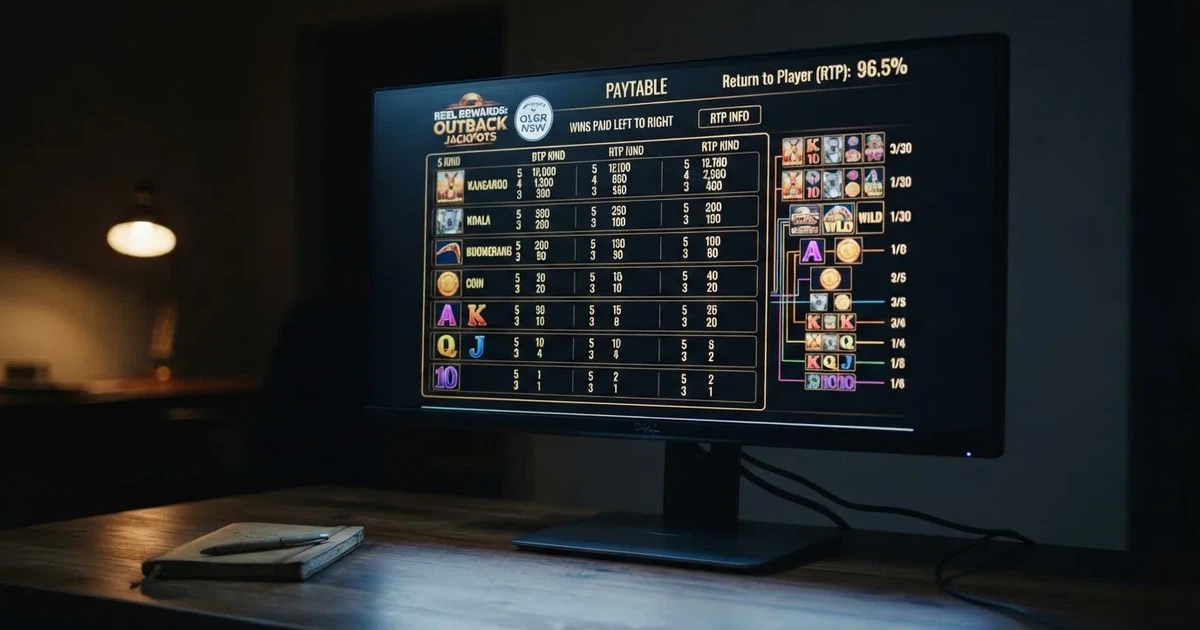
A snapshot of the data as of 2 November 2026, cross-checked against the ACMA’s published formal-warning register and the IGA prohibition regime.
Table of Contents
- Responsible Gaming and Player Protection in Australia
- Specific Games, Providers and the Mechanics of a “High-RTP” Slot
- How the Featured Operators Were Selected
- The Offshore Casino Landscape and the ACMA’s 2026 Action
- Legality and Regulation: The Prohibition Regime
- Brand-by-Brand: What the ACMA Record Says About Each Operator
- The Mechanics of a Blocking Round
- The 2026 Cluster: What the ACMA Record Says About This Year
- What the Reader Should Take Away
- Frequently Asked Questions
Responsible Gaming and Player Protection in Australia
A page about high-return slot games has to start with the off-ramps, because the product at the centre of it sits in a regulatory grey zone that Australia’s offshore-marketing industry works hard to keep there. None of the offshore brands reviewed below are connected to the Australian consumer-protection frame, and the frame itself is worth sketching first so the rest of the page reads in proportion.

Gambling Help Online runs the National Gambling Helpline on 1800 858 858 — a free, 24/7 service with a chat function reachable through the same provider. The line is for anyone whose gambling has stopped being a choice and started being a problem, and it is the first call anyone reading this page should know how to make.
BetStop, the National Self-Exclusion Register, has been live since August 2023. A person registered with BetStop is blocked from every Australian-licensed online and phone wagering service simultaneously. The register binds the licensed bookmakers and wagering operators only — none of the eleven offshore brands reviewed further down are participants, and registering with BetStop does not stop those sites from accepting a deposit or sending a promotional email. That is the clearest single sentence on the limits of Australia’s self-exclusion regime as it currently stands.
State-level self-exclusion registers — the one run by the Victorian Gambling and Casino Control Commission, the one in New South Wales, and the equivalents in other states — operate against the electronic gaming machines inside licensed venues. They are the right tool for someone playing the pokies in a pub or club, and the wrong tool for an offshore online account.
A final word on the geography of help. The helpline and BetStop are federal. The state registers are state. The two systems do not cross-talk to each other, which is the same gap an offshore casino falls through: it is not licensed under either layer, it is not bound by either scheme, and the protections those schemes extend do not reach it.
Specific Games, Providers and the Mechanics of a “High-RTP” Slot
The shelves that follow cover the mechanics of how a slot’s RTP is actually set, where the figures come from, and which provider-level patterns the high-RTP marketing leans on.
What RTP Actually Means
A slot’s RTP, expressed as a percentage, is the share of all money the game is programmed to return to players across a very large number of spins. A 96% slot, played forever under perfect conditions, returns $96 for every $100 wagered, with the remaining $4 retained by the house. The number is set by the developer when the game is built, locked into the game’s random-number generator and paytable, and verified by independent test houses — typically GLI, eCOGRA or QUIT — before the game is released.
Three details follow from that, and each one changes what the headline number means to a player. First, RTP is a long-run average: the figure only converges to its published value across millions of spins. A player who sits down for a hundred spins sees almost any outcome the game’s volatility will let through, including a session that returns 30% of stake and a session that returns 250%. Second, the figure is a return to players in aggregate, not a return to any individual player: a single player can be ahead or behind the line on any given day. Third, the figure is set by the developer, not by the operator — the same game on two different sites carries the same RTP, the same paytable and the same hit frequency, because those are properties of the code.
Why Two Slots with the Same Theme Can Have Different RTPs
The single most useful thing to know about RTP figures on the marketing pages of offshore sites is that developers publish multiple RTP configurations for the same game. A title listed at 96.2% on one site may be configured at 94.0% or 91.5% on another, with identical artwork, identical bonus features and an identical game name. The operator chooses which configuration to load, and the choice is rarely advertised.
The configurations exist because developers sell the same game into jurisdictions with different minimum-RTP rules. Nevada requires a minimum of 75% for slot machines; Mississippi, 80%; New Jersey, 83%. A game that has to clear an 80% floor in one US state can comfortably load a 96% configuration in a market with no such floor. The result is that a “96% slot” on an offshore site is one configuration of a game whose name also describes configurations at 91%, 94% and 98%, and the player has no way to tell which one is loaded without opening the in-game paytable and reading the figure off the bottom corner.
Independent Testing Before Release
A slot’s published RTP is, in practice, the developer’s claim backed by a test-house certificate. GLI, eCOGRA and QUIT run the game through millions of simulated spins against the developer’s stated math model and certify the result. The certificate travels with the game and is published by most licensed operators as part of their regulatory disclosures. The offshore sites reviewed in this page are not under any obligation to disclose the certificate, and most do not.
What testing confirms: the game’s random-number generator produces outcomes at the rate the math model predicts, the paytable returns the listed percentages, and the game does not misbehave under abnormal conditions. What testing does not confirm: that the operator is running the certified version, that the operator has not modified the game, or that any specific player will receive the listed return over any specific session. The certificate is a check on the developer; it is not a check on the operator.
Where the High-RTP Marketing Points
The high-return end of the slot market is dominated by a small number of studios. BGaming, the provider whose listings carry a couple of the operators reviewed in this page, sits in that group along with NetEnt, Play’n GO, Pragmatic Play, Nolimit City and a handful of others. The titles that top the published high-RTP lists tend to be the same dozen or so games under different skins — a Blood Suckers-style low-volatility release, a Book of-style high-volatility title, one or two jackpot slots whose headline RTP excludes the jackpot contribution. The pattern is consistent enough that any site claiming a unique catalogue of “exclusive high-RTP” slots is, in practice, republishing the same set of games with the same configurations.
How the Featured Operators Were Selected
This page ranks eleven offshore casino brands. The ranking is not a recommendation — none of these brands can be licensed in Australia under the Interactive Gambling Act 2001, and the Australian player who opens an account on any of them is using a service the ACMA has explicitly named as prohibited. The ranking exists to record, in one place, the full set of operators the ACMA has issued formal warnings against for offering prohibited interactive gambling services to Australians, in the order in which the warnings were issued or in which the underlying operator surfaced in the ACMA’s published register.
The single column that separates one brand from another on this page is the ACMA’s own action against it: which operator was warned, in which month, for which brand. Two of the eleven were subject to repeat warnings, which is recorded as such in the write-up rather than as two separate entries. Where research carries a listing for the brand on a third-party site that documents the brand’s footprint — its game catalogue, its operator history — that listing is named in the write-up; where no such listing was found, the brand is presented on the ACMA’s own record and on nothing else.
The Featured Operators
| Brand | ACMA action and date | Operator named by the ACMA | Subject support |
|---|---|---|---|
| RocketPlay | Formal warning, March 2026; earlier warning to a predecessor operator, May 2022 | Pulsup Ltd (current); Dama N.V. (2022) | — |
| Level Up Casino | Formal warning, May 2022 | Dama N.V. | BGaming game catalogue listings |
| Woo Casino | Formal warning, March 2025 | Dama N.V. | — |
| Spirit Casino | Formal warning, May 2025 | Dama N.V. | — |
| National Casino | Formal warning, July 2025 | Consolutetish S.R.L. | Catalogue listings published on Wikipedia |
| Bizzo Casino | Formal warning, July 2025; earlier warning to a predecessor, 2022 | Consolutetish S.R.L. (current); TechSolutions (2022) | — |
| Ignition Casino | Formal warning, July 2025 | Bamboo Media | — |
| Instant Casino | Formal warning, February 2025 | EOD Code SRL | — |
| Jackbit | Formal warning, April 2026 | Ryker B.V. | — |
| Casino Intense | Formal warning, April 2025 | Sterplay Holding Ltd | Listings on ABC News, the ACMA register and Crown Melbourne’s own site |
| Sky Crown | Formal warning, September 2022 | Hollycorn N.V. | — |
The brand behind the brand matters here, because Dama N.V. recurs across four entries, and Consolutetish S.R.L. sits behind two more. The same operator running a stack of superficially distinct brands is the structural pattern in this market, and the ACMA’s published register is the only source that connects the dots.
The Offshore Casino Landscape and the ACMA’s 2026 Action
The ACMA’s enforcement record against offshore operators offering prohibited interactive gambling services to Australians is the spine of this page, and it is worth setting out in one section before the brand-by-brand breakdown. The full register of ACMA formal warnings is published on the regulator’s own site; the figures below are drawn from that register.
The Blocking Round and What It Tells Us
According to the ACMA as reported in June 2026, a total of 1,751 illegal gambling and affiliate-marketing websites had been blocked since the first blocking request in November 2019. More than 230 unlicensed gambling services had left the Australian market since enforcement was strengthened in 2017. In a single round reported on 26 June 2026, the ACMA asked Australian internet service providers to block twelve further sites: 7Signs, ChromaBet, Donbet, Duospin, Freshbet, Slots Gem, Jacks Club, Lucky Start, Pointsbetz.com, Spinrise, Vinyl Casino and Wildsino.
The arithmetic the page’s writer asks the reader to hold in mind is straightforward: 1,751 sites blocked since November 2019, against a count of illegal-gambling losses to Australians of roughly A$3.9 billion a year, against an Australian legal-channel share of gambling spend that fell from 74% in 2021 to 64% in 2025.
| Blocked Site | Category |
|---|---|
| 7Signs | Online Casino |
| ChromaBet | Online Casino |
| Donbet | Online Casino |
| Duospin | Online Casino |
| Freshbet | Online Casino |
| Slots Gem | Online Casino |
| Jacks Club | Online Casino |
| Lucky Start | Online Casino |
| Pointsbetz.com | Online Casino |
| Spinrise | Online Casino |
| Vinyl Casino | Online Casino |
| Wildsino | Online Casino |
The proportion matters more than the totals. A blocking round that names twelve sites per round, repeated on the ACMA’s roughly monthly cadence, does not thin the market so much as rotate it: a site blocked under one name resurfaces under another, with the same games, the same software provider and the same marketing budget pointed at the same audience.
H2 Gambling Capital’s Loss Estimate
H2 Gambling Capital’s 2025 report estimates that Australians lose about A$3.9 billion a year to illegal gambling sites. The same report records the legal-channel share of Australian gambling falling from 74% in 2021 to 64% in 2025 — a ten-point slide in four years, against an absolute loss figure that is large enough to dwarf any plausible reduction in onshore gambling harm. The losses the ACMA cannot reach are the ones the ACMA most needs the reader to understand, because they are the part of the market this page’s subject sits inside.
The NT Online-Bookmaker Anomaly
Australia’s licensed online wagering market is, structurally, the Northern Territory’s market. The Northern Territory Racing and Wagering Commission (NTRWC) regulates 52 of Australia’s online bookmakers — including Sportsbet, Bet365 and Ladbrokes — licensed in the Territory primarily for tax reasons. The commission has no full-time staff and meets once a month in Darwin. The reader should hold that image: a regulator with no staff, licensing 52 of the country’s licensed online bookmakers, while the ACMA pursues formal-warning actions against the offshore operators the NTRWC regime was never designed to cover.
The point is not that the NTRWC is failing. It is doing exactly the job it was set up to do. The point is that the licensed-wagering side of the Australian market and the prohibited-casino side of the Australian market operate under two entirely different enforcement architectures, and the offshore casino brands reviewed on this page sit on the side that has no Australian licence, no Australian regulator and no Australian consumer-protection fallback.
Legality and Regulation: The Prohibition Regime
The Interactive Gambling Act 2001 (IGA), strengthened by the Interactive Gambling Amendment Act 2017, makes it an offence for an operator to provide online casino games, online pokies or in-play betting to a person in Australia. No state or territory licenses online casino games or online pokies. What is licensable is wagering on races and sport placed before the event, lotteries and keno — in practice, the 52 operators licensed by the NTRWC.

Minimum age is 18. The individual player is not prosecuted under the IGA — the Act targets the provider — but the practical consequences for the player are not nothing. An offshore site gives no Australian consumer protection, no complaints body and no recourse if a withdrawal is refused. A site can be blocked, mid-session, with a balance still on it. The ACMA can and does direct those blocks, on a roughly monthly cadence, against the operators reviewed in this page and against hundreds of others.
The 2026 Reform Agenda
The Interactive Gambling Amendment (Gambling Reform) Bill 2026 passed Parliament on 19 August 2026. Its advertising and inducement measures commence on 1 January 2027. The Bill is law, with a start date, not yet in force on a page published before that date. The advertising measures, once in force, will constrain the marketing the offshore industry has historically directed at Australian players. They will not, on their own, make the prohibited services licensable. The fundamental prohibition stays.
Payment Rules
Credit cards, credit-related products and digital currency are banned as payment for licensed online wagering since 11 June 2024, with penalties up to A$247,500 for operators. Legal deposit routes for licensed wagering are debit card, bank transfer, PayID/Osko and BPAY. A site that asks an Australian player for a credit card or a crypto deposit is, by definition, operating outside the Australian rules. The offshore brands reviewed below accept all of these, plus a handful of further e-wallets, because they are not subject to the 11 June 2024 prohibition and have no reason to be.
Tax Position
Gambling winnings of a recreational Australian player are not assessable income under section 6-5 of the Income Tax Assessment Act 1997. Losses are not deductible. The position holds unless the person carries on a business of gambling — a model the ATO has set out but that applies to very few players. The reader who wins on an offshore casino account and withdraws to an Australian bank account owes no tax on the win and gets no deduction on the losses. The bank will, however, want to know where the deposit came from, and the answer is a useful audit trail in its own right.
Brand-by-Brand: What the ACMA Record Says About Each Operator
The eleven brands below are listed in the order in which the ACMA’s formal-warning register surfaces them. Each block records the ACMA action, the operator named by the ACMA and the date of the warning, with no qualification that research does not support.
RocketPlay
The ACMA issued a formal warning to Pulsup Ltd over Rocketplay.com.au in March 2026. An earlier Dama N.V. warning from May 2022 covered Rocketplay under a previous ownership pass, which means the brand has been the subject of two separate ACMA actions under two different operator shells. The site displays offshore licences from Curaçao; none of those licences cover Australian players, because no licence covers Australian players for an online casino product. What RocketPlay offers is a Dama-N.V.-era catalogue rebranded under Pulsup Ltd, with the same bonus mechanics, the same game providers and the same withdrawal structure. The cost to the player is the cost of any offshore casino account: no Australian consumer protection, a balance that can be frozen by an ACMA-directed block, and a payout process that lives entirely outside Australian jurisdiction.
Level Up Casino
Level Up Casino sits under Dama N.V.’s May 2022 warning, alongside Bambet, Dazard, Rocketplay, Wild Tornado and Cobra Casinos. The brand’s BGaming catalogue is documented on BGaming’s own listings, which is what research carries on its footprint. The Dama N.V. cluster is the largest single operator footprint in the ACMA’s published register, and Level Up is one of the older names in it — the kind of brand an Australian player is more likely to have encountered through an affiliate-marketing funnel than through any direct search. The five-year gap between the warning and the 2026 review does not narrow the underlying prohibition; it widens it, because each year the brand remains online is another year the ACMA could act again.
Woo Casino
Dama N.V. picked up a further warning over Woo Casino in March 2025 — a second action against the same operator, this time for a brand the May 2022 warning did not name. The ACMA’s register records the brand separately from the original 2022 cluster, which is the right way to read it: Woo Casino is its own product, with its own bonus mechanics and its own game catalogue, and the Dama N.V. connection is the through-line, not the substance. Woo Casino’s footprint is not documented on any third-party listing research could verify, so the brand is presented here on the ACMA’s action alone.
Spirit Casino
The ACMA’s May 2025 warning over Spirit Casino is the third Dama N.V. entry in this page, and the second on a brand that surfaced in the register after the May 2022 cluster. Spirit Casino carries no third-party listing research could verify, and the brand sits in the same gap as Woo Casino: an ACMA action with no supporting documentation on what the brand actually offers. The pattern — operator behind operator, brand after brand, with the ACMA catching up in waves rather than in real time — is the structural shape of the offshore market in Australia.
National Casino
Consolutetish S.R.L. picked up a July 2025 warning over National Casino and Bizzo Casino. National Casino’s catalogue is documented on Wikipedia’s gambling-industry listings, which is what research carries on its footprint. The brand has been a recognisable name in the offshore market for several years; the 2025 warning is its first ACMA action on the public record.
Bizzo Casino
Bizzo Casino’s July 2025 warning sits under Consolutetish S.R.L. alongside National Casino, but the brand’s history with the ACMA goes further back: TechSolutions (CY) Group Limited and TechSolutions Group N.V. were the subject of a 2022 formal warning that named Bizzo Casino among the brands covered. The 2025 warning is the second ACMA action against the same brand under a different operating company, and the gap — three years, with the brand continuing to take Australian players throughout — is the kind of gap the ACMA’s blocking cadence does not, on its own, close.
Ignition Casino
The July 2025 warning over Ignition Casino names Bamboo Media as the operator. Bamboo Media is not the same operator as any other entry in this page, which makes Ignition a standalone case in the brand set. The brand has a longer history in the US-facing market than in the Australian-facing one, and the ACMA warning is its first published action for offering prohibited services to Australians.
Instant Casino
EOD Code SRL picked up a February 2025 warning over Instant Casino. The brand surfaced in the ACMA’s register ahead of the Consolutetish S.R.L. cluster, and its presence here is part of a wave of formal warnings the ACMA issued in the first half of 2025 across a range of operators. Instant Casino’s footprint on third-party listings is not documented in research, so the brand sits on the ACMA record alone.
Jackbit
Ryker B.V. picked up an April 2026 warning over Jackbit and CasinOK. The April 2026 date is the most recent ACMA action in this page, and the Jackbit / CasinOK pairing reflects Ryker B.V. running two superficially distinct brands from the same operator shell. Jackbit’s catalogue is not documented on any third-party listing research could verify.
Casino Intense
Sterplay Holding Ltd picked up an April 2025 warning over Casino Intense. Casino Intense is the only brand in this page with documented listings across three named third-party sources — ABC News, the ACMA’s own register and Crown Melbourne’s own site. Crown Melbourne’s listing of Casino Intense in a category of comparison is a notable data point, because Crown is the only Australian-licensed casino operator whose site features in the research footprint for any of these brands. The ABC News listing reflects the broader Australian gambling-industry coverage; the ACMA register is the regulator’s own action.
Sky Crown
Hollycorn N.V. picked up a formal warning over Sky Crown and Blue Leo, dated September 2022. Sky Crown is the oldest ACMA action in the brand set, and Hollycorn is a separate entity from the Dama N.V. and Consolutetish S.R.L. clusters. Hollycorn’s operating model — running a portfolio of small casino brands under a single Curaçao licence — is the structural pattern the Australian market has had to learn to read. The Sky Crown / Blue Leo pairing is the cleanest example on this page.
The Mechanics of a Blocking Round
A blocking round is the ACMA’s primary enforcement tool against offshore operators that ignore formal warnings. The mechanics are worth setting out, because they explain what a “blocked site” actually means in practice.
The ACMA investigates an offshore operator offering prohibited interactive gambling services to Australians. If the operator does not respond or does not bring its offering into compliance, the ACMA issues a formal warning. If the operator continues, the ACMA refers the matter to the Department of Infrastructure, Transport, Regional Development, Communications and the Arts, which can direct Australian internet service providers to block the site at the DNS level. A blocked site is unreachable from a typical Australian residential internet connection; the underlying server continues to operate, and the same brand typically re-emerges at a slightly different domain within weeks.
The blocking cadence is the wrong frame for a reader who wants to know whether a brand is “safe” to use. A brand not currently on the ACMA’s blocking list is not a brand the ACMA has cleared; it is a brand the ACMA has not yet reached. The formal-warning register is the leading indicator; the block is the lagging one. The 1,751 figure is the count of sites the ACMA has reached. The number the reader actually needs is the count of sites still to be reached.
What an ACMA Block Leaves Behind
An ACMA-directed block is a DNS-level intervention on Australian internet service providers. It does not cancel the player’s account, return the balance, freeze the player’s bank account or initiate any consumer-protection process. The player who has deposited funds and is in the middle of a session when a block lands loses access to the site, the operator’s customer-support channel, the in-game balance and the withdrawal interface in the same instant. The offshore operator is under no obligation to return the balance; the player’s bank is under no obligation to reverse the deposit.
The reader who treats an offshore casino account as a low-stakes side activity should also treat the balance on that account as a balance they can lose access to without recourse. The two facts are the same fact.
The 2026 Cluster: What the ACMA Record Says About This Year
The ACMA’s 2026 enforcement actions sit on top of a six-year enforcement record, and the year-by-year count tells its own tale. The November 2019 first blocking request set the cadence; by 2026 the ACMA has directed the block of 1,751 sites and has issued formal warnings against the eleven brands in the featured set, plus a longer tail of operators not reviewed on this page. The H2 Gambling Capital loss estimate of A$3.9 billion a year to illegal gambling sites is the scale figure the enforcement record is trying to dent, and the legal-channel share falling from 74% to 64% is the trend line the enforcement record has not yet reversed.
What the 2026 record adds is a clearer picture of the operator clusters behind the brands. Dama N.V.’s footprint across four entries on this page — the May 2022 cluster, Woo Casino in March 2025, Spirit Casino in May 2025, and the historical Rocketplay warning in May 2022 — is the largest single operator cluster in the brand set. Consolutetish S.R.L.’s footprint across National Casino and Bizzo Casino is the second-largest. Hollycorn N.V.’s Sky Crown / Blue Leo pair is the oldest entry on the page. The new 2026 entries — Pulsup Ltd over Rocketplay in March 2026 and Ryker B.V. over Jackbit and CasinOK in April 2026 — extend the cluster pattern into the current year rather than disrupting it.
The market structure this record reveals is not a long tail of small operators. It is a handful of mid-sized operator shells running dozens of brands between them, with the ACMA catching up to each operator on its own timeline. The reader who learns only one structural fact about offshore casinos in Australia should learn this one.
What the Reader Should Take Away
The single most useful sentence on this page is also the shortest. A high-RTP slot on an offshore site is a slot that returns, on average, more of every dollar wagered to its players than a low-RTP slot — and it is offered by an operator the ACMA has named as offering a prohibited service to Australians. Both halves of that sentence are true, and the reader has to hold them at the same time.
The numbers are real. A 96% slot is genuinely a 96% slot, on the configuration the operator has chosen to load, across the millions of simulated spins the test house has certified. The marketing on these sites is not lying about the RTP; it is highlighting the most flattering figure on the most flattering games, while quietly not advertising the offshore status, the Australian-prohibition regime, the absence of any Australian consumer protection, and the ACMA-directed block that can land on the site at any time.
The Australian alternative is not a higher-RTP online slot — no such alternative exists, because the online casino product is prohibited — but a much larger offline one. Pokies-style slot machines outside casinos numbered 87,298 in New South Wales as of June 2023, 26,380 in Victoria (2021–22), 21,122 in Queensland (October 2023), 11,672 in South Australia (September 2023) and 3,587 in the ACT (November 2023). The Australian player who wants to play a slot machine plays one of those, in a licensed venue, under the state’s gaming-machine regulations, with the state’s self-exclusion register available. The offshore online product is not an alternative to that; it is a different product, in a different regulatory jurisdiction, with no Australian fallback when it goes wrong.
A final word on the page’s own scope. The brand write-ups above are not a recommendation. The ranking is not a service list in the sense an Australian player can act on. It is a record of who the ACMA has named, in what order, for what the ACMA calls offering prohibited interactive gambling services. The reader who finishes this page and decides to open an account on any of these brands has read the page and acted against the page’s evidence; the reader who finishes it and decides to play the pokies in a licensed venue has read the page and acted with it.
Frequently Asked Questions
How is a slot’s RTP percentage calculated over the long run?
A slot’s RTP is the share of total money wagered that the game’s paytable returns to players, calculated across millions of simulated spins. The figure is set by the developer, locked into the game’s math model, and verified by an independent test house — typically GLI, eCOGRA or QUIT — before release. The published number is the long-run average; it does not describe any individual session.
Does a slot’s RTP figure guarantee any result over a single session?
No. RTP is a long-run average across millions of spins. A single session of a hundred or a thousand spins will return whatever the game’s volatility distribution happens to produce in that window, which can be far above or far below the listed figure. The number a player sees on the paytable is the average the game will deliver across millions of sessions, not the average across the player’s own sessions.
Are RTP figures independently tested before a slot is released?
Yes, in practice. GLI, eCOGRA and QUIT run each new slot through millions of simulated spins against the developer’s math model and certify the result. The certificate confirms the random-number generator behaves as described and the paytable returns the listed percentages. It does not confirm that any specific offshore operator is running the certified version of the game, and it gives the player no recourse if the operator has modified the configuration.
How many licensed gaming machines operate outside casinos in Queensland compared with New South Wales?
As of the figures research carries, 21,122 pokies-style machines operated outside casinos in Queensland (October 2023), against 87,298 in New South Wales (June 2023). New South Wales operates roughly four times the Queensland machine footprint outside casinos. Victoria (26,380), South Australia (11,672) and the ACT (3,587) sit between or well below those two figures for the same period.
Why do two slots with the same theme sometimes carry different RTP figures?
Developers publish multiple RTP configurations of the same game to meet different jurisdictional minimums. Nevada requires at least 75%, Mississippi at least 80%, New Jersey at least 83%. The same game title can be loaded at 91%, 94%, 96% or 98% depending on the operator’s choice, and the choice is rarely advertised on the marketing page. A player who wants the configuration they’ve been quoted needs to open the in-game paytable and read the figure off the bottom corner.
Can a player request the RTP figure for a specific licensed pokies machine in Australia?
The state gaming-machine regulators do not publish a per-publish RTP figure for every licensed venue’s machines in a format a member of the public can query by serial number. The category-level RTP range for a venue is generally available through the venue’s gaming-machine signage and through the relevant state regulator’s published disclosure. A player who wants the figure for the specific machine they are sitting at reads it off the machine’s own help / info menu.