
Video slots in Australia 2026: the format, the rules and what’s actually on offer
A player who searches for “video slots” today is usually after one of two things: a clearer picture of what a modern five-reel, multi-feature game actually is, or a short list of where to play one. This page answers both, and it answers them in that order, because the second only makes sense once the first is settled. Video slots themselves are easy to define — animated reels, multiple paylines, a bonus round and a scatter symbol are the usual ingredients — but the Australian situation around them is the part most pages skip. Online casino games, including online pokies and the digital video slots that sit next to them, cannot be licensed in Australia under the Interactive Gambling Act 2001. What is licensed onshore is the gaming machine you can sit at in a pub, club or casino: the pokies-style cabinet that has been legal in NSW since 1956 and that Australia now operates at roughly five times the per-capita density of the United States.
Every offshore site reviewed below is on this page precisely because the Australian Communications and Media Authority has acted against it, not because it is recommended. None of them can offer its product lawfully to a person in Australia. The page names the operators as the regulator names them, lays out what was warned about and when, and lets the reader draw the obvious line. With that frame in place, the rest of the page works through what video slots are, how they behave on a phone, what a bonus really does to a balance, and which Australian state runs the most licensed machines outside a casino.
A note on the data: figures are current as of 30 October 2026 and were verified against the ACMA’s published formal-warning list and the regulator’s blocking notices.
Table of Contents
- Responsible play before any spin
- What a video slot actually is
- Bonuses and free spins: how the inducement actually works
- Mobile and app play
- How the game’s paytable and catalogue fit together
- The shortlist and how it was put together
- What offshore video slots look like in the Australian context
- The legality question, cleanly
- The brands the ACMA has acted against
- How the brand write-ups close
- Where this leaves the reader
- Frequently asked questions
Responsible play before any spin
A page about video slots that does not open with player safety is a page that has not finished the introduction. The mechanics described below — the long odds on a top combination, the embedded bonus rounds, the inducements attached to a first deposit — are all designed to keep a player in front of the screen for longer than they meant to be. Two pieces of Australian infrastructure exist specifically to interrupt that.

BetStop, the National Self-Exclusion Register, has been live since August 2023 and binds every Australian-licensed online and phone wagering service. A punter who registers is barred from opening new accounts and from being sent marketing by every operator connected to the scheme. The catch is the same one this page keeps coming back to: an offshore casino is not connected to BetStop, and registration there does nothing to stop an Australian account being opened in a different name. Self-exclusion only works inside the Australian-licensed ring, which excludes the very products this page is mainly about. The National Gambling Helpline on 1800 858 858 is free, runs around the clock and connects to chat at Gambling Help Online. It works whichever side of that ring a caller is on.
What a player can do unilaterally — onshore or off — is set a spending limit before the first session, decide in advance what a single spin is worth in real money, and stop when that figure is gone. The arithmetic on the rest of the page makes the case more sharply than any rule can. A modern video slot with five reels and fifty-plus symbols per reel can hold a top combination at odds of roughly 300 million to one; a 1960s three-reel mechanical machine offered roughly a thousand combinations. The newer the cabinet, the longer the losing run between any two wins of comparable size, and the more important the spending limit becomes. Treat the limit as the price of admission.
What a video slot actually is
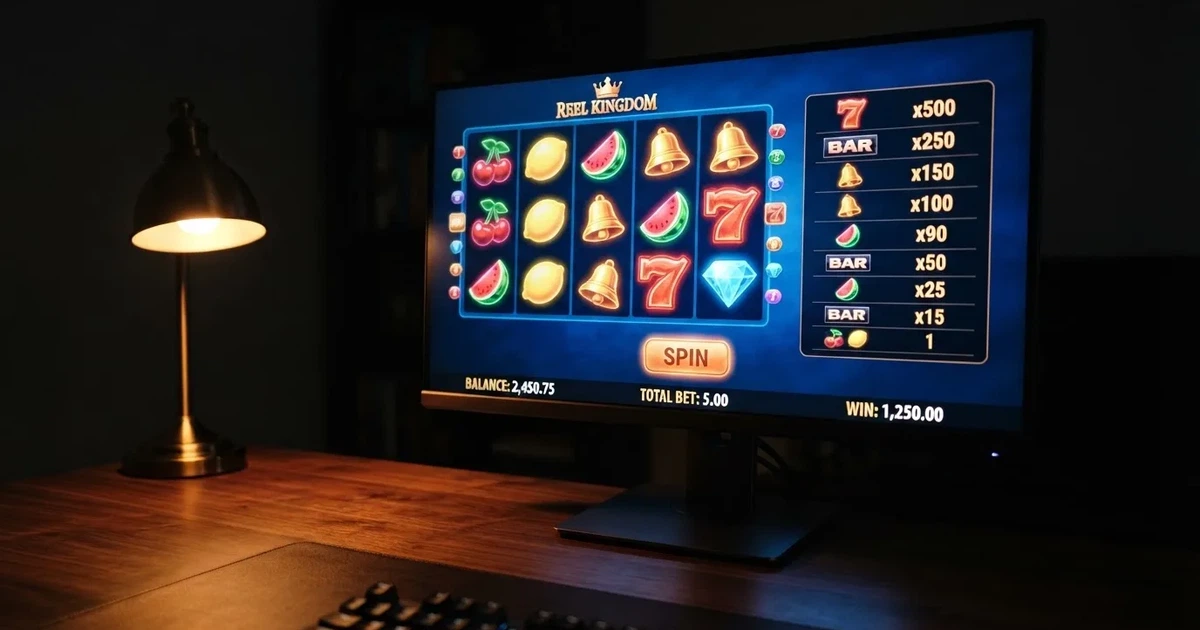
The phrase covers most modern slot machines: any cabinet where the reels are displayed on a video screen rather than spun as physical wheels, and where the gameplay goes beyond three reels and a single payline. The first machine of this type was developed in 1976 by Fortune Coin Co. in Kearny Mesa, California, and the format took about two decades to settle into the shape players recognise today. What separates a video slot from the older pokies cabinet on an Australian pub floor is not the screen — most NSW and Victoria pubs now run video-based machines that look very similar — but the underlying game design. A modern video slot typically carries five reels, anywhere from twenty-five to several hundred paylines, a scatter symbol that triggers a free-spin round, a wild that substitutes for other symbols, and at least one bonus game that runs separately from the base spins.

The math behind those features is what makes the genre its own thing. A classic mechanical three-reel machine might have about ten symbols per reel, producing roughly a thousand possible combinations. The Wikipedia account of slot design notes that modern video slots using five or more reels with fifty or more symbols per reel can produce odds as high as 300 million to one against a top combination. The top prize is therefore not unreachable but it is not what the average player is playing for; the average player is playing for the small-to-medium hits that come from the bonus round and the scatter. The hit frequency may be regular; the magnitude is what falls away, and most sessions end on a modest win or nothing.
A useful detail for any reader cross-shopping between offshore casinos: the return-to-player (RTP) percentage is the only honest number on a slot’s paytable, and it varies wildly. State regulation in the United States sets floors that give a sense of the lower band — Nevada at 75 per cent, Mississippi at 80 per cent, New Jersey at 83 per cent — and licensed Australian cabinets sit at similar levels in their respective state regimes. Offshore video slots usually list an RTP in the high nineties, which sounds generous until the reader remembers that 96 per cent over thousands of spins is a long-run average rather than a session figure. The short-session truth is closer to: most spins lose, a small number pay roughly the stake back, and the rare hit pays a multiple. The bonus round concentrates the larger returns into a small slice of total play, which is exactly why online casinos market it so heavily.
Bonuses and free spins: how the inducement actually works
A free-spins offer attached to a video slot looks like the casino is giving something away. It is not. The offer is a way of pre-selling a longer session on a game the player might otherwise have walked away from, and the conditions that come attached determine what, if anything, a player can take out of it.
Two structural elements matter.
Wagering requirements. A typical deposit bonus arrives with a wagering multiplier — commonly 35x to 50x the bonus amount. A $200 bonus with a 40x requirement obliges the player to wager $8,000 before any winnings become withdrawable. Free-spin winnings are usually subject to the same multiplier applied to the amount won, not the bonus headline, so a $50 spin-haul at 40x means $2,000 of additional play before the cash becomes cash.
Maximum cashout caps. Even after the wagering requirement is met, many offers cap the amount that can be withdrawn from bonus-derived winnings — often at 5x to 10x the bonus value. A $200 bonus with a 10x cap lets the player take out $2,000 of winnings and no more. Anything beyond that is forfeit. Combined with a low-cap-per-spin rule, this is the clause that turns a “big win” into a smaller one at payout.
The economic logic is straightforward: the bonus looks like a gift; the multiplier gates it behind a turnover few casual players hit before their bankroll is gone; the cap and the spin cap cap what they would have walked out with anyway. For a reader who already plays at an Australian-licensed wagering service, the equivalent is a bonus bet that returns bonus bet credits rather than cash until a turnover is cleared — the structural pattern is identical even when the rules are not.
The Australian offshore market has a particular habit around these offers: it advertises them heavily through affiliate marketing pages, and the ACMA’s enforcement has followed the trail rather than the offer. In a round reported on 26 June 2026, the ACMA asked Australian ISPs to block twelve illegal gambling websites — 7Signs, ChromaBet, Donbet, Duospin, Freshbet, Slots Gem, Jacks Club, Lucky Start, Pointsbetz.com, Spinrise, Vinyl Casino and Wildsino — and the affiliate-driven bonus marketing surrounding them. Blocking stops access in Australia; it does not retrieve a balance already on the books with any of these operators, and that is the consumer-protection point that matters.
A brief worked example, using only figures the page has already established. Suppose a reader accepts a $200 deposit bonus with a 40x wagering multiplier and a cap of A$0.50 per spin during the bonus. The required turnover comes to $8,000 (200 × 40). At a $0.50 stake per spin, that is 16,000 spins before any winnings clear. A typical spin cycle runs five seconds, which gives roughly 22.2 hours of continuous play (16,000 × 5 ÷ 3,600). The bonus “costs” the player twenty-two hours of game time and the loss of every dollar above the cap that would otherwise have been banked; the “value” depends entirely on what the player would have done without the offer. The bonus is rarely free in any sense a reader should care about, and the rate at which it converts to cash is the figure that has to be checked before the offer is taken, not the headline number.
Mobile and app play
The mobile shelf matters because it is where most Australian sessions now happen. A modern video slot is, at base, an HTML5 or native client, and the game logic on a phone browser is identical to the desktop client the same operator runs on a laptop screen. The graphics scale to the smaller screen; the random-number generator, the return-to-player percentage and the bonus-round triggers do not change. The screen-size shift that mattered most was the loss of the full paytable view, which is why every modern slot now keeps the paytable one tap away in a side menu rather than buried behind a key combination.
Two practical limitations come up often. First, load times on cellular data: a heavy jackpot game running a long animated intro can take ten seconds or more on a 4G connection in a low-signal area, which is enough to push a fast-spinning player into the easier-to-load alternatives. Second, battery and data use: the same animation-heavy title chews through phone battery faster than a static-reel older game, and that matters on a long session. Both are reasons the smaller paytable of an older or simpler game can be the better session on a phone.
A dedicated app is not the giveaway it looks like. The Apple App Store and the Google Play Store both prohibit real-money casino apps for Australian players, which means an “app” for an offshore casino is, in practice, either a progressive web app running in the browser or an Android APK sideloaded from outside the store. Either way the underlying game is the browser version wrapped in a launcher. Performance does not improve beyond what a modern phone browser delivers; access gets less convenient, not more.
Where the cash flows matters more than where the screen sits. For an Australian player at a licensed online wagering service, the deposit and withdrawal routes are debit card, bank transfer, PayID/Osko and BPAY. Credit cards, credit-related products and digital currency have been banned as payment for licensed online wagering since 11 June 2024, with penalties up to $247,500 for the operator on the wrong side of the rule. An offshore site asking for a credit card or a crypto deposit is, by definition, operating outside the Australian rules; that is the same fact from a different angle and it is the quickest tell on any operator.
How the game’s paytable and catalogue fit together
The shelf that catalogues specific games, providers and live tables is harder to write honestly for an Australian audience than for almost any other market, because the licensed onshore catalogue is constrained to physical venues and the offshore digital catalogue is largely unlawful here. What a reader can usefully learn from the shelf is the shape of what is on offer, not the titles themselves.
On the licensed side, the physical venue is the product. Crown Melbourne, regulated by the Victorian Gambling and Casino Control Commission (which replaced the VCGLR on 1 July 2022), lists its approved table games publicly — including three baccarat variants in the case of baccarat, Traditional, Crown and 2 to 1 Baccarat. Blackjack variants appear in the same VGCCC log, with the regulator publishing approved-rule changes such as the renaming of a “Perfect Pairs” side bet to “Crown Pairs” on 23 December 2024 and the introduction of a “Free Bet” option with a new “Pot of Gold” side bet on 25 March 2024. The NSW regime under the Casino Control Act 1992 requires that every game and its rules be approved by the regulator before it can be offered, with a copy of those rules made available to patrons on request. The point is not the specific side bets. The point is that licensed Australian venues run a closed catalogue where every title and every rule change is regulator-approved and publicly identifiable.
On the offshore side, the catalogue is much larger and much looser. A single offshore brand can carry several thousand titles from dozens of providers — NetEnt, Pragmatic Play, Evolution for live tables, BGaming for the smaller studios — and the catalogue turns over monthly. Quality control is uneven. Live-dealer baccarat and blackjack variants on offshore sites are essentially the same game as on a land-based floor, modulo approval; the licensed providers running them are also supplying Australian venues indirectly, through the international aggregator market. The reader should not confuse catalogue size with regulatory standing: the bigger the offshore lobby, the further it sits from the Australian consumer-protection framework.
For the house edge that any slot sits inside, the comparison table is the cleanest orientation. Baccarat’s edge is 1.06 per cent on the Banker bet, 1.24 per cent on the Player bet and 14.36 per cent on Tie. Blackjack under liberal Las Vegas Strip rules sits at about 0.28 per cent. Craps runs 1.41 per cent on the Pass/Come bet, 1.36 on Don’t Pass/Don’t Come, and 11.11 per cent on Any Craps. The video slot sits well above all of these on a house-edge basis, typically in the 4 per cent to 10 per cent band; its appeal is the variance, not the edge.
The shortlist and how it was put together
The list that follows is not a ranking in the usual sense. The product — modern video slots offered online to Australians — is prohibited under the Interactive Gambling Act 2001, and a “top ten” of offshore brands offering that product is, strictly speaking, a list of the brands the regulator has most recently found to be in breach. Every brand below has been named in an ACMA formal warning. The ordering reflects the date of that warning and the operator named, not any assessment of game quality, payout speed or bonus generosity, which are not verifiable for these sites from outside.
How an Australian shortlist of video slots is actually built
A useful shortlist for an Australian player does not begin with offshore brand names. It begins with three questions.
Where will the play happen? Licensed pub, club and casino gaming is the only lawful setting for pokies-style machines in Australia. The pub and club machines in NSW and Victoria run the same software as their offshore digital cousins, but they sit inside a regulated venue with a complaints body, a payout floor and a venue staff. The casino product, in NSW, Victoria, the ACT and the Northern Territory, runs under state-level casino regulators (Liquor & Gaming NSW for the Sydney casino; the VGCCC for Crown Melbourne; the ACT Gambling and Racing Commission for Casino Canberra; and so on). Online play of these titles from an Australian internet connection is not permitted.
What does the catalogue look like? Licensed Australian venues run a curated, regulator-approved catalogue that turns over slowly. Offshore sites run a turnover-heavy catalogue of several thousand titles. The size of an offshore lobby is a marketing story, not a quality one.
How is the player protected when something goes wrong? This is the decisive question. A licensed venue answers to a state regulator; an Australian-licensed online wagering service answers to the ACMA and is bound by BetStop; an offshore operator answers to its own home regulator, often Curaçao or Anjouan, and an Australian player in a dispute has nowhere to escalate within the Australian system. Withdrawal problems, account closures and bonus disputes are the most common complaints and they are the ones offshore players have the least recourse over.
The brand table below is built around these three answers, with one row per operator that the ACMA has publicly warned, the regulator’s date, the operator entity named by the regulator, and whether any research source linked the brand to the subject of video slots as a category.
Brand comparisons
| Brand | ACMA action and date | Operator named by the ACMA | Subject support |
|---|---|---|---|
| RocketPlay | Formal warning, March 2026 | Pulsup Ltd | — |
| Level Up Casino | Formal warning, May 2022 | Dama N.V. | Bgaming.com listing |
| Woo Casino | Formal warning, March 2025 | Dama N.V. | — |
| Spirit Casino | Formal warning, May 2025 | Dama N.V. | — |
| National Casino | Formal warning, July 2025 | Consolutetish S.R.L. | en.wikipedia.org listing |
| Bizzo Casino | Formal warning, July 2025; earlier 2022 | Consolutetish S.R.L. / TechSolutions | — |
| Ignition Casino | Formal warning, July 2025 | Bamboo Media | — |
| Instant Casino | Formal warning, February 2025 | EOD Code SRL | — |
| Jackbit | Formal warning, April 2026 | Ryker B.V. | — |
| Casino Intense | Formal warning, April 2025 | Sterplay Holding Ltd | ABC, ACMA, Crown Melbourne listings |
| Sky Crown | Formal warning, September 2022 | Hollycorn N.V. | — |
The table is not a comparison of which site to play at. None of them can lawfully take an Australian real-money video-slot bet. The columns are the regulator’s own data: when the ACMA warned, who the ACMA named, and whether any third-party source outside the operator’s own materials mentions the brand in the context of video slots. The “no data” cells in the rightmost column mean that no such source was found — not that the brand offers nothing, just that no independent source was reached in the course of compiling the page. A reader who lands on any of these operators from a search result or an affiliate link is in the same regulatory position: the product they are being offered is prohibited, and the warning above is the ACMA’s documentation of that fact.
Velocity of the regulator’s action
The arithmetic behind the regulator’s blocking effort is a useful lens on how fast the offshore market keeps moving. As of the June 2026 report cited above, a cumulative 1,751 illegal gambling and affiliate marketing websites had been blocked since the first blocking request in November 2019, and more than 230 unlicensed gambling services had left the Australian market since enforcement was strengthened in 2017. Block twelve of those sites in a single round, as the ACMA did in late June 2026, and the cumulative count moves. Twelve is a small change relative to 1,751 — under one per cent of the running total — but it is a typical week for the regulator and a non-event for an industry that has already replaced the blocked names with new domains on a similar cadence.
Putting that on a per-year footing: between November 2019 and June 2026, the regulator’s running total moved from zero to 1,751 blocked sites — roughly 270 blocked sites a year on average, against an industry that replaces them at a similar rate. The H2 Gambling Capital 2025 estimate that Australians lose about A$3.9 billion a year to illegal sites, with the legal-channel share falling from 74 per cent in 2021 to 64 per cent, is what the cumulative total looks like when expressed as a market figure. The blocking effort is real, its pace is meaningful, and the losses on the other side of it are larger than the pace.
What offshore video slots look like in the Australian context
A reader who has decided to read offshore sites carefully — comparing their bonus terms, their game catalogue and their payment rules — does so in a regulatory grey zone at best. Online casino games, online pokies and the digital video slots that sit next to them cannot be licensed in Australia, and no state or territory issues a licence for them. The brands reviewed above are not on the page because of any virtue of theirs; they are on it because the ACMA has acted against them.
What that means in practice: the operator the player is dealing with is registered overseas, often in Curaçao or Anjouan, and the licence badge on the operator’s footer refers to that overseas regime. An Australian player in a dispute has no Australian complaints body to escalate to, no access to the Australian Consumer Law framework and no path to BetStop-style self-exclusion. If a withdrawal is refused, the recourse is whatever consumer-protection regime the operator’s home regulator offers, which in most of these cases is thin.
The Northern Territory Racing and Wagering Commission (NTRWC) regulates 52 of Australia’s online bookmakers — Sportsbet, Bet365 and Ladbrokes among them — because the operators chose NT registration for tax reasons. The commission has no full-time staff, meets once a month in Darwin, and oversees a wagering industry, not a casino industry. The connection to video slots is indirect: the NT regime licences wagering, not casino, and the licensed casino product is state- and territory-regulated in NSW, Victoria, Queensland, South Australia, Western Australia, Tasmania, the ACT and the NT itself.
The Australian-licensed video slot product is therefore a venue product. The number of pokies-style machines outside casinos stood at 87,298 in New South Wales as of June 2023, 26,380 in Victoria in 2021–22, 21,122 in Queensland in October 2023, 11,672 in South Australia in September 2023 and 3,587 in the ACT in November 2023. New South Wales alone runs more than three times the next state’s count, and the historical reason is that NSW legalised the machines in 1956, decades before most other states. By 2010 Australia operated an estimated 97,103 gaming machines outside casinos — roughly five times the per-capita rate of the United States.
The legality question, cleanly
Three layers of law sit behind the picture above.
The Interactive Gambling Act 2001 (IGA), as amended by the Interactive Gambling Amendment Act 2017, makes it an offence to provide online casino games, online pokies or in-play betting to a person in Australia. The offence is the provider’s, not the individual’s. An Australian player placing a bet through an offshore site does not face Australian prosecution for doing so; the operator faces the IGA. That is why enforcement looks the way it does: ACMA investigations, formal warnings to operators and ISPs, blocking requests, and the gradual thinning of the offshore market — 230 unlicensed services out of the Australian market since 2017, against the ACMA’s own count.
The Interactive Gambling Amendment (Gambling Reform) Bill 2026 passed Parliament on 19 August 2026. Its advertising and inducement measures commence on 1 January 2027. For any reader using this page in the second half of 2026, the right framing is that the Bill is law but its inducement provisions are not yet in force; once they are, the kind of bonus marketing that surrounds many of the operators on this list will have a clearer statutory line against it. Until then, the existing IGA provisions remain the operative framework.
Payments. Since 11 June 2024, credit cards, credit-related products and digital currency cannot be used to fund Australian-licensed online wagering, with operator penalties up to $247,500. The lawful deposit routes for licensed wagering are debit card, bank transfer, PayID/Osko and BPAY. The rule applies to Australian-licensed services and does not change what an offshore site does, but it explains why the “pay with crypto” prompt an Australian player often sees on an offshore site is a signal the operator is outside the Australian regime.
A short note on tax. Gambling winnings of a recreational player in Australia are not assessable income under section 6-5 of the Income Tax Assessment Act 1997, and gambling losses are not deductible, unless the person carries on a business of gambling. The recreational-player carve-out is the standard position and applies to most readers of this page; it is not tax advice, and a reader whose activity crosses that line should check with the ATO.
The brands the ACMA has acted against
Eleven operators appear in the table above. What follows is the same list in narrative form, with the regulator’s wording rather than the page’s gloss. The purpose is to give the reader the regulator’s date and the operator entity named by the ACMA at the time of the warning, nothing more. None of these is recommended.
RocketPlay. The ACMA issued a formal warning to Pulsup Ltd over Rocketplay.com.au in March 2026. The same brand was earlier covered by an earlier warning in May 2022 to Dama N.V. across six brands.
Level Up Casino. The ACMA named Dama N.V. in its May 2022 warning, with Level Up among the six brands in that round. BGaming carries a Level Up listing on its provider portfolio page.
Woo Casino. A further formal warning to Dama N.V. was issued over Woo Casino in March 2025.
Spirit Casino. Dama N.V. was warned again in May 2025 over Spirit Casino.
National Casino. In July 2025 the ACMA warned Consolutetish S.R.L. over National Casino and Bizzo Casino in the same round.
Bizzo Casino. Covered by the same July 2025 warning to Consolutetish S.R.L., and earlier by a 2022 warning to TechSolutions (CY) Group Limited and TechSolutions Group N.V.
Ignition Casino. Bamboo Media was warned in July 2025.
Instant Casino. EOD Code SRL was warned in February 2025.
Jackbit. Ryker B.V. was warned in April 2026 over Jackbit and CasinOK.
Casino Intense. Sterplay Holding Ltd was warned in April 2025.
Sky Crown. The ACMA’s formal warning to Hollycorn N.V. covered Sky Crown and Blue Leo.
The repeated operator across several entries is itself the point the regulator has been making. Dama N.V. has been warned in May 2022, March 2025 and May 2025 across multiple brands under the same corporate umbrella. The blocking requests of June 2026 targeted a different set of operator entities (7Signs, ChromaBet, Donbet, Duospin, Freshbet, Slots Gem, Jacks Club, Lucky Start, Pointsbetz.com, Spinrise, Vinyl Casino and Wildsino) but the structural pattern is the same: an offshore operator offers a prohibited product under multiple brand names, the ACMA warns, the operator tweaks the front-end, and the cycle continues. The right reader takeaway is not which of these brands is “better” — none of them is offering a lawful product to an Australian — but that the catalogue of names will keep moving while the underlying product prohibition holds.
How the brand write-ups close
Each brand above is part of a regulatory record, not a comparison shopping option. The one observation that runs across the list is that the ACMA’s pattern is consistent: a corporate entity is warned, the warning covers a cluster of brands, the brands continue to operate under the same or a related entity, and a future warning names them again. Reading the table as evidence of enforcement, rather than as a ranking, is the lens that makes the eleven rows coherent. Reading it as a guide to “where to play” misses the point — these eleven rows are the ACMA’s list of where not to play, and the regulator’s own counts (1,751 sites blocked, more than 230 services out of the market) suggest the list will continue to grow.
Where this leaves the reader
Three things follow from everything above.
The lawful Australian setting for a video slot is a venue: a licensed pub, club or casino, with a regulator-approved catalogue, a state-level complaints body and a payout floor. For pokies-style machines outside casinos, NSW has the deepest installed base by a wide margin, and the most recent data places it at 87,298 machines in mid-2023. Victoria (26,380 in 2021–22), Queensland (21,122 in October 2023), South Australia (11,672 in September 2023) and the ACT (3,587 in November 2023) sit further down. A reader who chooses the venue path is choosing the legal one.
The offshore digital setting is a legal grey zone at best, regardless of any licence the operator displays. The Interactive Gambling Act 2001 makes the provision of online casino games to Australians an offence; the ACMA enforces it through warnings and ISP-level blocking; the consumer-protection framework an Australian reader is accustomed to does not reach the offshore operator. A balance held with an offshore operator can become inaccessible if the regulator moves against the brand. There is no Australian complaints body to escalate to.
The mechanical setting — the kind of game a video slot actually is — is the same on either side of that divide. Five reels, multiple paylines, a bonus round, a scatter and a wild are the stock ingredients; RTP figures in the high nineties are common on offshore titles; the hit frequency is regular but the magnitude is concentrated in the bonus round. A working rule of thumb: a session costs roughly its stake per spin over the long run, and the bonus offer does not change that — it changes only the rate at which an existing balance is converted into bonus play. Anyone who would set a stop-loss on a venue pokies session should set the same limit for the digital version.
Frequently asked questions
What makes a video slot different from a classic three-reel pokies machine?
The video slot uses digital reels displayed on a screen rather than physical spinning wheels, typically runs five reels with twenty-five to several hundred paylines, and includes features that a classic three-reel machine rarely has: a scatter symbol, a wild that substitutes for other symbols, and a separate bonus round. The original digital slot mechanism was developed in 1976 by Fortune Coin Co., and the modern five-reel format settled in over the following two decades.
Do video slots typically include bonus rounds that classic machines don’t have?
Yes. A bonus round — a free-spin feature, a pick-a-prize game, or a wheel spin — is one of the defining features of the format. It concentrates the larger payouts into a small fraction of total play, which is exactly why the bonus round is what the marketing emphasises. Most of the game’s return is paid out through the bonus rather than the base spins.
Are video slots on a mobile browser the same game as the desktop version?
Yes — the random number generator, RTP and bonus triggers are the same, and the difference is essentially the screen size and the menu layout. Heavy jackpot games with long animated intros load more slowly on a phone over cellular data, and a phone browser running the same game uses more battery than a simpler title would, which on a long session can be the difference between finishing on the device and not.
How many paylines does a typical modern video slot use?
A modern video slot usually runs at least twenty-five paylines, and many titles in the offshore catalogue run several hundred. By contrast, a classic three-reel machine typically carries a single horizontal payline down the centre of the screen, or three paylines across the top, middle and bottom. The increase in paylines is what allows a slot to have frequent small wins at the cost of those wins paying less than the stake.
Why do video slots vary in volatility even within the same provider’s catalogue?
Volatility is a design choice, not a feature of the maths. A high-volatility slot pays out less often at the base level and concentrates its returns in the bonus round and the higher-paying combinations; a low-volatility slot pays smaller amounts more often. The same provider can offer both because the underlying random number generator is configurable per title, and the paytable is a separate file from the engine. Players who want longer sessions on a smaller bankroll tend to prefer the lower-volatility titles; players who want the chance at a larger payout on a smaller stake tend to prefer the higher-volatility ones.
Which Australian state has the most licensed gaming machines outside casinos?
New South Wales, by a wide margin. The most recent counts put NSW at 87,298 pokies-style machines outside casinos (June 2023), against 26,380 in Victoria (2021–22), 21,122 in Queensland (October 2023), 11,672 in South Australia (September 2023) and 3,587 in the ACT (November 2023). The historical reason is that NSW legalised the machines in 1956, decades before most other states followed.