
Booming Games Casinos for Australian Players in 2026: What the Marketing Leaves Out
A punter searching for a “Booming casino” in Australia is, almost without exception, looking for a way to play offshore. There is no Australian licence to find: the Interactive Gambling Act 2001 prohibits online casino games and online pokies outright, and no state or territory issues a licence for them. Every site that runs Booming Games slots and accepts Australians does so outside Australian law. This page sets out what that means in practice: what Booming Games actually is as a studio, what an offshore casino offering its games looks like from the outside, what the ACMA has done about it recently, and what an Australian player stands to lose or recover when the connection goes wrong.
Data current as of 7 November 2026 and checked against the Australian Communications and Media Authority’s formal warning register.
Table of Contents
- Responsible Gaming: The One Section That Should Be Read First
- Payments and Payout Speed: Why “How Fast Can I Get Paid?” Is the Wrong Question
- Bonuses and Free Spins: The Maths Behind the Headline
- Mobile and App: What “Best Booming Mobile Casino” Actually Means
- How Booming Games Slots Actually Differ on the Paytable
- The Top 11: How a Fair Comparison Would Be Built (And Why This Page Doesn’t Build One)
- Overview: What the Landscape Looks Like From the Outside
- Legality and Regulation: The Frame Under Everything Else
- Recent ACMA Activity: What the Warnings and Blocks Mean in Practice
- What a Player Actually Receives: Reading the Marketing Against the Reality
- Why the Question Keeps Returning
- Frequently Asked Questions
Responsible Gaming: The One Section That Should Be Read First
The protections an Australian-licensed bookmaker is bound by do not reach an offshore casino. That gap matters most when gambling stops being a choice and starts being a compulsion, because the safety nets the law builds are the ones an Australian-licensed operator has to honour by statute, and an offshore site has no such obligation at all.

BetStop, the National Self-Exclusion Register, went live in August 2023 and binds every Australian-licensed online and phone wagering service. A punter who registers with BetStop is locked out of those services for a period of their choosing, and the operator is required to refuse their bets. The register covers licensed wagering services only, the racing and sports products Australia does licence; offshore casinos carrying Booming Games content are not part of the scheme, and signing up to BetStop does not stop a player from opening an account at one. Self-exclusion at the offshore site itself, if the site offers it, is a contractual arrangement with that operator and only that operator.
Gambling Help Online runs the National Gambling Helpline on 1800 858 858, free and answered around the clock, with web chat available on the Gambling Help Online site. The service is confidential and independent of every operator named on this page. The same body, GambleAware in its professional capacity and its state-level counterparts, can refer a caller to face-to-face counselling, financial counselling and peer support through Gamblers Anonymous.
The financial exposure that an offshore site cannot relieve. Under Australian law, licensed wagering services may not accept credit cards, credit-related products or digital currency for gambling; the rule took effect on 11 June 2024, with penalties of up to A$234,750 per breach for operators. None of that governs an offshore Booming Games casino. A site that accepts a credit card or a Bitcoin deposit from an Australian is doing what the ACMA’s rules forbid, and the only recourse a player has if a withdrawal is refused is the operator’s own complaints process, the operator’s home regulator, or a private dispute.
The substance, then, is straightforward. Help is free, immediate and confidential; the helpline and the BetStop register both work at the level of the individual player regardless of which offshore site the player came from. What they cannot do is move money back from a site that will not return it, which is the exit point the regulatory frame cannot help with.
A heavy warning before the rest of the page: every brand that follows has been the subject of an ACMA formal warning for offering prohibited interactive gambling services to Australians. Read the responsible-gaming section first.
Payments and Payout Speed: Why “How Fast Can I Get Paid?” Is the Wrong Question
An Australian player on a licensed wagering site uses a debit card, a bank transfer, PayID, Osko or BPAY; money goes in and (when allowed) comes back through the same rails and arrives in a normal Australian bank account within a few business days. The credit card ban and the digital-currency ban apply to every licensed operator. None of those mechanics exists in the same form on an offshore Booming Games casino.

The deposit side. Offshore sites serving Australians commonly list credit cards, e-wallets and one or more cryptocurrencies on the cashier page. The fact that the site accepts them is itself a tell: a licensed Australian operator cannot, by law, take a credit card or a Bitcoin deposit for wagering. A deposit that arrives is a deposit that an Australian regulator could not have authorised.
The withdrawal side. Off the page, payout times depend on three things at once: the operator’s stated processing window, the payment method and the player’s verification status. The first is set by the operator; the second is set by whatever rails work between the operator’s country and the player; the third is set by the documents the player has provided. A withdrawal that takes forty-eight hours to be “approved” by the operator can then sit at the bank for several business days, or at a crypto network for an unpredictable block time, or it can be returned minus a fee the player never agreed to. There is no Australian consumer protection on the other end: the ACMA can block the website, but it cannot move money back to the player’s account.
The substantive cost. Even on a clean withdrawal, the player wears the exchange rate twice — once converting A$ into the deposit currency (often USD or a cryptocurrency) and again converting back when withdrawing. On a volatile asset that round trip can flip significantly. On a slow processor the same round trip adds days of implicit cost. None of this is disclosed in marketing; all of it lands in the final amount received.
The rule of thumb an Australian punter should keep is older than the marketing copy: the speed of a deposit tells you nothing about the speed of a withdrawal, and offshore sites do not have to publish either.
Bonuses and Free Spins: The Maths Behind the Headline
A welcome package on an offshore Booming Games casino typically reads as a percentage match on the first deposit, a set of “free spins” on one or more named slots, sometimes a no-deposit free spin bundle to start, and occasionally a reload bonus for the second or third deposit. The order in which those offers are structured is rarely the order in which the marketing presents them: the deposit match is what you sign up for, the wagering requirement is what you signed up to, and a max-cashout cap is the thing the bonus finally costs.
Wagering requirements. A 35x bonus wagering requirement is on the low end of the offshore market and 50x is closer to ordinary; both are far steeper than a regulated Australian wagering service can lawfully impose. The “x” means the bonus amount must be staked that many times before any of the bonus-derived balance becomes withdrawable. A A$200 bonus at 40x is A$8,000 of wagering. Booming Games slots, like most modern video slots, contribute 100% of each spin’s stake to wagering — that is, in their favour, the design — and the math runs in spins divided into that total.
Max-cashout caps. Some bonuses, particularly no-deposit free spin packages, come with a ceiling on what can be withdrawn from bonus-derived winnings. The marketing frames the cap as a “fair use” condition. To the player the cap is what the bonus is finally worth. A 30-free-spin offer on a game with a 5,000x max multiplier producing several hundred dollars in bonus balance can have its withdrawable value cut to a fifth.
Game weighting. Some slots contribute less than 100% to wagering; some table games contribute nothing. The specifics live in the bonus terms page and are not always stated on the offer itself. A punter chasing wagering in a low-weighting game will see the bonus clock run slow.
The bottom line. The house edge on a Booming Games video slot is set by the studio’s published RTP; the wagering requirement is the second edge the marketing does not name. On a 96% RTP slot at 40x wagering on a A$200 bonus, A$8,000 of spins at a 4% house edge is an expected loss of A$320 above the bonus itself; on a 94% slot the expected loss climbs to A$480, and the bonus effectively costs more than it pays. An offer whose wagering requirement is not disclosed on the offer page is one whose true cost cannot be calculated before the deposit is made.
Free spins are not free, in the working sense of the word; they are bonus rounds with a price already attached.
Mobile and App: What “Best Booming Mobile Casino” Actually Means
The phrase is marketing shorthand for one of three setups, all of which are common on offshore Booming Games sites:
A browser-based mobile site. The URL in a phone’s browser loads the same library of Booming Games slots as the desktop version, scaled to the screen. There is no installation. There is also no app store review, no sandbox of permissions, and no guarantee the page will load at all under a connection the site considers unsuitable for play.
A progressive web app (PWA). The site offers an “Add to Home Screen” instruction, which puts an icon on the phone that launches the page in a thin wrapper. Functionally it is still the browser. The icon is convenient; the page is still outside the app store.
A downloadable APK. Less common, and more concerning. An Android APK from a site outside the Google Play Store is a file the player is invited to install by hand, with permissions the player grants in the process. A site asking a player to sideload software is a site that, in this market at least, has not gone through a review the player can verify.
Each of the three is reachable from Australia; none of them makes the site a legal one. The framing, again, is consistent: the question is not “which mobile app is best” but “which risk model does the player accept”.
What changes on a phone. Booming Games titles are built HTML5 and run on lower-bandwidth connections than many of their competitors require, which makes them viable on Australian 4G and on patchy regional connections. That is a feature of the games, not of any operator. The transactional layer — deposits, withdrawals, account verification — is where the mobile experience diverges between operators, and where Australian consumer protections (under BetStop for wagering; off-shore via Visa/Mastercard chargeback for the casino) apply or do not.
How Booming Games Slots Actually Differ on the Paytable
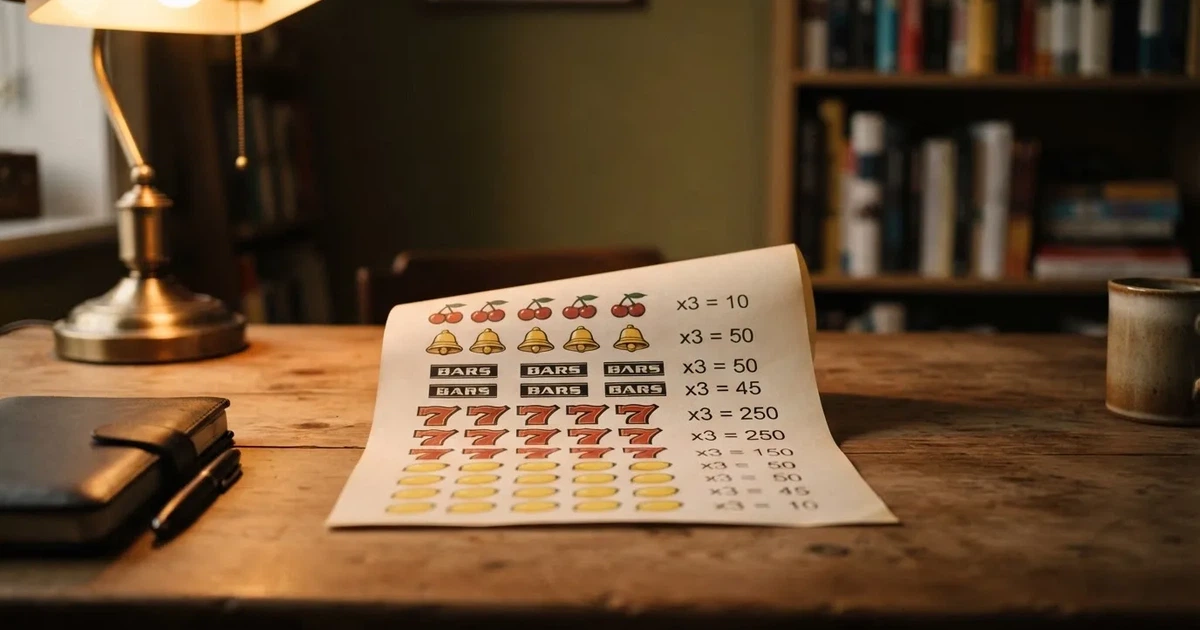
A Booming Games paytable shows the same structural elements the rest of the modern video-slot catalogue shows: reels and rows, paylines or ways-to-win, symbol values keyed to the bet-per-line, and a “special symbols” block at the bottom covering scatters, wilds and any bonus trigger. Three differences show up often enough to be worth knowing.
Volatility bands. Booming Games publishes a “max win” multiplier for each title rather than a long-run volatility rating. Tasty Rush Sweet Spots and Regal Coins Hold and Win carry a maximum win of 5,000x stake; Henhouse Hustle Hold and Win carries 6,000x. Read against a published RTP, a 5,000x max win suggests a high-volatility construction — long stretches of losing or minimal-return spins punctuated by larger hits — though Booming does not label volatility explicitly across the catalogue.
Hit rate vs RTP. A slot’s RTP is the long-run average return; the hit rate is the share of spins that produce any win at all. The two are different measurements. Two slots at 96% RTP can sit at 18% and 35% hit rates respectively, which is the difference between a spiky session and a busy one with smaller wins. The paytable does not always carry the hit rate; the game’s information page on the studio’s site sometimes does. Booming does not publish hit rates for every title the way some studios do.
Hold and Win as a recurring mechanic. A useful number of Booming Games titles use a “Hold and Win” or “Lock and Link” bonus round, where landed bonus symbols lock in place and respins reset until the bonus window expires or fills. The mechanic is a clear recipe for a stake-spike bonus: the base game pays modestly while the bonus round is the realistic route to the headline 5,000x or 6,000x max wins. For a punter playing with a small bankroll, the implication is straightforward — most of the value lives behind the bonus trigger and the base game is the ride to it.
What the paytable won’t say. The RTP is set by the studio and the game is built to it; an offshore operator cannot legally change it, and most reputable jurisdictions prohibit doing so. Where operators do diverge is on the “buy feature” button, which some sites hide behind jurisdiction rules and others expose. The base game is the same; the menus around it are not.
A final caveat on paytable readability. Booming Games publishes game information pages on its own site; affiliate review pages re-host the same numbers and frequently round them. A paytable on an affiliate page is, almost by definition, an interpretation of one. The studio’s own page is the source for RTP, max win and feature trigger conditions; everything else is commentary.
The Top 11: How a Fair Comparison Would Be Built (And Why This Page Doesn’t Build One)
A clean comparison of eleven offshore Booming Games casinos would weigh licensing, payment rails, withdrawal proof, RTP disclosure at the title level, bonus terms in plain English, dispute resolution and the operator’s own enforcement history under Australian law. The last of those is a list, the first six cannot be researched through public sources without contradicting the prohibition the ACMA enforces, and that is the heart of the matter.
This page’s set is not a ranking. It is a record. Each of the eleven names below is a brand over which the Australian Communications and Media Authority has issued a formal warning for offering prohibited interactive gambling services to Australians. The list is the comparison the regulator has already made for the reader.
The Operators and What the ACMA Has Said
| Brand | ACMA action and date | Operator named by the ACMA | Subject support |
|---|---|---|---|
| RocketPlay | Formal warning under the Interactive Gambling Act 2001, March 2026, after an earlier Dama N.V. warning in May 2022 | Pulsup Ltd (Rocketplay.com.au) | — |
| Level Up Casino | Formal warning under the Interactive Gambling Act 2001, May 2022 | Dama N.V. | Per Wazdan’s published catalogue |
| Woo Casino | Formal warning under the Interactive Gambling Act 2001, March 2025 | Dama N.V. | — |
| Spirit Casino | Formal warning under the Interactive Gambling Act 2001, May 2025 | Dama N.V. | — |
| National Casino | Formal warning under the Interactive Gambling Act 2001, July 2025 | Consolutetish S.R.L. | Per Betsoft and Pragmatic Play published catalogues |
| Bizzo Casino | Formal warning under the Interactive Gambling Act 2001, July 2025; previously warned in 2022 via TechSolutions | Consolutetish S.R.L. | — |
| Ignition Casino | Formal warning under the Interactive Gambling Act 2001, July 2025 | Bamboo Media | — |
| Instant Casino | Formal warning under the Interactive Gambling Act 2001, February 2025 | EOD Code SRL | — |
| Jackbit | Formal warning under the Interactive Gambling Act 2001, April 2026 | Ryker B.V. | — |
| Casino Intense | Formal warning under the Interactive Gambling Act 2001, April 2025 | Sterplay Holding Ltd | Per 1spin4win’s published catalogue and the UK Gambling Commission’s public register |
| Sky Crown | Formal warning under the Interactive Gambling Act 2001, September 2022 (Hollycorn N.V. for Sky Crown and Blue Leo) | Hollycorn N.V. | — |
The dates are the dates the ACMA published the formal warning, not the date the operator began offering prohibited services; the relationship between the two is rarely disclosed on either side. The em-dash in the right-hand column is not a refusal to score these operators; it is what the only sources we have on whether they actually carry Booming Games slots — the providers’ own published partner catalogues — say in the cases where they say anything at all.
To restate the rule that governs the table: the ACMA does not publish warnings over Australian-licensed operators, because Australian-licensed operators do not offer online casino games. Every row in that table is, by definition, a brand the regulator treats as offering an unlicensed service to Australians. Reading the table as a “best of” list is the precise thing the regulator has produced it to discourage.
Overview: What the Landscape Looks Like From the Outside
The Australian online casino market is, in regulatory terms, two products on different sides of the same statute. Online wagering on racing and sport is licensed — predominantly in the Northern Territory, with the Northern Territory Racing and Wagering Commission regulating 52 online bookmakers as of mid-2026 — and is the product an Australian can use legally. Online casino games, online pokies and in-play betting are prohibited, and no state or territory issues a licence for them. What the punter looking for a Booming Games casino is looking for, by the shape of the offer, is the unlicensed product.
The scale of that gap is worth naming. According to H2 Gambling Capital’s 2025 estimates, Australians lose about A$3.9 billion a year to illegal gambling sites, and the share of gambling going through legal channels fell from 74% in 2021 to 64%. The trend, on those numbers, is downward: more play, more loss, more of it offshore. Booming Games content sits inside that pattern, not outside it.
Why a regulator gets involved at all. The Interactive Gambling Act 2001, strengthened by the Interactive Gambling Amendment Act 2017, makes it an offence to provide online casino games, online pokies or in-play betting to a person physically in Australia. The target of prosecution is the provider, not the player. The Australian Communications and Media Authority has the investigative and enforcement role: it issues formal warnings, accepts enforceable undertakings and can direct Australian internet service providers to block sites.
| Matter | Details |
|---|---|
| First blocking request | November 2019 |
| Total sites blocked (as of June 2026) | 1,751 |
| Monthly blocking rate estimate | ~22 sites |
What enforcement looks like in numbers. As of June 2026, the ACMA has asked ISPs to block a cumulative total of 1,751 illegal gambling and affiliate-marketing websites since the first blocking request in November 2019. The June 2026 round alone added 12 more: 7Signs, ChromaBet, Donbet, Duospin, Freshbet, Slots Gem, Jacks Club, Lucky Start, Pointsbetz.com, Spinrise, Vinyl Casino and Wildsino. More than 230 unlicensed gambling services have left the Australian market since 2017, when the current regime was strengthened.
What enforcement looks like in formal warnings. The formal warnings collected in this page span February 2025 through April 2026 at the cluster level, with the longest tail running into the 2022 Dama N.V. round. The pattern in the warnings is the pattern in the blocks: the operators come and go, the warnings issue, the domain migrates, a new warning issues. The cycle is the regulator’s normal output, not a setback.
The start of the player-protection timeline. BetStop went live in August 2023. The credit-card and digital-currency ban on licensed wagering took effect on 11 June 2024. The Interactive Gambling Amendment (Gambling Reform) Bill 2026 passed Parliament on 19 August 2026, with its advertising and inducement measures commencing on 1 January 2027 — a law with a start date, not yet binding at the moment a page written in 2026 is read.
This is the page’s picture of the landscape: a legal product that exists, an illegal product that does not, an enforcement regime that blocks thousands of offshore sites and warns hundreds, and a player-protection regime that reaches the licensed side and stops at the border.
Legality and Regulation: The Frame Under Everything Else
The page’s frame is built out of three pieces, in this order: the Interactive Gambling Act 2001, the ACMA’s enforcement role, and the limits of consumer protection on the offshore side.
What the IGA prohibits. The Interactive Gambling Act 2001 prohibits the supply of online casino games, online pokies and in-play betting to a person in Australia. A site physically located overseas that accepts an Australian customer is supplying a prohibited interactive gambling service; the location of the server is irrelevant to the prohibition. Wagering on races and sport placed before the event, lotteries and keno are licensable in Australia and (with rare exceptions) are licensed in the Northern Territory. Minimum age for any gambling activity in Australia is 18.
The role of the ACMA. The Australian Communications and Media Authority investigates, issues formal warnings and can direct ISPs to block illegal sites under section 313 of the Telecommunications Act 1997. The ACMA’s enforcement record on this product class is the most active in the page; the blocking figures are its most public output. Where the ACMA issues a formal warning, the operator has an opportunity to cease offering the service; if the warning is not heeded, the next step is a block.
What an Australian player is and is not protected by. The individual player is not the target of prosecution under the IGA; the regulator’s target is the operator. The protections available to a player who has a dispute with an Australian-licensed operator are the operator’s internal dispute resolution, the relevant state or territory regulator’s complaints process, and the Australian Financial Complaints Authority for monetary disputes with licensed wagering services. None of these protections is automatically available against an offshore operator. A withdrawal refused by an offshore site is, in most cases, a withdrawal the player cannot recover — the ACMA can block the site but cannot compel a payout, and the site’s home regulator (Curaçao, Malta, Anjouan) is rarely a practical forum for an individual dispute over a few hundred dollars.
Minimum age and credit bans. The minimum age for any gambling activity in Australia is 18. The credit-card and digital-currency bans on licensed wagering took effect on 11 June 2024, with operator penalties of up to A$234,750 per breach; the rules do not bind offshore sites, and a player using a credit card or a cryptocurrency at an offshore Booming Games casino is not the subject of an Australian prohibition, but the site is.
The blocking rate, in the page’s arithmetic. The ACMA’s first blocking request went out in November 2019; the cumulative count as of the June 2026 round was 1,751 sites. Over the roughly 79 months between those two points, that comes to a blocking rate of between 1,650 and 1,800 sites blocked across the period — a rate of roughly 22 blocked sites per month across all operators, brand variants and affiliate marketing pages the ACMA has identified. The band is wide because enforcement rounds cluster: a single round can ask ISPs to block ten or twelve sites at once, and quiet months follow. Read at full width, the rate is the cost of an unlicensed market that does not stand still — new sites open as old ones block, and the regulator’s job is to clear the new ones as they appear.
What that arithmetic does and does not tell a reader. The rate confirms that the ACMA is actively blocking. It does not confirm that the volume has fallen; on a roughly constant denominator the rate trends with enforcement prioritisation rather than the underlying supply. The casual reader will see “1,751” and read it as a victory; the careful reader reads it as a moving target.
The marketing reform that is in transit. The Interactive Gambling Amendment (Gambling Reform) Bill 2026 passed Parliament on 19 August 2026. Its advertising and inducement measures — covering how offshore operators market to Australians, including inducements made through affiliates and bonus offers — commence on 1 January 2027. On a page read in 2026 the bill exists; on a page read in 2027 the bill is in force; the two reads are not the same.
Tax treatment. Gambling winnings of a recreational player are not assessable income under section 6-5 of the Income Tax Assessment Act 1997, and losses are not deductible. The rule applies to all gambling winnings, onshore or off. The exception is a punter who carries on a business of gambling, which is a different category. The ATO remains the authoritative source, and “check with the ATO” is the right endpoint.
Recent ACMA Activity: What the Warnings and Blocks Mean in Practice
The shape of the ACMA’s recent work is the shape of the offshore market’s recent offerings. Two patterns recur.
Operators returning under a new corporate wrapper. Dama N.V. was warned in May 2022 over a list of six brands that included Rocketplay. Dama was warned again in March 2025 over Woo Casino and May 2025 over Spirit Casino. Pulse-Eight’s Rocketplay brand was separately warned under Pulsup Ltd in March 2026. The same brand can outlive the warning that was meant to reach it. The implication for a player is that a single ACMA warning is a snapshot, not a closure; the site that the warning names may not be the site that the player lands on.
First-time contact with operators the ACMA had not previously named. Bamboo Media, Consolutetish S.R.L., EOD Code SRL, Sterplay Holding Ltd and Ryker B.V. were all first named in formal warnings between February 2025 and April 2026. The list of operator entities the ACMA has acted against is longer than the list of brands the ACMA has warned, and getting longer at a steady rate. The implication is the one the regulator has been stating for years — the supply keeps moving.
Where the action sits in 2026 specifically. The June 2026 blocking round added a fresh twelve brands; the formal warnings in the same window were over Ryker B.V. (April 2026) and Pulsup Ltd (March 2026). On the ACMA’s enforcement timeline, that places the operator-end activity of 2026 on roughly the same pace as the previous two years.
The cumulative scale. Across the cumulative window from November 2019 to the most recent blocking round, the ACMA has cleared 1,751 sites and issued formal warnings to dozens of operators, with more than 230 unlicensed services leaving the Australian market since 2017. Each year’s round of enforcement is not an exit from the problem; it is one rotation of the wheel.
What a Player Actually Receives: Reading the Marketing Against the Reality
The marketing for an offshore Booming Games casino tends to cluster on five points. Each one deserves a direct reading.
“Licensed and regulated.” A site licensed in Curaçao, Malta, Anjouan or a similar jurisdiction is licensed for the supply of online gambling in that jurisdiction, not for the supply of online gambling to Australians. A site holding a Curaçao licence and an Australian IP address is doing what the Interactive Gambling Act 2001 forbids; the licence does not cure the prohibition.
“Fast payouts.” A site’s stated payout time is the time the site itself needs to approve a withdrawal. The bank’s processing window, the cryptocurrency’s block time and the verification status are independent of that number, and they are where the delay lives.
“Welcome bonus up to A$X.” A first-deposit bonus of that headline size is subject to a wagering requirement the offer page may not describe in full, a max-cashout cap the terms page does, and a list of game weightings that determines how much each spin counts. The real cost is the requirement, not the headline.
“Play on the go.” A site offering a mobile site or an APK is offering access. Access does not equal legitimacy. An Australian-facing casino that asks a player to install an APK from a domain outside the Google Play Store is not a site whose software supply chain the player can audit.
“Trusted by Australians.” Trust signals at an offshore site are unaudited; they are affiliate review sites, gaming forum threads and the operator’s own “As Seen In” bar. The Australian regulator’s response to a brand — formal warning, blocking — is the published record the operator does not link to.
The honest read is that every one of these marketing points is a sentence that has a quieter second sentence attached. The second sentence is the page’s job to write.
Why the Question Keeps Returning
The market exists because the demand is there. Booming Games content is one of several international studio catalogues offshore sites use to compete on the Australian side of the search bar; its appeal is concrete — a recognisable studio brand, modern video slots with a Hold and Win mechanic that performs reasonably on a phone, and a release rate of roughly four new games per month that keeps the catalogue fresh.
The obligation is to be plain about the frame around it. The prohibition is the frame, the regulator’s enforcement is the visible side of that frame, and the player-protection regimes stop at the border. The page has named the brands the regulator has warned, described the studio’s own published features, listed what protection does and does not reach an Australian player on an offshore site, and outlined the maths of an offshore bonus in plain numbers.
The next move sits with the reader. The National Gambling Helpline is 1800 858 858, free and answered around the clock. BetStop is the self-exclusion register for Australian-licensed wagering services. Neither of these is a recommendation; both are tools. The rest of the decision is the reader’s.
Frequently Asked Questions
What is Booming Games actually — an operator or a game studio?
Booming Games is a game studio. Its corporate entity, Booming Games (Malta) Limited, is headquartered in Malta and holds a Malta Gaming Authority B2B licence (MGA/B2B/459/2018), with further licences from regulators in the UK, Sweden, Ontario, Romania, Denmark, Greece, Belgium, Germany and Brazil. The studio’s role in the industry is to design and supply slot content to operators who then make those games available to players; it does not itself run a casino, deposit players’ money, or operate under the gambling laws of any single national market.
Can I play Booming Games slots for real money at a licensed Australian casino?
No. Online casino games and online pokies cannot be licensed in Australia under the Interactive Gambling Act 2001, and no state or territory issues a licence for them. A player who wants to play a Booming Games slot for real money from an Australian IP address is, by the act’s design, doing so at an offshore site operating outside Australian law. The only licensed real-money gambling product Australia offers online is wagering on racing and sport placed before the event, plus lotteries and keno.
What does a Booming Games paytable typically show that other studios’ don’t?
A Booming Games paytable is structurally similar to other modern video-slot paytables — reels, rows, paylines, symbol values, scatters and wilds — but the studio publishes a “max win” multiplier for each title rather than a labelled volatility band. Tasty Rush Sweet Spots and Regal Coins Hold and Win are advertised at a 5,000x max win, Henhouse Hustle Hold and Win at 6,000x. Many of the studio’s recent titles use a Hold and Win bonus round where landed bonus symbols lock in place and respins reset to fill the window; that mechanic is where the headline multipliers live, with the base game pacing the way to the bonus.
Does Booming Games run its own casino, or only license games to operators?
Booming Games only licenses games to operators. Its B2B licences from the MGA and other regulators cover the supply of content to licensed gambling operators; the studio does not hold a B2C licence and does not accept deposits from players directly. The “best Booming casino” framing is one the affiliate marketing industry uses to mean “an operator that carries Booming Games content” — and in Australia every operator carrying that content does so without an Australian licence.
Why do offshore casinos highlight Booming Games as a selling point for Australian visitors?
The marketing hook is the studio’s release rate (Booming publishes four new games per month) and the modern feature set of its catalogue, especially the Hold and Win mechanics that compete with similar designs from other studios. For an offshore site, Booming Games is one of a handful of well-known international studio names that performs well in search ads aimed at Australian traffic. The brand recognition is the sell; the regulatory status of the offer is not.
Is it legal for a site to offer Booming Games slots to people in Australia?
Offering is illegal; playing is not the regulator’s target. Under the Interactive Gambling Act 2001 it is an offence to provide online casino games, online pokies or in-play betting to a person physically in Australia, regardless of where the operator’s servers sit. The ACMA enforces the prohibition by issuing formal warnings and by directing ISPs to block sites; the individual player is not prosecuted but is also without the consumer-protection machinery that an Australian-licensed operator would be subject to.